
It’s Ramadan and things get a little bit wild at the Seaside mosque on Friday nights. About 150 people gather to break the fast at sunset, eat the lavish iftar meal and celebrate. Men and women dine separately, one group upstairs and the other downstairs. Children run between the two floors.
The Islamic calendar follows the moon, and sunset meals take place each night a minute later. Dates and water are a common first plate to break the fast, but there are multiple ways to prepare the fruit. Ehab Ali, originally from Egypt, likes to soak his dates in milk, following sunnah, the ways approved by Prophet Muhammad himself. The older the dates are, the better, according to Ali. “Dates soak the milk like a sponge,” he says, becoming silken and delicious.
Ali is deeply involved with Seaside’s Islamic Society of Monterey Bay. He explains that an iftar meal is available at no cost to anyone on weeknights. “Some people travel through the area,” he says. “Others are single.” The standing invitation provides a place to gather.
As for Friday and Saturday feasts, each night a different group of local Muslims – Afghans, Indonesians, Egyptians – take responsibility for cooking dishes for the entire community. An iftar meal includes small bites, soups, entrees and desserts. People bring their favorites: fragrant Kabuli pulao (lamb and rice with caramelized carrots and raisins) from Afghanistan, haleem stew (wheat or barley with meat gravy) from South Asia, Moroccan harira with chickpeas served with couscous, Palestinian maqlubeh, the “upside down” dish of layered meat, rice and fried vegetables, or the Nigerian chicken, tomato and pepper stew called obe ata. Add to it delicious salads (fattoush and tabbouleh) and inviting desserts, such as Indonesian lapis legit and cheesy knafeh made with shredded phyllo pastry, and guests are in for a feast.
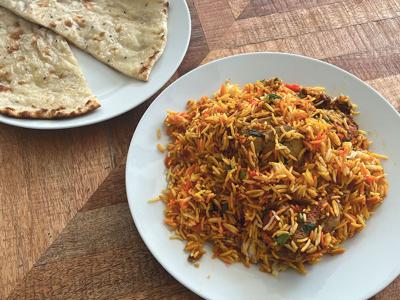
In Seaside, “everybody loves biryani,” says Bibi Masouda, who cooks this dish at the mosque every Friday through the year (each week available for sale), and two or three days per week during Ramadan.
Masouda is originally from Afghanistan. The dish is Pakistani and Indian, she explains, but it has become a fast-breaking tradition around the world – especially the chicken biryani, which is also her favorite.
When it comes to ingredients, biryani sounds simple: rice and meat. But one look at this gorgeous dish – the array of yellow, orange and red – betrays steps required to make it at home. This fragrant one-pot specialty is based on basmati rice and a rich blend of spices such as cardamom, cloves, cinnamon and saffron. The key is layering the rice and meat, sautéing them in ghee with caramelized onions, and then simmering it in a covered pot. Making a batch takes Masouda about five hours.
Tastes are a bit different in Salinas, where the second of three Monterey County mosques is located (the third is in Castroville). The crowd in Salinas can also reach 150 on weekends, the facility is bigger so children can roam without causing as much commotion as in Seaside.
According to Islamic Community of Salinas Imam Shaykh Mekaeel Mohsin, the majority of local Muslims are Yemenis. Instead of biryani, here kabsa – considered the national dish of Saudi Arabia – is the popular favorite.
Also a one-pot rice and meat dish, kabsa is not unlike biryani. The crucial difference is that no garam masala, saffron or yogurt are used in preparing the latter. Dried limes provide flavor, as well as toasted nuts and raisins.
In the Salinas mosque, iftar meals are potluck dinners. In addition to kabsa, a staple winter oatmeal and chicken soup called chorba is served immediately after water and dates.
“Fasting in winter is a little bit easier than in summer,” Mohsin says. “It’s not as hot and the days are shorter,” he adds, recalling a June Ramadan a few years back when the sun could be up for as long as 15 hours.
Speaking of children, whose laughter and roaming seems to be an integral element of every iftar gathering: What age is a safe age to start fasting?
It depends on the child, Mohsin says. Age 12 is when children are expected to join the fast, but for many it is a gradual process that starts at a few hours per day. “Usually children want to fast long before their parents are comfortable with them doing so,” he adds with a laugh.
(0) comments
Welcome to the discussion.
Log In
Keep it Clean. Please avoid obscene, vulgar, lewd, racist or sexually-oriented language.
PLEASE TURN OFF YOUR CAPS LOCK.
Don't Threaten. Threats of harming another person will not be tolerated.
Be Truthful. Don't knowingly lie about anyone or anything.
Be Nice. No racism, sexism or any sort of -ism that is degrading to another person.
Be Proactive. Use the 'Report' link on each comment to let us know of abusive posts.
Share with Us. We'd love to hear eyewitness accounts, the history behind an article.