

It’s Saturday, the final round of Mecum Auctions’ visit to Harrisburg, Pennsylvania. Bidding on a 1964 Pontiac GTO convertible has stalled at $96,000.
Auctioneer Jimmy Landis pauses his patter and fixes his eyes on a prospective buyer in the crowd. “You want to do 98?” he asks. “I would do 98 if I was you.” Seconds later the reserve comes off and the car sells.
Moments of direct communication are part of his style. When one Harrisburg bidder turns to consult a friend as the figure for a car approaches $40,000, Landis calls out to the crowd: “Who thinks he should give 40?” As the audience roars in approval, the auctioneer nods toward the bidder. “You asked for advice, we gave it to you,” he says from the stand.

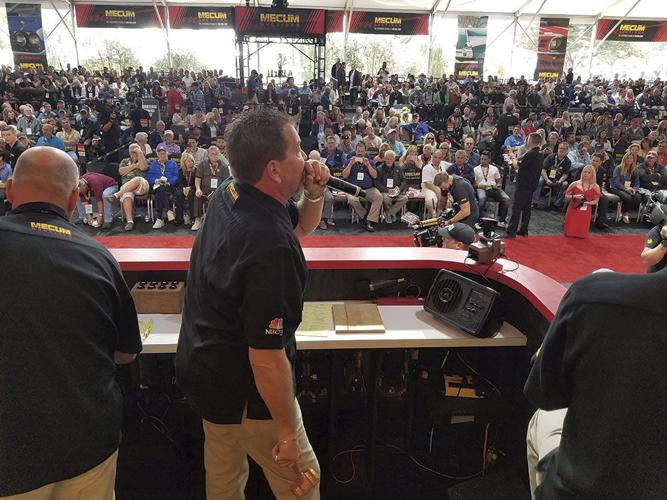
Jimmy Landis of Mecum Auctions entertains the audience in Monterey. At the time, Mecum’s events were televised live on NBC Sports Network. Now they are a staple on MotorTrend TV.
Mecum is one of five auction houses that set up on the Monterey Peninsula during Car Week. And the figures registered here are more impressive. Last year, between Bonhams, Gooding & Company, RM Sotheby’s, Broad Arrow and Mecum, 150 cars broke the $1 million mark, with six broaching $5 million.
The star lot was a 1967 Ferrari 412P Berlinetta, which hammered at Bonhams in Carmel Valley for $30.2 million. In 2018, RM Sotheby’s, which sets up in the Monterey Conference Center, sold a 1962 Ferrari 250 GTO for a then-record price of $48 million.
In all, 1,200 cars crossed the Car Week auction blocks in 2023, taking in just over $400 million – considered an off year.
At each venue, the auctioneer shares the stage with the vehicles. Their role is unique, part salesperson, part amateur psychologist and all performer.
“What I’ve learned is if I can communicate with each individual in the crowd, I can produce more,” Landis explains. “If I don’t produce, I’m not on the stand.”
TWO DISTINCT STYLES OF CALLING AN AUCTION ARE ON DISPLAY DURING CAR WEEK. At typical American events, the auctioneer presents the audience with both the amount currently bid and the amount they are asking from the next bidder. In Europe, it’s more common to simply state the current figure – with no in-between to be filled with a staccato cadence.
“There is dead space; there is not the patter,” says Eric Minoff of Bonhams. “The English style you see more frequently in fine arts. That’s how we treat cars.”
There is an expected tone to high end collector gatherings. At Concours d’Elegance, the Car Week centerpiece at Pebble Beach, attendees don jackets and showy hats. For Concours d’Lemons, the free display of automotive failure in Seaside, many of these same people carouse in jeans and T-shirts.
And so it is for the auction houses at events like Amelia Island in Florida or Monterey County’s Car Week. There is a different pace – a moment to admire the machine on the block, a briefing on its provenance.
“One is dealing with higher-value items,” says Charlie Ross of Gooding & Company, which sets up in Pebble Beach. “You can’t rush a person who is spending $10 million. You try to push them to $11 million and you might annoy him.”

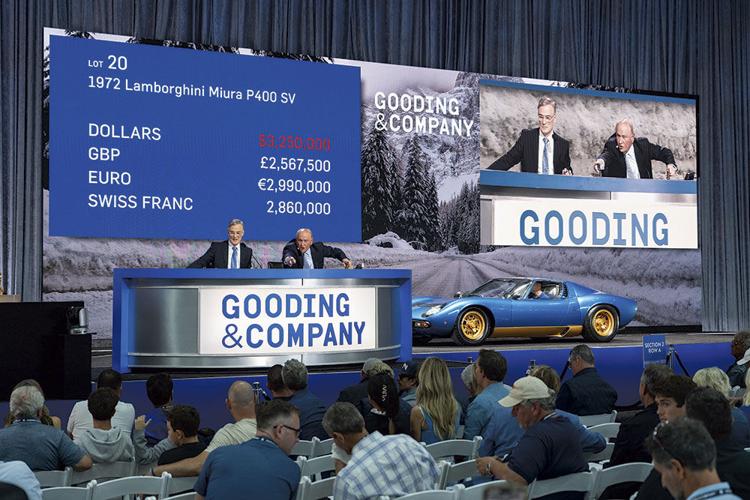
Charlie Ross identifies a bidder as the figure for a 1972 Lamborghini Miura climbs well over $3 million. The Gooding & Company auctioneer recently published his autobiography, titled Sold!
ESSENTIALLY THERE ARE COMPETING LOGICS AT PLAY, but both rely on similar tools. Auctioneers can use inflection or pregnant pauses. They can suggest different increments, as well – for instance dropping a $10,000 advance on the current bid to $5,000.
“The auctioneer is driving the auction,” Minoff adds. “The auctioneer has a lot of leeway.”
With both styles, however, is a form of communication that engages everyone in the room while focusing on the bidding action.
“My job is to connect with people,” Ross observes. “My job is to make him want the car more than he originally did. I create a good atmosphere in the room.”
See Mecum auctioneers Jimmy Landis and Matt Morevec in action.
The assumption is that emotion influences behavior, something confirmed by research into auction psychology and behavioral economics. What academics refer to as the endowment effect is known more colloquially as a form of “auction fever.” The adrenaline gleaned from a clamoring crowd and the competitive nature of bidding can cause both buyers and sellers in a moment of excitement to place greater value on an item.
“If I keep the rhythm going, the crowd gets involved and the crowd stays involved,” Landis observes, to which Minoff adds, while it’s possible to purchase vehicles electronically, “No one is going to cheer you for buying online.”

Bonhams’ Eric Minoff, on the phone with a bidder, signals the intention to up the ante.
MINOFF HAS BEEN IMMERSED IN THE WORLD OF UPSCALE COLLECTOR CARS FOR SOME YEARS. He joined the Bonhams motoring department in 2007 as a skilled appraiser and now serves as a senior specialist. He is also credited with growing the company’s auction presence in the U.S. – an enthusiast, collector and expert, as well as an auctioneer.
When Landis says he was born into the auction business, he means it literally. His father was on the stand for some of the first collector car auctions in the U.S. A Pennsylvania native, he joined Mecum in 2000 and is the lead auctioneer for the events, which are also broadcast live on MotorTrend TV.
Ross, meanwhile, is more general in his talents. He has overseen all types of auctions over a career he documents in a recently published autobiography, Sold! Ross may be best known as a presenter and expert on the long-running British television series Bargain Hunt.
The first car he sold for Gooding at Pebble Beach in 2004 – also Ross’ first trip to the U.S. – was a Duesenberg that gaveled for $4.2 million.
“That made me happy,” he recalls. “I don’t need to be an expert on cars to auction them. That person in the audience knows about the car. My job is to make them want to be there, make them want to bid.”
Although the three come from varied backgrounds and adopt different styles, they all wield a common tool, one that both works the room and drives bidding.
“I believe I’m pretty well known for ridiculing people,” Landis says with a laugh. “They like it. The crowd just eats it up.”
When Landis senses enthusiasm flagging, he has been known to drop the cadence momentarily and ask for a show of hands from first-time Mecum attendees. As people respond, he returns to his patter, quickly pointing at unwittingly outstretched arms with a rapid-fire: “I have $30,000, now 35, 40, 45… ”
A chorus of laughter rises as the crowd catches on to the ruse.
If humor isn’t common to all auctioneers, Ross believes that it should be. It can be tricky, he admits, to balance professional auctioneering and little quips in an atmosphere where cars are trading in the millions of dollars. But the room is the target audience.
“I do have fun,” Ross says. Once, when a bidder wavers, Ross delivered a good-natured scolding. “You don’t want to wake up tomorrow and say, ‘I nearly bought a Ferrari,’” he told the man. “That’s no good.”
An auction is a show, one with a cast of steel, chrome or carbon fiber characters. There may be only a few audience members keen to bid on a particular set of wheels, but there are many wanting to catch the action. Over this, one central figure presides.
Or, in the case of Mecum, a team of four. The Wisconsin-based auction house is broadcast live on television, often for stints of six hours. So Landis and his team rotate on the stand, 30 minutes at a time.
If Landis is known for his banter, fellow Mecum auctioneer Matt Moravec catches attention because of his attire. He never takes the stand without a cowboy hat.
“You can’t have four that are exactly the same or you’re not changing the tempo of the room,” Landis explains. “If I were to stay the entire day, the crowd would get bored with me.”
In recent years, the room the auctioneers refer to has expanded. For decades, there were three avenues of bidding – those in person, those on the phone and the auctioneer’s book, meaning absentee actors who enter maximum amounts in advance.
Mecum began broadcasting in 2008, opening a new audience. In the same decade, the internet came into play. Online bidding is not instantaneous, so auctioneers must be aware of fractional delays before banging the gavel.
“But more importantly,” Minoff says, pointing out the most significant change to the psychological and entertainment aspects of his role, “the auctioneer has no insight into that bidder’s mood.”
Minoff, Landis, Ross and quite likely the auctioneers of Broad Arrow and RM Sotheby’s see auctions as human interaction, as entertainment and business in one package. The presence of television in Mecum’s case and the ubiquity of online bidding just adds a different dimension to their multitasking.
“There’s so much going on, but it’s all second nature to me,” Landis says of the rush of information directed to the stand and back to the crowd, the constantly escalating numbers and bids coming from different directions.
“But I can’t remember where I put my keys.”
(0) comments
Welcome to the discussion.
Log In
Keep it Clean. Please avoid obscene, vulgar, lewd, racist or sexually-oriented language.
PLEASE TURN OFF YOUR CAPS LOCK.
Don't Threaten. Threats of harming another person will not be tolerated.
Be Truthful. Don't knowingly lie about anyone or anything.
Be Nice. No racism, sexism or any sort of -ism that is degrading to another person.
Be Proactive. Use the 'Report' link on each comment to let us know of abusive posts.
Share with Us. We'd love to hear eyewitness accounts, the history behind an article.