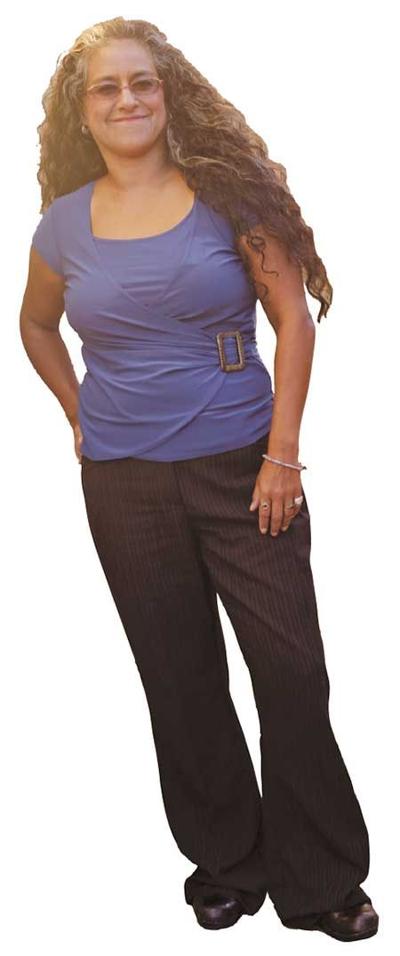

Claudia Meléndez Salinas is a career journalist, but she turned to fiction to tell a very real story about the city of Salinas. Relying on thoroughly researched material obtained while working as a full-time reporter at the Monterey Herald and as an observant Alisal resident, she writes about a time about a decade ago when the city’s libraries and community centers were closing and youth violence was soaring.
It was against this backdrop that she decided to plug in the youth’s perspective. She created Miguel Angel, a 17-year-old Latino who spends his spare time at a boxing club trying to get away from gangs. The plot thickens when the teen falls in love with a Pebble Beach girl, and Monterey County socioeconomic disparity enters the theme.
The multiple storylines aim to humanize that strenuous time for youth in Salinas, and to tell a story that is not often told in mainstream or local media.
Meléndez Salinas, who grew up in Mexico, came to Salinas to study computer science. At a young age, she says she wanted to be a boxer, just like her main character. But once in Salinas, she realized she loved to talk and learn from people and pursued a career in journalism instead.
Ten years later, at 47, she debuts her first novel: A Fighting Chance for young adults, which she considers to be a love letter to a city that has welcomed her.
Weekly: What is your opinion on local media coverage of Salinas?
Melendez-Salinas: The way the media works right now, unfortunately, is set up for us to cover what bleeds. I think that has always been the case, but because of the way the media is suffering right now, it is not leaving enough room for analysis. I think it’s a problem, and I know community members are very upset about it. That we are paying a lot of attention to gang shootings and crime, and we are not covering other things that are happening in the city.
How is the theme of your book real in Salinas today?
I do think that because of the way shootings are happening right now in Salinas, which are targeting more adults, things might have changed since I wrote my book. In fact, Salinas Police Chief Kelly McMillin keeps saying how things have improved, and I haven’t done an analysis, but he could be right. I believe there has to be analysis to see why these crimes are happening now, because it is definitely not the age group that it used to be. That age group addressed in my book was the group being killed up until recent years.
What’s your advice to Latino youth?
I think because of the way this society works we are brought up with a lot of insecurities, I didn’t grow up here, but I grew up with a lot of insecurities that are brought to you by a society that has all these misconceptions. It’s very hard to listen to your voice and trust it. So that’s my advice, listen to your voice and trust it because that is going to be the best for you and whatever it is you want to do.
What was the hardest part of creating likeable Latino characters?
It is still up in the air; I don’t know if anyone is going to like it, but hopefully people will. But my first concern was to write about the lack of opportunity Latino boys sometimes have in tough neighborhoods. These are good kids, these are smart kids, and these are kids who sometimes have trouble in life because they don’t have a lot of guidance. Not everyone, of course, but some. I wanted to show that. But I also knew that if it was just going to be that, it was going to be hard to sell. So to make it more appealing, I made it into a love story.
Why write about Salinas?
You know, I love Salinas. I hate that it gets such a bad rap, but I love Salinas with all my heart. I love the people there and I love the fact that Salinas is feeding this country, which I think is so powerful. So my book is just an offering of love. It is sort of like a love letter, in a weird way.
(0) comments
Welcome to the discussion.
Log In
Keep it Clean. Please avoid obscene, vulgar, lewd, racist or sexually-oriented language.
PLEASE TURN OFF YOUR CAPS LOCK.
Don't Threaten. Threats of harming another person will not be tolerated.
Be Truthful. Don't knowingly lie about anyone or anything.
Be Nice. No racism, sexism or any sort of -ism that is degrading to another person.
Be Proactive. Use the 'Report' link on each comment to let us know of abusive posts.
Share with Us. We'd love to hear eyewitness accounts, the history behind an article.