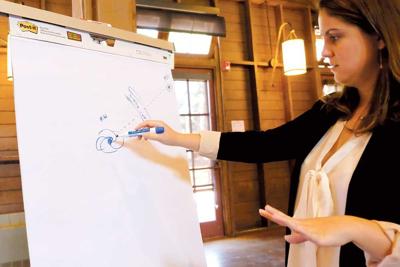

It’s an overcast, rainy morning when about 150 astronomers from all over the globe convene Oct. 1 for a three-day conference at Asilomar Conference Center. The stars are invisible in conditions like this, which seems ironic. But to Patrick McCarthy, director of the Giant Magellan Telescope Organization based in Pasadena, it’s a nice break.
“I’m on vacation,” he says.
The organization is constructing what will be the world’s largest telescope on a mountaintop in the Atacama Desert of Chile, selected mostly because the conditions are so inhospitable that development – and the light pollution that comes with it – is highly unlikely.
“We think we’ll have good sky there for 50 or 100 years,” McCarthy says. And once the scope is built (estimated to be 2024), it should last indefinitely. Earlier revolutionary telescopes have diminished in significance not because of they’ve worn out, but primarily because of light pollution.
The Giant Magellan Telescope falls into a category called “extremely large telescopes.” Backers have raised more than $500 million so far to build it, and McCarthy says it will enable astronomers to see further into the history of the universe than ever before. Today, they think they can see far enough to see light from 13.6 billion years ago, but more precision on those early years after the Big Bang can help answer big questions like, “Where do we come from?” and “How did the universe start?”
To do it, they’re sharing data widely at conferences like this. It’s part of a cultural shift in how astronomers operate, McCarthy says. Astronomy used to require staying up all night in the cold. “Getting a little data was hard, so people were protective of it,” he says.
With newer technology, we can capture more, so the process has shifted: the more brain power, the better. “Now that we’re data-rich, our challenge is, how do we make sense out of it? The younger generation is trying to bring the best minds to bear. That’s a good thing.”
Some of those young minds are presenting at the conference, and it’s practically impossible for a layperson to understand. Emily Cunningham, a graduate student at UC Santa Cruz, presented a paper called “Disentangling the Milky Way’s Accretion History with Observations in 7 Dimensions.”
It means she’s studying metallicity – the relative amounts of various elements found in ancient stars – in an effort to date them. The first generation of stars was made mostly of hydrogen, helium and a little bit of lithium. When those stars eventually exploded at the end of their lives, that burst of energy produced additional metals like iron, forming a later, heavier, generation of stars. The next generation we can see with the naked eye on a clear night as a dark band down the center of the Milky Way, a gassy mess that will form into future stars with even more metals, like chromium and copper.
A local astronomer is responsible for the less glamorous task of developing measurements to date stars, based on the presence of different metals.
“If those data aren’t right, then everything they’re saying in there is nonsense,” says Bruce Weaver, director of the nonprofit Monterey Institute for Research in Astronomy, which operates a lab in Marina and an observatory on Chews Ridge in Cachagua. “If your ruler is wrong by 10 percent and you use it to make a house, you’re going to make a funny house.”
In this world, there are big telescope people and small telescope people. “Astronomy has aperture envy,” Weaver says. (His focus is smaller telescopes.) He’s also a data nerd, and thinks all of the research scientists are presenting on in Pacific Grove would benefit from tighter numbers when it comes to factors like metallicity: “[The data] is not nearly as accurate as they think it is,” he says. “It’s not that it’s wrong. It needs a lot of work to be more accurate.”
While Weaver works away in his Marina lab improving the accuracy of the data, others are looking at bigger, better more far-seeing telescopes. One conference presenter, Jason Kalirai of Baltimore (and a UC Santa Cruz grad), delivers an update on the James Webb Space Telescope, destined to outdo the Hubble with how far, and how precisely, it can see.
Kalirai’s team expects to ship the scope in 2017 off of Redondo Beach on a barge bound for the southern tip of Argentina. From there, it will launch into space on a rocket.
“The future is going to be completely transformed,” he tells the crowd. “The pictures are going to be exquisite.”
(0) comments
Welcome to the discussion.
Log In
Keep it Clean. Please avoid obscene, vulgar, lewd, racist or sexually-oriented language.
PLEASE TURN OFF YOUR CAPS LOCK.
Don't Threaten. Threats of harming another person will not be tolerated.
Be Truthful. Don't knowingly lie about anyone or anything.
Be Nice. No racism, sexism or any sort of -ism that is degrading to another person.
Be Proactive. Use the 'Report' link on each comment to let us know of abusive posts.
Share with Us. We'd love to hear eyewitness accounts, the history behind an article.