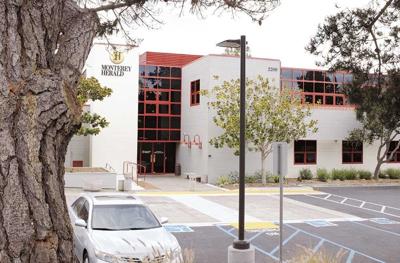

It’s a story that’s become legend in local journalism circles.
In August 2014, The Monterey Herald was preparing to move from its too-old, too-large building on Upper Ragsdale Drive in Ryan Ranch to a smaller, more contemporary building on Garden Road near the Monterey Airport. The Ragsdale building, one of the paper’s last remaining physical assets after the Herald dismantled its press and sold it for scrap, had been sold as well, for $5.7 million to the University Corporation at CSU Monterey Bay.
At his Ragsdale desk, Larry Parsons, a 32-year veteran of the news business and perhaps the paper’s greatest font of institutional knowledge about Monterey County government, took a long look around. And then he decided: He wasn’t going to pack his desk and he wasn’t going to move to Garden Road.
“What he said was, ‘Fuck it,’” a former colleague recounts.
He resigned. There was no severance package, buyout or golden parachute. He was just done.
“I wanted to remember a newsroom when it had a big staff and big stories and big ideas.” Parsons said at the time. “I was tired of being pissed off at the way the industry has changed.”
At the Herald, there’s a lot of reason to be pissed off. The paper, which multiple sources with some amount of inside knowledge say remains profitable, is strangling under the ownership of a hedge fund, Alden Global Capital, that specializes in distressed assets. That same ownership chased a “digital first” innovation strategy under the Bond-villain moniker “Project Thunderdome,” which collapsed when corporate abruptly change course, slashed $100 million from the budget and fired everyone involved.
In May, after months of negotiations, a deal for Alden Global Capital to sell Herald parent company Digital First Media to Apollo Global Management died, reportedly because Apollo wouldn’t meet the $400 million price. Then-CEO John Paton, who left the company shortly after the deal fell apart, told media analyst Ken Doctor that it’s likely DFM, instead of selling the whole company, would sell clusters of papers by region.
A local group has formed and is trying to bring community ownership back to the Herald. Sources say the group has some financial backing from Santa Cruz-based real estate developer George Ow Jr., and that the group includes Geoffrey Dunn, a filmmaker, writer and historian who has been an alt-weekly fixture for years.
Talks are so advanced there appears to be a nondisclosure agreement in place, meaning nobody’s talking. Voicemail left for Dunn was not returned, and HeraldPublisher Gary Omernick did not respond to several emails requesting comment.
So if someone’s going to buy the Herald, what exactly are they buying? Is it possible a small-city daily, even one that’s been cut to the bone, could stand alone and flourish?
“The answer to that is 95-percent yes,” says Robert Powell, who for five years was the Herald’s vice president of advertising and, for five years before that, held a similar job at the Salinas Californian. Powell left the Herald in 2013 to launch Zero Moment Of Truth, Inc., a digital marketing agency for the auto dealer industry. He’s also the chief performance officer at Cardinale Automotive Group.
“I say that just knowing the financial outlook of the paper. I was there for five years, I know what the return is and it’s a viable business model,” Powell says. “But they need to transition to today. There is opportunity on the digital frontier, with tablet and mobile. Will you make the same money on a digital ad as you will a page in the paper? Probably not, but audience is audience and you have to find a way to get the audience.”
And being in the death grip of a hedge fund specializing in distressed assets is not the way to get an audience.
“They want to squeeze the profits as much as they can,” Powell adds. “It’s not just the newspaper industry. It’s all sorts of businesses today. In a community, it doesn’t matter if it’s a weekly, a three-day, a six-day or a magazine. They are all viable business models.”
Jason Hoppin, the Herald’s former assistant city editor who joined the paper last October and departed in August to become a public information officer for the county of Santa Cruz, says while he’s never seen a ledger sheet, he’s been told more than once the Herald is profitable in a way that makes it very attractive to Digital First Media.
“So I’m not sure how for sale it is,” Hoppin says. “I believe it makes enough money and is supported enough that it deserves more investment. But I haven’t seen any sign of it happening.”
• • •
Back in 2014, Larry Parsons wasn’t the only casualty, self-inflicted or otherwise, of the Herald’s ownership. Last year, the Herald’s newsroom lost investigative reporter Virginia Hennessey, who now works as a private investigator; Editor Royal Calkins, who was laid off and replaced with Santa Cruz Sentinel Editor Don Miller, who now edits both papers (Calkins now blogs about local politics and issues at www.montereybaypartisan.com); music writer Mac McDonald; and the entire copy desk (their jobs were sent to Chico). Graphic designer James Herrera was laid off in one of the more recent purges, but was rehired and placed into a reporter’s job. Then Julie Reynolds, a Harvard-Nieman Fellow and award-winning investigative reporter whose recent book Blood in the Fields chronicles the notorious prison gang Nuestra Familia, left the paper to pursue her own journalism projects.
Full disclosure: The Weekly last week hired the Herald’s criminal justice and breaking news reporter, Ana Ceballos, who joined the paper on Sept. 11. The Weekly also hired Phil Molnar, the Herald’s military, business and Monterey reporter; he was also due to start Sept. 11, but instead took a job at the business desk of the San Diego Union-Tribune. The Herald’s City Editor, David Kellogg, along with Editor Don Miller, tried to make a counteroffer to Molnar when he told them about the Weekly job. Publisher Omernick nixed the idea; Molnar was given two weeks pay and that same day escorted from the Herald building.
They tried to muster a Ceballos counteroffer as well. No dice.
The more-than-solid local reporting and editorials produced by the Herald’s journalists, and the ads that reflected the sensibilities of designers who knew how to create for local businesses because they shopped locally themselves, has been supplanted by a bizarre amalgam. On any given day, half the stories found in theMonterey Herald are about Santa Cruz, because the papers share not only an editor, but a publisher and ad manager too. The editorial tone has taken a decidedly conservative bent, evidenced by editorials supporting the Monterey Downs development and California-American Water’s handling of its proposed desal project. In July, one editorial espoused that fracking is probably no more dangerous than other forms of drilling. Editorials were all over the map on Monterey’s leasing policies on Fisherman’s Wharf – from confusion over the newly implemented policies to siding with the leaseholders getting enriched by the old system.
Ad production, meanwhile, has been outsourced to India. In the past two weeks, the Herald ran an ad for a lunch-and-learn health care event taking place in Orem, Utah. Then it ran a second health care-related ad for an event that took place last January.
This summer, the Herald disastrously launched a publication called “Play Monterey Bay,” a product of the sales and marketing department that, in its first run, ripped copyrighted images from the Internet and ran them – a bozo no-no, lawsuit-waiting-to-happen of the highest magnitude. Instead of the “Go!” entertainment section, written and edited by professional journalists and inserted into the paper, “Play” is marketing copy disguised as journalism; “Go!” has been absorbed into the regular paper.
According to an email written by Herald/Sentinel Vice President of Advertising Daniel Krolczyk, for $650, one can purchase content with “premium front of book placement.” Half of the purchased page is a horizontal ad, while the other half is what he calls an “advertorial featurette,” meaning it’s a story about the purchaser’s business or event.
Buying the cover of the Aug. 27 issue, which featured BBC’s Big Blue Live series, cost BBC partner PBS $1,500. That amount got the buyer two pages inside, and the featurette carried the byline of Aquarium Executive Director Julie Packard. Three weeks later, she is listed among the regular contributors to “Play Monterey Bay,” along with former KSBW anchor Dina Eastwood and local marketing exec Rebecca Riddell, among others.
• • •
Calkins’ predecessor in the Herald’s editor seat, Joe Livernois, spent a total of 29 years at the paper, including a stint running a Salinas bureau that had more reporters than the entire Herald has now. He, too, has heard the stories of profitability, and points to papers like Weekly as evidence local ownership and community-based journalism can work.
“If you become hyper-local and pay attention to the neighborhoods and communities, and you have reporters at meetings and at functions, people know you care, and they call you and sidle up to you and say, ‘Hey, have you heard… ’” Livernois says. “And I think I know what it looks like because that’s the way it was when I came to the Herald.”
As Calkins wrote on his Monterey Bay Partisan blog, local ownership might have less incentive to cut.
“Potentially, local investors motivated by public-spiritedness might even be able to reinvest some of the profits and rebuild the newspapers,” Calkins writes.
Right now, the paper is as light as a feather and employees are leaving in droves. With the exception of local news, features and sports, the content is of questionable value. The community suffers from a lack of competition in ferreting out and reporting important stories.
Public-spiritedness and local ownership: Both worth fighting for. Here’s hoping someone’s up for that task.
(0) comments
Welcome to the discussion.
Log In
Keep it Clean. Please avoid obscene, vulgar, lewd, racist or sexually-oriented language.
PLEASE TURN OFF YOUR CAPS LOCK.
Don't Threaten. Threats of harming another person will not be tolerated.
Be Truthful. Don't knowingly lie about anyone or anything.
Be Nice. No racism, sexism or any sort of -ism that is degrading to another person.
Be Proactive. Use the 'Report' link on each comment to let us know of abusive posts.
Share with Us. We'd love to hear eyewitness accounts, the history behind an article.