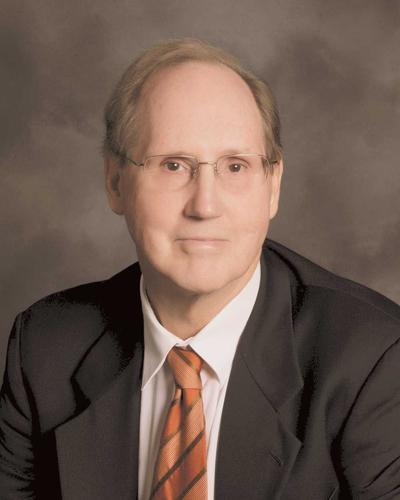

Dennis Williams’ résumé features a Ph.D. in hydrology and a 50-year career that’s taken him to places as far-flung as Iran and India. In 1978 he formed Claremont-based Geoscience Support Services, a consultancy that specializes in geohydrologic studies – the science behind municipal water supplies.
For more than a decade, he’s been working with California American Water on its desalination ambitions: first the 2004 Coastal Water Project, which got the planning ball rolling; then the Regional Desal Project, which collapsed after a conflict of interest was revealed in 2011; then its successor, the Monterey Peninsula Water Supply Project, which is still lurching forward in stops and starts.
One of those stops happened in early July, when a California Public Utilities Commission (PUC) judge extended the public comment period on the project’s draft environmental impact report because of an apparent conflict of interest, which the Weekly first reported in mid-June. At the center: Williams, who is not only doing the modeling work on Cal Am’s test slant well, but also serving on the project’s Hydrologic Working Group for the PUC. Simultaneously repping the project applicant and the regulator would be problematic on its own, but Williams also holds three patents for slant well technology Cal Am is using, meaning he stands to profit if the test well succeeds.
Williams spoke with the Weekly on conference call Aug. 11, with publicist Nicholas Gaffney – whose bio includes “expertise in litigation and crisis communications” – listening in.
Weekly: Tell me about what you do.
Williams: Ten years ago, I was asked by the municipal water district of Orange County to develop a [desal] feedwater supply for Dana Point. I did some exploratory work and developed this technique of drilling at an angle. It was only 350 feet long, but we successfully pumped that slant well for two years, and now the Doheny Ocean Desalination Project is the first successful slant well under the ocean that had an artificial filter pack. The slant well was developed as a necessity – we couldn’t get permitted for anything else [in California]. The vertical well technology is tried and true; all I did was turn these wells at an angle.
How did you get involved in the Cal Am desal project?
There are 10 or so subsurface intakes from San Diego to Monterey, in various stages. We’ve been involved in all of them because of our expertise. The California Ocean Plan said last year that subsurface [desal] intakes shall be looked at first. You can get them permitted much easier than open-ocean [intakes]. They do not harm any marine life, and they’re completely buried, so you don’t see them. And they have very pure water.
In the simplest terms, what do your patents cover?
You need to telescope the [slant] wells; start at the surface at a larger diameter, and angle down. That’s one thing in the patent. Second, you need to put an artificial filter pack around the well screen – a pipe with perforations to allow the water to get into the pump – to keep the fine sand from coming in and clogging the screen. The method I patented requires one. Since the wells are almost horizontal, if you put an artificial filter pack around the well screen, there’s no way of refilling that filter pack as time goes on. What we do with the pending patent, the half moon [well screen design], is perforate the lower portion of the pipe.
Now it’s come out the PUC hired you well after Cal Am did. Is the conflict of interest their fault?
I don’t know. We’ve been working in the last four years or so for [PUC consultant] Environmental Science Associates and [Cal Am consultant] RBF. They were fully aware of what we’re doing as far as the modeling. All our meetings of the Hydrologic Working Group were held in ESA’s offices, with representatives from everywhere. This was well known.
You have licensed the use of your patents to Cal Am for free. But will you make money if this project proves the technology?
One step at a time. It’s taken us 10 years to get to this stage. My whole career is dedicated to solving problems in groundwater. I really want to develop this and have input in making sure the technology is advanced and is not misused. The 724-foot Monterey well is behaving like I’d hoped it would. It’s a sustainable resource where we really need it.
Correction Aug. 24, 2015: The wording of the last question has been clarified. Due to an editing error, it originally stated Williams had not licensed his patented slant-well technology to Cal Am. That is inaccurate. Williams adds: "We have given Cal Am and the citizens of the Monterey area a license, for free, so they can benefit from our slant well technology and are happy to consider extending this offer to others."
(0) comments
Welcome to the discussion.
Log In
Keep it Clean. Please avoid obscene, vulgar, lewd, racist or sexually-oriented language.
PLEASE TURN OFF YOUR CAPS LOCK.
Don't Threaten. Threats of harming another person will not be tolerated.
Be Truthful. Don't knowingly lie about anyone or anything.
Be Nice. No racism, sexism or any sort of -ism that is degrading to another person.
Be Proactive. Use the 'Report' link on each comment to let us know of abusive posts.
Share with Us. We'd love to hear eyewitness accounts, the history behind an article.