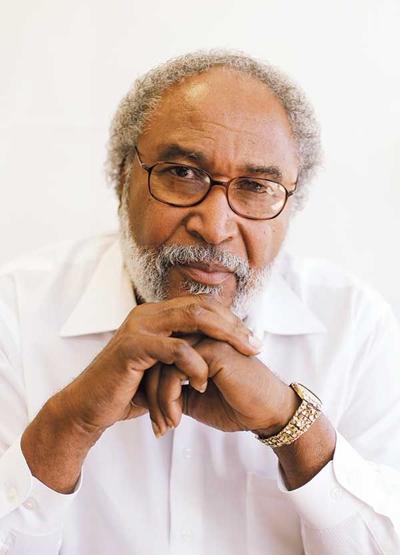

In 1980, the Seaside City Council election happened in April, not in November as elections do now. 72-year-old Mel Mason remembers the time well, and not just because he ran for one of the seats.
“The racist element in this town was trying to do everything to prevent me from being elected,” Mason says. “Red-baiting, playing up my socialist beliefs and my history with the Black Panther Party – a lot of racist hysteria.”
Another thing he remembers: the death threats. He and his supporters received lots of them. One night someone called while Mason was asleep, saying they put dynamite under his house and he had 10 seconds to get out. It turned out to be a hoax.
He went on to win that City Council seat. But his opponents weren’t done.
“At my first City Council meeting,” he says, “right after we were sworn in and took our seats at the dais, someone called, saying that they had placed a bomb in the building and were going to blow it up in order to ‘kill that Communist nigger.’”
The police and city manager cleared everyone out of the building, but Mason declined to leave.
“I didn’t think the cowards had enough guts to blow up the building,” he says. “I decided, I’m going to stay and read my agenda packet.”
He served one term – helping to establish contract set-asides for women and Seaside-based businesses, and supporting unions and tenants’ rights – but his political aspirations didn’t end there. In 1984 he ran for president of the United States on the Socialist Workers Party ticket.
“[That] brought me into my ongoing relationship with the FBI,” he chuckles.
A solidly built man who sports a gray beard and talks in a resonant voice, Mason’s been a therapist and counselor for almost 45 years. He sometimes chuckles at some of the things he’s been through, as if he can’t believe it.
“He’s quite a witty kind of fella,” says Regina Mason, his wife of 26 years. “He’s one of the most calm people that you would ever meet, and probably one of the most well read. If he does speak out on an issue, he definitely will be forthright. He doesn’t hold back.”
He might have inherited that quality from his family roots.
~ ~ ~
His great grandmother was Frances Woolfolk, a half-black/half-Cherokee, mother of 13 and a former slave. When she was 90 and blind, and Mason was 4 and reckoned her a witch, she came to live with the family in Kentucky. She plowed in the garden, cooked and sat in her rocking chair identifying the kids in the household by their footsteps.
She would call out to little Melvin as he tried to sneak past, and get him to sit near while she told him stories.
When she was younger, though a slave, she was defiant. She idolized Nat Turner.
“The overseers would try to whip her and she would pull the whip away and [turn it on] them,” he says.
After emancipation, when she was married to Mason’s great grandfather, Albert Woolfolk, and they were living on his inherited land, she had to fight again. This time against nightriders, precursors to the Ku Klux Klan who rode horseback at night wearing hoods and terrorizing newly enfranchised blacks.
“They rolled up and said ‘Niggers, get off this property!’ She came out of the house with a shotgun and said, ‘Over my dead body. And over a lot of your dead bodies, too.’”
They opted to turn around.
Frances’ fighting spirit wasn’t wasted on her great grandson. His early childhood in Providence, Kentucky, occurred in the time of Jim Crow segregation laws, down to the “white” and “colored” drinking fountains.
“One would be made out of porcelain, always clean, the metal part would be polished chrome,” he says. “The one right across from it, the colored fountain, you’d have ants, spider webs, the whole thing would be rusty.”
White people sat in the plush floor seats of the town’s movie theater while black people sat in the balcony, where rats dwelled. Curfews put black people at risk of being seen as a threat and attacked at night by white people, arrested by the police, or worse.
“WHAT’S HAPPENING TODAY IS NOT NEW. POLICE HAVE BEEN KILLING BLACKS A LONG TIME.”
“You knew your place unless you wanted to get into trouble,” says local ally and friend Alice Jordan, who also grew up in the South. “Mel Mason didn’t mind getting into trouble.”
His father, James Mason – damaged from what they then called “shell shock” (now, PTSD) from seeing his whole platoon killed by machine gun fire in World War II – drank and acted violently, and his parents divorced. On the urging of family stationed at Fort Ord, Mason’s mom, Eloise, moved herself and her son from Kentucky to Seaside in 1956.
Mason thought it was going to be a post-racial nirvana. Not quite.
“There was a part of Seaside [we] could not live in: Ord Terrace,” he says. “There was a form of Jim Crow called deed restrictions. Black people, non-whites and Jews were not allowed to live, rent or own property there.”
These restrictions existed all over the Peninsula, but they finally found a place to live on Waring Street in Seaside. His mother remarried to a man named Walker Wells, one of the people Mason credits for teaching him ethics.
“I grew up with a lot of really great role models,” Mason says. “Everybody knew each other, looked out for each other’s children. It was a real village. That was Seaside.”
The Broadway Avenue office of Mason’s Village Project, where underserved people are provided counseling services and cultural opportunities, sits across the street from what was once the nucleus of black life on the Peninsula: McKinney’s Restaurant.
Duke Ellington and Count Basie, in town for the Monterey Jazz Festival, ate barbecue there; when they toured Europe, they told everyone about it, so the spot saw a steady waves of white European tourists too. It also served as a meeting place for a growing black empowerment movement (along with some influential Seaside churches) that sought to incorporate Seaside. That campaign had been successfully opposed five times by the segregationist Ord Terrace Property Owners Association.
“Except the last one [when] black people took over the movement,” Mason says. That one, in 1954, succeeded. “That was the end of Ord Terrace being exclusively white.”
Mason credits that victory, which occurred before he arrived in Seaside, to a coalition of blacks, Filipinos, Latinos, Native Americans and poor whites working together. But he learned its lesson.
“Mel Mason is the epitome of coalition building,” says Stanford historian Carol McKibben, Ph.D., who’s written history books on Seaside. “He was vilified in Seaside because his politics were far to the left, but he invented coalitions.”
Incorporation changed the equation in Seaside, moving power from the hands of the few to the voting ballots of the many. Soon after, Monroe Jones became the first black person elected to city government – the first of an era to come.
~ ~ ~
Mason did not always live righteously then: he drank, smoked, did drugs, got into fights. Being a basketball star at Monterey Union High School and Monterey Peninsula College didn’t seem to calm his inner turmoil.
But when two of his friends were shot and killed in 1966, he and his other friends met on their usual street corner and talked about their futures. Some decided to keep living the street life; of those, most died or ended up in prison. Mason decided to quit drugs (but not drinking, which he finally gave up in 1989), and continue with school.
He found his groove in social consciousness. In 1968 he helped organize workers for Western Electric and other Santa Clara Valley companies, which caught the attention of the Black Panther Party. The group’s co-founder, Bobby Seale, asked to talk to him. They were promoting an initiative called Community Control of Police to halt police prejudice and violence against minorities.
Mason became a member, meeting folks like Huey Newton and Kathleen Cleaver, and learning about class and capitalism. He then got the Black Panthers involved in the United Farm Workers’ Salad Bowl Strike of 1970.
“Cesar Chavez gave this talk in Salinas,” Mason says, “and he said the UFW was more than a union, it was a civil rights movement. He talked about King and Malcolm X. We came back [to Seaside] and thought, we have to support this movement. We went out on the picket lines all the time when Cesar was in jail.” Coretta Scott King and Ethel Kennedy also showed up in support.
Mason had momentum. He helped organize a campaign against police brutality by the Seaside Police Department. In Salinas, Latinos were doing the same.
“We started going over to their campaign meetings and rallies, and they came to ours,” Mason says. “The beginning of black/Latino solidarity, in the early ’70s. I think there’s been some conscious efforts to separate us.”
Carlos Ramos, the California Deputy State Director of the 86-year-old LULAC (League of United Latin American Citizens), says there’s more to Mason than the high-visibility work.
“A lot of what Mel and people like him do is on a one-on-one basis,” Ramos says. “Mel has taken on issues family by family, neighborhood by neighborhood, case by case, that don’t reach the eyes and ears of the public because of the private nature of the issues.”
“ACROSS THE BOARD, YOUNG PEOPLE ARE SAYING ‘THERE ARE WRONGS IN THIS SOCIETY AND WE ARE HELLBENT ON CORRECTING THEM.’”
Mason’s synergy-building continued in the campaign to recall former Seaside mayor (then a city councilman) Lou Haddad, whom Mason calls an “enemy of black people.” He joined a broad coalition called the Citizens’ League for Progress, and against expectations, they unseated Haddad. That next year, Mason ran for the Council seat and won.
~ ~ ~
Mason stood up to bigger powers-that-be, too. Regarding his aforementioned “ongoing relationship with the FBI,” he testified against its Counter-Intelligence Program (COINTELPRO), which aimed to disrupt civil rights groups, extremist organizations, professional guilds and activists under the guise of counterterrorism. This happened in the same New York courtroom in which Julius and Ethel Rosenberg were sentenced to death in 1951 for espionage.
“I sat in the same seat as them,” Mason says. The courts ruled the program unconstitutional and proceeded to dismantle the covert FBI operation.
He’s served three terms as president of the Monterey County branch of the NAACP. He co-founded the Civil Rights Coalition of Monterey County in the aftermath of the Full Metal Jacket incident at Monterey County jail in which a deputy piped racist segments of the Stanley Kubrick war film into jail cells, presumably to agitate racial strife.
Mason says he gets inspiration from his wife’s ethic of serving others. And he’s maintained alliances with similarly oriented people: Ruthie Watts of black sorority alliance Monterey Bay Links, Joyce Vandevere of Monterey Peace and Justice Center, Leonard O’Neill of UNITE HERE Local 483 (with whom he got arrested supporting workers at Carmel’s La Playa Hotel), and state Sen. Bill Monning, D-Carmel.
“He’s tireless,” Monning says. “He goes into the areas where there is not a comfort zone. He established monthly meetings of all the [local] police chiefs – a former Black Panther.
“We need more Mel Masons on this planet,” Monning continues. “He’s been the 911 for all of Monterey County in discrimination cases, police misconduct, jail issues. The work behind the [police] shooting of [his friend] Charles Vaughn Sr. led to the establishment of the Crisis Intervention Team Academy, the first in the country.”
Mason works within the system and outside the system.
“You have to do both,” he says. “We all did it together. I was a basketball player; I always want to give credit to the team.”
Given enough time, history seems to repeat itself. Today’s NSA phone surveillance program looks like the old COINTELPRO. Black Lives Matter, like Community Control of Police. El Migueleno’s Restaurant sits where McKinney’s Restaurant used to.
Police violence in Ferguson and Baltimore is not daunting to Mason. It’s familiar.
“What’s happening today is not new,” he says. “Police have been killing blacks a long time. We can trace this back to the Ku Klux Klan in Tennessee in 1826. [There have been] secret white organizations inside police departments.
And through it all, the conflagrations of prejudice, the revelations of inhumanity, he retains hope.
“Across the board, young people saying ‘There are wrongs in this society and we are hellbent on correcting them.’ They are not afraid. They remind me of us. I’m proud of them.”
He says that all his work, from the Black Panthers to now, leads to moral principles often denied him and his family: “fairness and equity.”
The Village Project, for instance, marshalls resources related to the Mental Health Services Act of 2004 to provide counseling, clinical services and therapy to people in underserved communities. The nonprofit has expanded to offer tutoring, lessons on healthy food and eating, cultural enrichment and job assistance.
One of his comrades in the struggle, Billy Jennings, a former Black Panther, called Mason after The Village Project started up. Jennings recalled the legal services, counseling, health care and kids breakfasts that formed what the Panthers called their “community survival programs.” Those were often ignored in favor of more dramatic images of stern-looking black people in afros and leather jackets. But in the late ’60s to early ’70s, they were essential to the welfare of many.
Jennings said that through the Village Project, he was still carrying out the Panthers’ community survival programs.
To this, Mel Mason chuckled again.
(0) comments
Welcome to the discussion.
Log In
Keep it Clean. Please avoid obscene, vulgar, lewd, racist or sexually-oriented language.
PLEASE TURN OFF YOUR CAPS LOCK.
Don't Threaten. Threats of harming another person will not be tolerated.
Be Truthful. Don't knowingly lie about anyone or anything.
Be Nice. No racism, sexism or any sort of -ism that is degrading to another person.
Be Proactive. Use the 'Report' link on each comment to let us know of abusive posts.
Share with Us. We'd love to hear eyewitness accounts, the history behind an article.