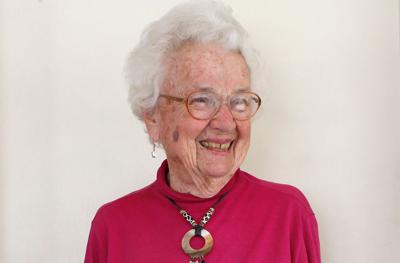

If you’ve participated in progressive or charitable causes on the Monterey Peninsula in the past 32 years, chances are you’ve met Lorita Fisher.
She’s served on local boards of the Women’s International League for Peace and Freedom and nuclear disarmament group SANE/FREEZE. She’s advocated for the rights of women, homeless men, LGBT people and the developmentally disabled. She’s fought for gun control, raised her voice for death with dignity and protested the death penalty. She once successfully sued the city of Monterey to remove its nativity scene from Colton Hall, making a point about the separation of church and state.
Done yet? No, Lorita Fisher is not done. She’s also served on the boards of the local World Affairs Council, League of Women Voters, Unitarian Universalist Church and United Nations Association, where she was vice president for 14 years.
She has been honored for her tireless volunteerism by the ACLU, Monterey County Commission on the Status of Women and, just last December, Baha’i Faith of Monterey Bay.
We chat in the living room of her scenic Victorian in New Monterey.
Tell me about your upbringing.
I was born in 1922 in India and lived there until I was 17. My parents were missionaries for the Church of the Brethren; my father was a fan of Gandhi. My first languages were English and Marathi. In 1939 I came to the States to attend my dad’s alma mater, Manchester University in Indiana – oh, that bad state, Indiana! [Referring to the recent anti-gay law.] That’s where I met my husband, Glen, whose father was a Brethren minister. We left the Brethren church, became Unitarians and dispensed with both families.
That must have been a big deal at the time.
Yes. Glen and I were novel types. We wrote our own wedding ceremony. I would not let my father give me away because I’m not anyone’s to give away. Glen and I walked down the aisle together. This was 1945. Yes, I wore a white dress, and it was hard to find material because the war was on. Glen and I went to Mexico for the Quaker Workcamps, the forerunners of the Peace Corps.
Glen later joined the Foreign Service. Where else did you live outside the U.S.?
Venezuela; Cebu, in the Philippines; Manila; Bolivia. Glen took early retirement in his 50s, and this is partly what brought us out to Monterey. He became an adjunct professor at MIIS. Telling my life story always means telling so much about Glen because we were together so long.
What was one of your first causes in Monterey?
For Death with Dignity [a failed ballot measure to allow physician-assisted suicide in 1992]. I was collecting signatures in front of post offices and grocery stores to get the proposition on the ballot. Often people would do it on a card table, but I set up my ironing board so people could stand there and sign it. I got a lot of signatures because it was the height of the HIV crisis, and people’s partners were dying.
[She has pamphlets displayed on the coffee table.] What are these?
I write poetry. I also write parodies of Broadway musicals for the League of Women Voters’ annual meetings. The first two were [comic opera composers]Gilbert and Sullivan. For the next one, Clint Eastwood was running for mayor, and I called it “The Mayor and I.” [She starts singing to the tune of “Shall We Dance?”] “Shall I run, shall I challenge incumbents in the town? Shall I run, shall I turn stodgy Carmel upside down?”
You once told a Planned Parenthood crowd you think couples should have no more than two children.
I’m a firm believer in zero population growth. I think it’s regrettable when people say, “It’s nice to have a large family.” It isn’t anymore. The population explosion has been disastrous for the entire planet, and it’s high time we reign it in. I have been a follower of Planned Parenthood, and I helped them raise money. Of course they do lots of other things beside birth control, but lots of young people would love to know what their alternatives are.
Anything else you want to add?
People ask me, what’s the secret of my longevity? Part of the secret is good genes. But I have also learned how to meet stress in my life in a flexible, calming way. Some of it might be due to the fact that my parents had good ideas: The important question was, “How is your life being lived?” rather than, “What financial gains do you expect from it?”
(0) comments
Welcome to the discussion.
Log In
Keep it Clean. Please avoid obscene, vulgar, lewd, racist or sexually-oriented language.
PLEASE TURN OFF YOUR CAPS LOCK.
Don't Threaten. Threats of harming another person will not be tolerated.
Be Truthful. Don't knowingly lie about anyone or anything.
Be Nice. No racism, sexism or any sort of -ism that is degrading to another person.
Be Proactive. Use the 'Report' link on each comment to let us know of abusive posts.
Share with Us. We'd love to hear eyewitness accounts, the history behind an article.