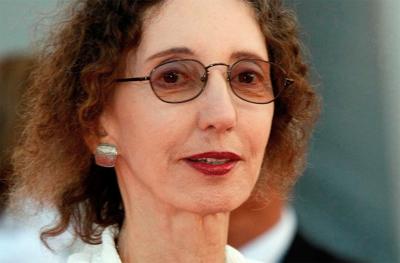

She began writing as a child and the 76-year-old hasn’t slowed down, publishing waves of material she writes in longhand. Her bibliography has its own Wikipedia page, separate from hers, filled with lists of her 40 novels (each of those with its own Wikipedia page) including them (1969), an installment of her Wonderland series that won her the National Book Award, and Black Water (1992), What I Lived For (1994) and the Marilyn Monroe historical fiction Blonde (2000), all of which were nominated for Pulitzers. (There’s been long-running odds betting on when she’s going to win that elusive Pulitzer.) She’s published novels under the pseudonyms Rosamond Smith (eight of them) and Lauren Kelly. She’s turned out dozens of short story collections including Where Are You Going, Where Have You Been? (made into a movie starring Laura Dern), and last year’s Lovely, Dark, Deep. She’s written poems, plays, criticism, essays, novellas, memoir, kids books, an e-book. She’s published so much that Michael Dirda in the New York Times pondered, “Where does one start?” The Rocky Mountain News suggested starting with the short stories. But she herself prefers discussing, via email, her newest work, The Sacrifice, a fictional novel based on actual events – the Tawana Brawley case of 1987-88. The Guardian liked the book: “We see how, in the hands of a great writer, a gripping story can be torn from the poisonous rubble.” She is one of the most admired living writers and teachers. She taught at Princeton for 35 years, has been lecturing at UC Berkeley, and speaks at Monterey Peninsula College’s Guest Authors Series ($20) 7pm Thursday.
• • •
Weekly: Are there any genres you haven’t tried and would like to?
Joyce Carol Oates: I am most engaged by the classical genres – novel, poetry, short story. I am not so interested in situation comedies, for instance, or blogs.
You run. What’s been a profound idea or thought that has arrived to you while running?
I think of my work every time I run or walk – that is, every day. These are likely to be practical ideas more often than “profound” ideas.
Do you consider yourself an advocate for minority, oppressed or disenfranchised people? How much does that inform your writing in The Sacrifice?
I would not say that I am an “advocate” – that sounds like social work or legal defense work. Writers concentrate on creating sympathetic characters in worlds that mimic the real world – my hope in The Sacrifice is to evoke sympathy and identity on the part of readers to whom the world of the novel is not familiar. Racial issues are not specialized issues in the U.S. but primary, essential.
There seems to be more conflagrations of police and state power, race, poverty, class and guilt these days. What do you see as the most divisive issue in America right now?
There may be two: the economic (the increasing gap between the very wealthy and the rest of the country, who pay a disproportionate amount of taxes and other fees) and, linked to this, the political (the use of law enforcement officers to maintain racist boundaries while protecting the property of the wealthy). Much focus on the Middle East by the media allows us to pretend that all is well at home.
What are your thoughts on John Steinbeck?
Steinbeck is an impassioned, gifted spokesman for the dispossessed. His work is rich in regional color, texture, life.
Are there any online streaming shows that have captured your attention?
The Wire is excellent – like the old Homicide: Life on the Streets. House of Cards is skillfully presented but very hollow and shallow – indeed, a “house of cards” that can collapse at any moment.
How do you feel about your teaching career at Princeton coming to a close?
I have retired as a full-time faculty member at Princeton but will teach one workshop from time to time in the creative writing program there (as I will be teaching in fall 2015).
What do you think of California now that you’ve moved to [the Bay Area]?
We are renting a beautiful Julia Morgan-designed house on Panoramic Way, above the university, in Berkeley. But we will be leaving in May.
If you win the Pulitzer, what will you say in your acceptance speech?
I don’t think there is an acceptance speech for this prize…
(0) comments
Welcome to the discussion.
Log In
Keep it Clean. Please avoid obscene, vulgar, lewd, racist or sexually-oriented language.
PLEASE TURN OFF YOUR CAPS LOCK.
Don't Threaten. Threats of harming another person will not be tolerated.
Be Truthful. Don't knowingly lie about anyone or anything.
Be Nice. No racism, sexism or any sort of -ism that is degrading to another person.
Be Proactive. Use the 'Report' link on each comment to let us know of abusive posts.
Share with Us. We'd love to hear eyewitness accounts, the history behind an article.