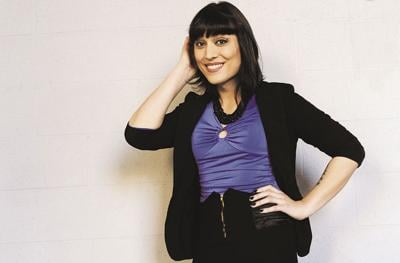

The young woman sitting across from me has big brown eyes rimmed with winged eyeliner. She has flawless skin and perfect posture, and speaks with an articulacy that seems especially mature for a 24-year-old college student.
As member of the local ACLU board and an activist for transgender rights, Veronica Ripley says she puts herself out there, in part, so she can spare other trans people the constant onslaught of curious (and only sometimes well-intentioned) questions.
She grew up in Monterey, Marina and Prunedale, studying theater at Monterey Peninsula College and acting in the Children’s Experimental Theatre. Her dad, James Vocelka, was Marina mayor in the late 1990s. After high school, where she was crowned Mr. North County in 2008, she spent several years in L.A., working in casting. She recently returned to the Monterey Peninsula as a music major at CSU Monterey Bay. She began her transition in early 2013.
~ • ~
Weekly: I hope you don’t mind me saying this, but I wouldn’t have guessed you were transgender.
Ripley: Thank you. [Pause.] There’s a thing called passing privilege. I want to stress that passing is not the important thing about trans people at all. I try not to hold passing as a high standard, but there’s a selfish part of me that wants to pass, too. Most people accept the gender they were born with, so there’s this major disconnect.
What made you decide to transition?
While I was working in Hollywood, I had a bit of a crisis. As a young male, I had to represent the epitome of what young males should be. I realized I didn’t want to be male anymore. I just couldn’t stand my whole life crumbling around me while I had to purport this little lie. It was eating me from inside.
I’ve known since I was a kid that I was a girl. We’d play 101 Dalmations and I was always Cruella DeVille. But as I got older, people started getting weird, and eventually you get put in a gender box and I was there for most of my childhood.
Then my kidneys shut down. When you’re in the hospital with acute renal failure, things get pretty real. [I thought], Maybe you’re not going to be around for a long time and maybe you should do something to be happy.
What was the process like for you?
It can be a long road to transition if you don’t adhere very stringently to notions of what trans should be. Under the Harry Benjamin laws, doctors only offer hormone replacement therapy to transpeople who adhere to a strict protocol. They want you to follow this script, “I was born in the wrong body,” and in a lot of cases it’s not true. Gender is a complex web.
I did months of independent research and had a meeting with my general practitioner, and he said sure. I take two pills: a testosterone blocker and synthetic estrogen. When they work together, they basically induce a second puberty. You remember what that was like – It’s a lot of awkwardness. Imagine doing that as an adult.
You had a hard time getting your new ID from the DMV, right?
I went to the DMV in Seaside because I needed an updated name, photo and gender. Nobody wanted to touch this. They would go up and go to the office and whisper and look at me – it was an actual nightmare. I went to court to change my name and gender, and the judge was cool. I went straight from the courthouse to the DMV and handed them my court documents and they updated my card. It took months; I got my ID in the main with a handwritten note addressed to “Vorunica.”
School was equally strange. I get a lot of friction from the older generation. When I come into the office at CSUMB, the administration had a hard time wrapping their minds around my transition. My department is great – every one of my classmates is awesome, my teachers are cool. It’s just that that the administration has a lot of catching up to do.
Do you prefer it if I don’t publish your birth name?
A lot of people do get dysphoric talking about their life before transition. It is a painful topic, this life you had to stumble through and lie about. I did a lot of public things before my transition, so there are a lot of digital ghosts floating out there. IMDB (the Internet Movie Data Base) wouldn’t merge profiles without naming the old one. I want recognition in the here and now.
How do the hormones affect your identity?
I think whatever hormone composition you have in your body amplifies the identity you have already. [Hormone replacement therapy] allowed me to capture a lot of things that made me female. It’s been a wild ride, HRT. It’s been nearing two years.
Personally I’m an open book. I could talk about hormones and gender for days. But a lot of trans people would be offended by questions about hormones.
I saw my skin change, my hair started curling a little bit, I started to grow breasts, my body fat redistributed. It’s been such a bizarre thing to try to communicate just how different a couple little pills can be over the years. They affect you on an emotional level, too. I find children fun and a little cute. I never used to. Now I love kids and animals. It’s like I can finally handle happiness and love on an emotional magnitude I never used to before.
But I’m still the same person. All of the things that are core about my being are the exact same. I still like cat pictures. I still hate broccoli. I’m a daughter and a girlfriend. I am also a trans person. Transgender is an umbrella term and transsexual is more clinical; it literally means what sex you are [physically]. A lot of people think transgender means you’re crossing genders when you’re really staying the same.
Why did you change your career focus from acting to music?
Before [transition], I couldn’t bring myself to feel that much. I was an actor and that’s part of the job, to be able to feel emotion. Now I don’t have to act anymore. I’m a music major, but the focus is recording technology and engineering – basically learning to make people sound good. I’m also a composer. I love using my computer as an instrument. I didn’t have access to a double bass or an orchestra, but I was able to make an entire film score.
Is it exhausting dealing with people’s curiosity about your transition?
Oh my God, I have had some of the most awkward questions. What needs to be said really clearly is, if it doesn’t need to be said, don’t ask it. If it’s really personal, don’t ask. The most awkward is where people are inebriated, like in a bar.
In my early stages, when I wasn’t passing as ubiquitously, grown men would come up to me and ask me about my genitals. Women do it too, but men tend to feel like they have ownership over a woman’s body, period. In a bar, where inhibitions are lax, they feel like of entitled. They feel you shouldn’t even get offended. Specifically I get a lot of questions about [air quotes] “the surgery.” The questions isn’t even, “Have you had the surgery?” The subtext is, “Are you fuckable to me?”
For someone who was socialized male as a child, there is a very specific repression. Men think being attracted to transwomen makes you gay, when it’s kind of the opposite. Men who are gay are attracted to masculinity at some level.
I also tend to get a lot of weird slurs from women. I have some grown suburban women call me a “tranny” and think I’m a drag queen. There are a lot of buzz words that are associated with the sex industry, so when someone calls me a tranny, it puts me in a weird position where I think they associate me with a stripper or porn star, and it’s not the case. Generally what people see in porno is a grossly exaggerated person who has gone through a lot of surgery. In real life, transsexuals look a lot different than that.
Did you observe a loss of male privilege after transition?
As somebody who subverted gender norms from a young age, I don’t think I experienced all the male privilege that was out there, but I experienced some of it. I went from being paid $15 an hour to being paid $9 [after transition]. I can’t get a job outside of school. Nobody will hire me. You’re forced to come out to your employers because of paperwork, and it’s incredibly awkward.
I don’t want to sit here and claim to be in a really oppressed area, because here [in Monterey County], most people don’t really care. I was sure when I came out, my parents would disown me, but they were OK with it. I thought for sure my abuela was going to disown me, but no, she wanted to know if I wanted to come over and make tortillas. I was afraid my friends would leave me, but really almost all of my friends are totally fine with it.
What’s the best way for a cisgender person to be an ally to trans people?
To understand that if a trans person is presenting as a female, you treat them like a cis woman. That’s all they want. You don’t question them about their history, you don’t ask them strange personal questions about their surgery, you don’t wonder what their quote-unquote real name is. You take what they say and accept it. The best allies I have treat me like any other person. Treat me like a woman. That’s all I want.
There are a lot of wonderful things about being trans. I have experienced life from both binaries. I am infinitely happier now than I ever was before.
(1) comment
I would like to congratulate Veronica for speaking, and the Coast Weekly for doing her story; but I thinkthere has not been said about the other area of being a Transgender woman, the over 60 year old woman, who is married, has children, retired, and is a woman of color. I think that to get a different perspective, you have to look at the other side of being Transgender, what will we look like when our beauty has faded, and we are now older, a little bit wiser, and look back on our own contributions to the Transgender Community....
Welcome to the discussion.
Log In
Keep it Clean. Please avoid obscene, vulgar, lewd, racist or sexually-oriented language.
PLEASE TURN OFF YOUR CAPS LOCK.
Don't Threaten. Threats of harming another person will not be tolerated.
Be Truthful. Don't knowingly lie about anyone or anything.
Be Nice. No racism, sexism or any sort of -ism that is degrading to another person.
Be Proactive. Use the 'Report' link on each comment to let us know of abusive posts.
Share with Us. We'd love to hear eyewitness accounts, the history behind an article.