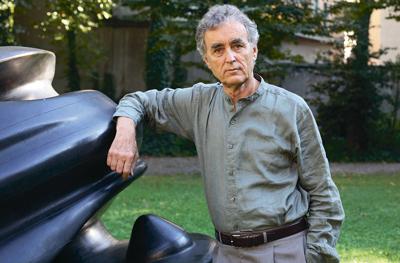

Fritjof Capra discovered his passion for the sciences at age 16, as a high schooler in post-WWII Austria. There was one teacher in particular – a young mathematics teacher – who helped spark it, and challenged Capra to tackle problems no one in the world had yet solved. “He would say, ‘For this one you wouldn’t get the Nobel Prize, but for that one you [would],’” Capra says. “It was very exciting.” Capra’s interest shifted to theoretical physics at the University of Vienna, and after earning his Ph.D. in 1966, he was lured to teach at UC Santa Cruz, where he arrived in 1968, just one year after the Summer of Love. It was there he met counterculture icons Alan Watts, Jiddu Krishnamurti and Carlos Castaneda, who helped inspire Capra to draw connections between Eastern spirituality and the world of physics. He moved to London in 1971, where he spent four years synthesizing those ideas into his first book, The Tao of Physics, which has gone on to sell more than a million copies. Capra came to Berkeley in 1975 and has remained there ever since, authoring several books, including his most recent, The Systems View of Life, which was published in 2014 and co-authored by Italian biologist Pier Luigi Luisi. The book is a culmination of the ideas Capra has spent his life studying.
• • •
Weekly: One thing that seems to be a theme in your books is that the sum of things can be greater than – or less than – the parts.
Capra: Yes. Quantum physics shows that the qualities of each part derive from its relationship with other parts. This is also true in living nature, and after writing The Tao of Physics, I shifted my interest in physics to the life sciences. I was looking for a corresponding framework that would be able to treat the biological aspects of life, but also the social aspects, the ecological aspects, the cognitive dimensions, to treat all this in a coherent framework. I was really exploring this traditional systems thinking, and trying to find an integrated framework to deal not only with the understanding of life, but also with the world’s problems, which are all interconnected.
What are some solutions to modern problems that you propose in your latest book?
Whether we talk about energy, the environment, climate change, poverty, economic inequality, these are all interconnected. These are problems of the system as a whole.
A good example is agriculture: If we changed from industrial agriculture – which is chemical, large-scale and energy intensive – to organic, community-oriented, sustainable farming, this would significantly solve three of our biggest problems. It would greatly reduce our energy dependence, because we are now using about 20 percent of our fossil fuels to grow and process food. It would have a huge positive effect on public health, because many chronic diseases are linked directly to diet. And organic farming would contribute significantly to fighting climate change, because organic soil is rich in carbon, the chemical backbone of life, and so this means it draws CO2 from the atmosphere and locks it up in organic matter.
One of your books is Green Politics. Why have green politics failed in this country, particularly when compared to Europe?
To put it bluntly, the system, at least at the federal level, is not a democracy. It’s a plutocracy where billionaires and industries determine the politics. But on a local level, green politics can work, even in this country. I don’t know if you followed the last election to re-elect the city government of Richmond, who were opposing Chevron and their oil refinery. Chevron spent millions of dollars to unseat this local government, and they were not successful. The community was stronger than the industry and all their money.
(0) comments
Welcome to the discussion.
Log In
Keep it Clean. Please avoid obscene, vulgar, lewd, racist or sexually-oriented language.
PLEASE TURN OFF YOUR CAPS LOCK.
Don't Threaten. Threats of harming another person will not be tolerated.
Be Truthful. Don't knowingly lie about anyone or anything.
Be Nice. No racism, sexism or any sort of -ism that is degrading to another person.
Be Proactive. Use the 'Report' link on each comment to let us know of abusive posts.
Share with Us. We'd love to hear eyewitness accounts, the history behind an article.