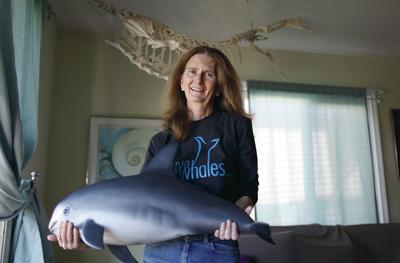
It began with a T-Shirt expressing a simple message: “Save the Whales.”
When Maris Sidenstecker was 14, she read an article in an airline magazine about how whales were being hunted and killed. She’d never thought about whales as mammals like humans before, but she was moved to do something – a T-Shirt fundraiser. She appeared on TV and the idea went viral. In 1977, the then-16-year-old co-founded the nonprofit with her mother.
Her work now goes far beyond whales. Sidenstecker is tackling the health of the whole ocean. “Whales are like the canary in the coal mine,” she explains. The giants are very sensitive to disturbances in the ecosystem, and they accumulate toxins during their long lifespan. When orca corpses washing up in Washington’s Puget Sound are so contaminated they’re considered toxic waste, Sidenstecker says it should trigger alarm bells.
Save the Whales’ Big Idea is to continue the work of marking storm drains with decals reminding people that dumping leads to the ocean. That’s where Hope Services – a nonprofit that provides opportunities for people with developmental disabilities – became involved. It is an ideal chance to engage an often-overlooked segment of the population, as Hope Service’s clients tackle the work of marking the storm drains.
Save the Whales also heads a program to give hands-on presentations in schools across the country using whale bones, recorded songs and interactive models. Sidenstecker says the goal is to “inspire students early on and make them realize their actions have a direct impact on the oceans.”
Anna Muñoz, a science teacher at Los Arboles Middle School, invited Save the Whales to her class. She saw her students become excited about endangered marine life when listening to a real scientist. “It was like going to a natural history museum,” she says. The presenter responded to the students’ unusual questions in a way that encouraged their curiosity. He also explained the carbon cycle and global warming, and how the kids could make a difference through actions like recycling.
Muñoz says it was such a hit that other students were jealous. She hopes to bring Save the Whales back, this time in a school-wide assembly.
“For all that we do, we can always do more,” Sidenstecker says.
“There are a lot of issues facing marine creatures,” she adds, “and everyone can play a role.”
(0) comments
Welcome to the discussion.
Log In
Keep it Clean. Please avoid obscene, vulgar, lewd, racist or sexually-oriented language.
PLEASE TURN OFF YOUR CAPS LOCK.
Don't Threaten. Threats of harming another person will not be tolerated.
Be Truthful. Don't knowingly lie about anyone or anything.
Be Nice. No racism, sexism or any sort of -ism that is degrading to another person.
Be Proactive. Use the 'Report' link on each comment to let us know of abusive posts.
Share with Us. We'd love to hear eyewitness accounts, the history behind an article.