The courtyard of Rockrose Gardens is decorated with mosaics and landscaped with drought-tolerant plants. The brand-new complex is painted a warm shade of yellow, and the place is expected to be designated LEED Silver. It feels inviting and pleasant, which is all the point: Affordable housing can be nice.
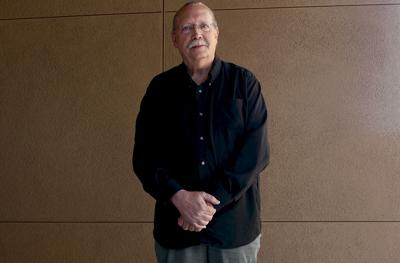
Steve Hutson, 61, was one of more than 100 people who entered a lottery for 20 one-bedrooms, and he moved into his furnished apartment just about a week ago. He’d been renting a room in a Seaside house, but knew that arrangement was going to end soon. His plan after that was to move into his car.
Hutson pays $332 a month in rent for his apartment, constructed and managed by Interim, Inc., a nonprofit that provides transitional and permanent housing for mentally disabled low-income adults. With a diagnosis of schizoaffective disorder and checks from Social Security disability, Hutson qualified for permanent housing. “If it weren’t for Interim, I would be homeless,” he says. He’s a former electrical engineer who worked for a Texas phone company before moving to Pacific Grove in 2000.
The $5.6-million Rockrose project was paid for mostly by the Department of Housing and Urban Development and other government and nonprofit sources; private donations, totaling $700,000, paid for more $140,000 worth of furniture.
Hutson spoke with the Weekly from his new apartment.
Weekly: How did you end up on the Monterey Peninsula?
Hutson: I was born and raised in Dallas, Texas. I moved here 14 years ago for the outdoor air conditioning. I have a sweat gland condition, and I nearly died in Texas. Moving saved my life.
What would you have done if you didn’t win the lottery for Rockrose Gardens?
When I bought my car with my 401(k) from my previous job, I had in mind that it would have to be a car I would exist in if I had to. It’s a hybrid Nissan. It’s very comfortable; the seat lays back, it has a USB plug. It’s kind of like an office on wheels.
Have you always struggled with mental illness?
I was taking my son to the psychiatrist, and the questions he asked my son I was answering in my head, so I made an appointment after my son was taken care of. I had suffered with the symptoms of hearing dialogues in my head all those years, and I thought everyone had that experience. I was diagnosed in 1990, and continued to work until 2009.
How did it affect your family having two people with mental illness?
My [older] son is schizophrenic, and my other son has no mental illness. He’s definitely the hero of the family. Having a son with a mental illness definitely makes me more compassionate toward others.
How about your family’s compassion toward you?
The way I put it, I’ve been in the doghouse most of my life. People don’t understand mental illness. For that reason, they’re afraid of it.
Before you understood it, were you afraid of mental illness?
Pretty much. When I would see people talking to themselves, it did worry me.
Has mental illness made it hard to do your job?
With psychotropic medications I’m able to function better, but the conundrum is the side effects can be just as debilitating. That’s what I found in ’09 [when I resigned from a job as a systems analyst for an insurance company]. I had memory loss and difficulty concentrating.
What’s changed since then?
In the last five years, my doctor and I have tried other meds. We ended up going back to what I was originally taking 10 years ago. Pharmaceutical treatment of mental illness has a long way to go.
With the help of [Interim job-training program Supported Education and Employment Services] I hope to get back to functioning in the community, to the best of my capacity.
What kind of work do you want to do?
I would hope it would be something giving back to the community, a service that’s needed. I’ve been given so much.
A ribbon-cutting ceremony at Rockrose Gardens happens at 11:30am Friday, Dec. 5. Speakers include Marina Mayor Bruce Delgado, State Sen. Bill Monning, and HUD officials. 3012 Lexington Ct., Marina. Free; lunch included. RSVP to 649-4522 ext. 301
CORRECTION: This story previously misstated the cost of furniture. Private donations toward the $5.6 million project did total $700,000, but only $140,000 of that was spent on furnishing the apartments.
(0) comments
Welcome to the discussion.
Log In
Keep it Clean. Please avoid obscene, vulgar, lewd, racist or sexually-oriented language.
PLEASE TURN OFF YOUR CAPS LOCK.
Don't Threaten. Threats of harming another person will not be tolerated.
Be Truthful. Don't knowingly lie about anyone or anything.
Be Nice. No racism, sexism or any sort of -ism that is degrading to another person.
Be Proactive. Use the 'Report' link on each comment to let us know of abusive posts.
Share with Us. We'd love to hear eyewitness accounts, the history behind an article.