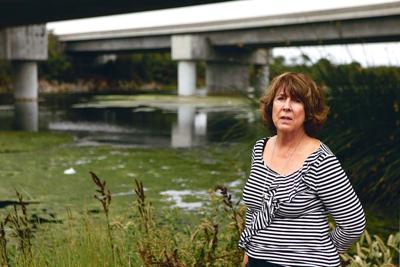

California water politics get murky fast, especially when stakeholders are fighting for pristine waters. A sign of the drought-ridden times: Now they’re fighting over murky waters too, including the stuff that gets flushed down the toilet, and some of the nastiest agricultural runoff in the state.
The politics are still murkier than the runoff, but here’s some clarity to the Byzantine system of water rights that rules the debate.
Groundwater pumping is something of a free-for-all, with landowners laying claim to whatever flows below. The state divvies up flowing surface waters – like the Carmel River or the Salinas River – based on complicated rules resembling finder’s keepers. Parsing out recycled water – sewage treated for reuse – is up to the local entities.
Sewage includes the toxic water flowing through the Salinas River’s Reclamation Ditch and Blanco Drain, which are often covered in greenish slime and full of agricultural runoff.
Two local water boards on either side of the Lettuce Curtain raced to call dibs. With an estimated 58,000 acre-feet still needed to replace what’s currently pumped out of wells to halt seawater intrusion, Salinas Valley growers – represented by the Monterey County Water Resources Agency – are eagerly looking for every drop they can get.
Meanwhile, the Monterey Peninsula faces a state-ordered, 70-percent cutback of Carmel River pumping by December 2016.
Suddenly wastewater looks better than ever before. Kathy Marowka, a senior engineer in the state Division of Water Rights, was surprised to see such interest. “It’s very unusual to see an application for an impaired source,” she says.
In April, the county resources agency paid $346,000 to apply to the state for rights to use up to 25,000 acre-feet per year of those ditch waters.
The Monterey Peninsula Water Management District had been preparing an application of its own – but the county water agency did it first.
That raises the stakes in the battle for the next tempting pool of water: toilet juice.
Wet years in the 1940s meant boom times for Salinas Valley ag. Since then, growers and policymakers have been struggling to reconcile that growth with a finite amount of water.
The state Department of Public Works issued a 1946 report describing the downside of success: Over-pumping groundwater let saline water creep in from Monterey Bay, ruining fields in Castroville and Moss Landing.
What followed were major infrastructure projects to provide supplemental water, using surface water instead of groundwater. First came two man-made reservoirs, Lake San Antonio and Nacimiento, storing rainwater for strategic releases. Then, in the early ’90s, a sewage treatment plant in Marina hooked in to the “purple pipe,” known by its cartoonish color snaking through North County, which started delivering recycled wastewater to 12,000 acres of farmland.
The Monterey Peninsula and Salinas Valley interests both have seats on the board of the Monterey Regional Water Pollution Control Agency, which runs the sewage treatment plant. The 1992 purple line project (paid for by farmers) delivered recycled water to North County farms, and three amendments since then guaranteed growers would get up to 19,500 acre-feet per year.
When the idea to send treated wastewater (or effluent) from the Peninsula back to the Peninsula first surfaced at the Pollution Control Agency back in 2012, its board was bitterly divided.
The growers saw an encroachment upon their agreed-to 19,500 acre-feet. The vernacular, “nineteen-five,” has become a mantra in the ag community to describe the Peninsula trying to get in on the action.
The Peninsula side thought ag was unfairly stonewalling them. Monterey City Councilwoman Libby Downey wondered why the Peninsula couldn’t keep its own wastewater, and threatened to drop out of the Pollution Control Agency entirely: “Does the Peninsula have to stay in this organization? Could they pull out and take their effluent with them?”
Sand City Mayor and PCA board member David Pendergrass put it more bluntly: “We need to find a way to put the fear of God into the Salinas Valley. [They] are not fair.”
A handful of representatives from the Peninsula and from Salinas Valley ag interests have been meeting quietly under the auspices of the Pollution Control Agency. The group is reportedly drafting a memorandum of understanding that would establish who gets how much recycled effluent water – but they closed their meetings to the public, so things are murkier than ever.
“There’s a lot I can’t say about this, because it’s big,” says Salinas Public Works Director Gary Petersen. “The negotiations are extremely fragile.”
On July 30, the group denied the Weekly access, despite the fact that at least a dozen public officials were there. Former Marina Coast Water District board member Ken Nishi and PCA board member Libby Downey have been allowed to attend at least a couple meetings as members of the public. According to an email from PCA attorney Rob Wellington, “the meetings involve sensitive negotiations… and as such are not, nor need they be, open to the public.
“The principals/negotiators in attendance reportedly do allow others, non-negotiators, to attend and observe, but they attend at the pleasure of the principals,” Wellington writes.
The Weekly has filed a Public Records Act request for the attendance and minutes from the meetings.
One of the negotiators, Monterey Peninsula Water Management District General Manager David Stoldt, sees a real and somewhat obvious opportunity in wastewater recycling: Both growers and residents get water they didn’t have before, the desal plant and its carbon footprint can shrink.
“It’s kind of a win-win,” he says.
He adds that not only would the deal give the Peninsula an additional 3,500 acre-feet of water per year; it would give growers 5,400 acre-feet when there’s enough to go around.
But growers have again resisted that split.
“We’re shaking our heads over the illogical pushback that we’re getting from some of the folks that seemingly don’t want to do this deal,” Stoldt says.
That pushback comes from growers, who insist on their nineteen-five threshold – which has never been met. There’s simply not that much wastewater, and with improved conservation practices, the total going into the purple pipe to artichoke fields has dropped consistently.
Another of the negotiators is County Supervisor Simon Salinas, whose district includes all of South County. “If we can clean it, we want it,” he says.
Besides, he’s loathe to share with Peninsula water officials, who he says have dragged their feet for years on replacing Carmel River water.
“They’ve got to start demonstrating they can solve their own problems first,” Salinas says. “Don’t make us the bad people here.”
(1) comment
Contractually, the Peninsula signed off on their waste water years ago, and I don't blame the farmers for not wanting an encroachment on their 19,500 ac/ft of promised water...Give an inch, take a mile...Supervisor Salinas is RIGHT...The Peninsula has had this problem for YEARS, and now that it is getting down to the wire, they are desperate..They could have had a perfectly good permitted project in the Regional Project if they hadn't let the BOS and Cal Am pull the wool over their eyes, so to speak, and for a lot less money than they are charging the rate payers now..It's still a viable project and instead of all this tomfoolery should be put into play again for the needed 10,000 ac/ft...
Welcome to the discussion.
Log In
Keep it Clean. Please avoid obscene, vulgar, lewd, racist or sexually-oriented language.
PLEASE TURN OFF YOUR CAPS LOCK.
Don't Threaten. Threats of harming another person will not be tolerated.
Be Truthful. Don't knowingly lie about anyone or anything.
Be Nice. No racism, sexism or any sort of -ism that is degrading to another person.
Be Proactive. Use the 'Report' link on each comment to let us know of abusive posts.
Share with Us. We'd love to hear eyewitness accounts, the history behind an article.