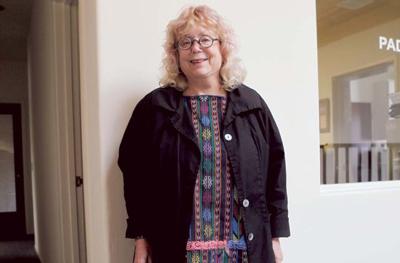

“I’m going to be working for as long as I can because that’s what I do,” says Paddy Grinstein.
Standing in at a couple inches shy of 5 feet, Grinstein estimates that she’s handled at least 2,500 cases in her more than 25 years practicing family law, which have mostly entailed public representation in juvenile dependency court. Aside from a part-time receptionist, Grinstein’s practice is a one-woman operation and she’s perpetually on call – she’s also a Door to Hope board member, active banjo player and is about to make her second appearance in a Paper Wing Theatre production.
There’s nothing about the Seattle native that’s conventional: Grinstein wears a couple sleeves of tattoos (well-hidden while in court) on her arms – a jester skeleton playing banjo and a Paul Frank monkey for her 5-year-old granddaughter Maia stand out – and streaks of hot pink are visible beside her gray locks. But Grinstein’s passion for her clients needs no dress code.
~ ~ ~
What are some of the most difficult cases?
The ones where there’s abuse and the mother refuses to acknowledge that it’s going on. You just want to take the mom and say, “Look, usually young children don’t make this stuff up.” It’s my job to represent the mother and help her to reunify, if possible.
What’s your approach in these situations?
If the client is in denial, it may or may not be true, but it’s [the mother's] job to protect the child. And if you’re the parent, it’s your job to know what’s going on with your child. I don’t get into the specifics of the allegations initially and then I make sure they get therapy because [the mother] getting therapy right away is key. Maybe they’ll come around and see that maybe the abuse did happen and eventually see that it really did happen and realize they have to do something to protect their kid.
What are you most proud of?
I’ve had some delinquency cases that I’ve felt like I’ve made a difference, but that doesn’t happen very often. Then there are cases that you think you’re making a difference but it doesn’t quite turn out the way you thought. I have to be careful that I don’t assume what people are thinking. I had a case where my client – a 15-year-old involved in a big gang case – was housed in juvenile hall not in this county after speaking to the police about a serious incident. I’d go see him, and decided he’d do well if he had a good education and went to school away from here. I found out about the Honda School in Colorado. It’s free and for kids who need an alternate type of schooling. It looked great. I talked it up to him and he seemed really interested. I was looking to be his sponsor, so I gave him the paperwork to fill out, but he never turned it in. That was a good lesson for me: It really wasn’t what he wanted to do. He ended up getting placed somewhere in California and I don’t know what happened to him. He was a pretty good kid who I represented for a long time because the case dragged on.
What’s one thing you would like to change about the legal system?
Overall, the Department of Social Services is good, but there’s a lack of therapy. They say that they don’t have waiting lists anymore but you can have a client waiting for six to eight months for therapy. We have clients who really need to hit the ground running with therapy. They do a good job, but there’s just not enough of them. It means I can go into court and say I need to extend service for another six months because a client didn’t get therapy.
Did you have this type of law in mind when you were in law school?
I didn’t know it existed. I just thought it would be neat to have a job where you read, write and think. I did a little criminal law but once I got into dependency, I really liked it. You can’t make this shit up. You read some of these circumstances and you’re like, “What?”
On a completely different note, I heard you’re a big fan of the banjo.
I am. I go to banjo camp. I just went to one in Texas, outside of Lubbock, which I’ve been going to for the past five years. I have about 18 or 19 [banjos]. My favorite’s a Gariepy I got on eBay. I like the way it looks and it sounds really good. It came with a little history about [Art Gariepy], the guy who made it in the ’60s. He had a banjo shop, started drinking and that was the end of [his career]. It’s a good banjo though.
(0) comments
Welcome to the discussion.
Log In
Keep it Clean. Please avoid obscene, vulgar, lewd, racist or sexually-oriented language.
PLEASE TURN OFF YOUR CAPS LOCK.
Don't Threaten. Threats of harming another person will not be tolerated.
Be Truthful. Don't knowingly lie about anyone or anything.
Be Nice. No racism, sexism or any sort of -ism that is degrading to another person.
Be Proactive. Use the 'Report' link on each comment to let us know of abusive posts.
Share with Us. We'd love to hear eyewitness accounts, the history behind an article.