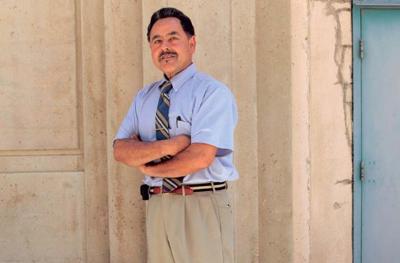

When Juan Martinez tells stories, he has a habit of dropping specific dates, names and details that most people would’ve forgotten decades ago. He recalls vividly the devastating Sept. 17, 1963 collision of a freight train with a bus carrying 58 farmworkers, when 25 were killed and 32 injured.
Since then, the 61-year-old has been fighting – mostly quietly and behind-the-scenes – to improve life for disadvantaged people. He served on the Hartnell College board of trustees from 1979-1991, the only elected office he’s ever held. Last year, Martinez raised about $10,000 for the road signs proclaiming a portion of Highway 101 “Bracero Memorial Highway.”
The Gonzales native caught up with the Weekly over lunch at Mama Lupita’s in Salinas, where he ran into two friends who greeted him warmly. After they left, Martinez said, “Carlos and Carlos, they’re both millionaires. They could be part of a group that could contribute to [progressive causes]. But it’s like, ‘Oh they’re in ag, so they’re part of that group of people.’ Really, we’re all in the same ship here.”
~ ~ ~
Weekly: Why did you first get involved in activism?
Martinez: What drives the madness of it? My first experience that really motivated me to be concerned about others was the accident in Chualar, in 1963. Our family witnessed the carnage. I was 11.
My dad was a first responder there. We were sitting in the car along the side of the highway, and my mom was crying. There were bodies lying around. It was just an image you don’t forget. So for the rest of my life, going up and down the highway, it was like sacred ground.
You keep a treasure trove of farmworker artifacts, like newspaper clippings and photos. Why?
My grandmother saved stuff, and my dad picked up the same habit. We all did. My dad, a World War II veteran, was the first employee of the city of Gonzales after it became incorporated. He paid for the first city vehicle out of his pocket, cash. We still have the receipt to this day.
Some stories are so unique that if I tell the story, people wouldn’t believe me. These documents all prove what I’m telling them is the truth.
What’s a story you tell that people don’t believe?
We started Lowrider magazine in Salinas in 1974. We would develop pictures in the washroom in my apartment and we had the magazine produced in San Jose. I’ve saved the magazines and negatives. Car enthusiasts will say, “No, I thought it started in San Jose.”
As a kid, you used the Salinas River for recreation. What was that like?
We would go out there with a .22 rifle and a 410 shotgun, and a bow and arrows. We went hunting for jackrabbits and quails. It was plentiful back in those days. As a matter of fact, jackrabbits were a nuisance in the fields, because they would eat the crops.
We would make rafts with inflated tire tubes, and we would float for a couple of miles downstream and then we’d have to walk back, which is why we’d only go a couple of miles. We would picnic out there. We’d float from Soledad to Gonzales, or Gonzales to Chualar, depending on where we wanted to go.
Tell me about your one elected office, on the Hartnell board.
The reason I chose to run was back in the ’70s, it was difficult to get a ride to school, so a lot of people lost an opportunity to get higher education because they didn’t have a vehicle. My objective was to help build a South County campus, which was King City. Mission accomplished.
What are you working on now?
Trying to preserve the old county jail [where UFW founder Cesar Chavez was once incarcerated].
One of the reasons I felt this was important is because, in 1974, Monterey County developed a tourist map. In one picture, I noticed a young Anglo girl holding up a bunch of grapes and I thought, it’s been a long time since I saw an Anglo girl working in the fields.
The caption said various nationalities have contributed to the Salad Bowl of the World; it listed Irish, Danes, Basque, Swiss, Italians.
It’s not that it wasn’t true – but that it lacked anybody of color. As a community, if you’re not at the table to make those decisions about developing a map, or how a budget is spent, then only those who are at the table are going to talk. We need to be at the table.
Who’s “we”?
Those that have been traditionally disenfranchised.
(0) comments
Welcome to the discussion.
Log In
Keep it Clean. Please avoid obscene, vulgar, lewd, racist or sexually-oriented language.
PLEASE TURN OFF YOUR CAPS LOCK.
Don't Threaten. Threats of harming another person will not be tolerated.
Be Truthful. Don't knowingly lie about anyone or anything.
Be Nice. No racism, sexism or any sort of -ism that is degrading to another person.
Be Proactive. Use the 'Report' link on each comment to let us know of abusive posts.
Share with Us. We'd love to hear eyewitness accounts, the history behind an article.