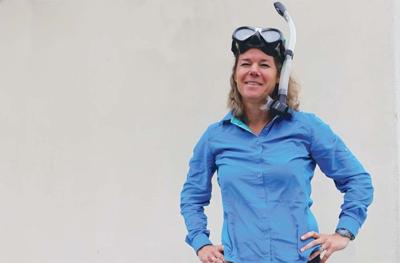

With a biology degree from Brown and a zoology Ph.D. from Duke, California native Tierney Thys migrated back west in 1998 to Cannery Row, where she spent a decade directing research for Sea Studios Foundation, an environmental media nonprofit. But that’s only one of the many hats (and snorkel masks) worn by the water-loving scientist.
Thys is probably best known for her work with ocean sunfish, also called mola. She founded the Adopt a Sunfish Project to support mola research, which takes her to various blue parts of the globe to track and tag the lovably homely, jelly-eating fish. Her 2003 TED talk about mola has nearly 600,000 views.
Her involvement with TED extends to TEDxKids and TED-Ed, where she’s developing a series called Stories from the Sea. She’s part of the TED Brain Trust, a steering committee packed with names like Bill Gates and Amazon CEO Jeff Bezos. A National Geographic Explorer since 2003, Thys writes, consults, lectures and develops expeditions for the National Geographic Society. She’s also been an adjunct professor at Monterey Institute of International Studies.
She lives with her husband and two children in Carmel Valley.
~ ~ ~
What does being a National Geographic Explorer entail?
One thing I do on a regular basis is, I’m inside this virtual world called Animal Jam, for 6-to-9-year-olds. You become an animal to play, and inside there’s a place called Tierney’s Aquarium. I have a tech bench where I showcase all sorts of equipment, from submersibles to underwater cameras. We have 20 million registered players in 150 countries. Animal Jam fashioned my aquarium after the Monterey Bay Aquarium; I was just there shooting yesterday with Makana the Laysan albatross.
How did you use Makana to teach kids about plastic pollution?
She came with a dislocated shoulder from Midway Atoll, at the center of the Pacific Garbage Patch. Every ocean basin has a gyre, a water circulation pattern that spirals and concentrates trash. Half a million tons of plastic are estimated to be in the ocean right now, and there’s more coming in. It doesn’t biodegrade, it doesn’t enter the useful food cycle. Albatross see these colorful bits of floating debris and they mistake it for fish eggs or cephalopods or small fishes.
They pick it up and they bring it back, and their youngsters’ first meal is this mouthful of plastic. It blocks their digestion, but it does more than that. Plastic can actually attract persistent organic pollutants like PCBs and DDT, up to a million-fold ambient levels. So it’s like swallowing this little poison pill for your first meal. It’s pretty morally reprehensible when you think, we’re putting that stuff in there. I’m always looking for creative ways to get out the message that we need to rethink our trash stream.
One way you’re doing that is with the bottle-cap mural recently unveiled at Carmel River Elementary School.
River is an Ocean Guardian school. It’s part of a NOAA program that involves raising ocean awareness. My daughter is part of the art group. Each one of the animals is cut out from a separate piece of plywood: the octopus, the dolphin, the Garibaldi. We’re talking over 16,000 bottle caps, and every one of them had to be drilled in. Every kid at River learned how to use a power drill. The girls could barely hold it, and then they did not want to let go of it. I’m all for giving kids power tools. I love these projects that combine science and art. You tap into a whole different part of your brain, and you release creative ways of rethinking our problems, and you get to a different audience. There’s a universality with something like that mural, that just stops people in their tracks.
Tell me about another of your other art-meets-science projects.
Last year was a big show with the Capacitor Dance Troupe in San Francisco, called Okeanos. It was like Cirque du Soleil meets the ocean. There were live vocalists, aerial objects and the best underwater footage imaginable. We had this contortionist – she actually came down here as part of the Blue Ocean Film Festival – and she performed her “Octopus Dance,” which was spectacular. I was the science advisor for that, and [renowned oceanographer] Sylvia Earle and I narrated the script.
How is writing science film script different than writing for print?
Writing for film has really been useful for writing for print. You don’t want to paint the picture as much. You are solely trying to help punctuate the picture, and not override it. If your language is too flowery, you’re going to detract from your film. But a word set at just the right time to bridge images can be so powerful. For most of the projects I’ve been involved with, we figure out, what do we want the audience to come away with? What footage do we have to work with? What do we need to shoot? What are the take-home messages, and how do we weave a story?
What’s the latest on your mola research?
I’ve been satellite-tagging them all over the world: in the California Current for the Census of Marine Life, in South Africa, Bali, Japan, Taiwan. Right now I’m working on three manuscripts. One is going to be done very soon, about mola behaviors and movement in the California Current. Mola comprise the single largest vertebrate species in the drift gillnet fishery. Thousands and thousands of them are caught in the drift gillnets every year. Here in California, the poster child of conservation, we’re still fishing with drift gillnets. So we want to find out, where are the mola going? Is there anything we can do to reduce the bycatch in the drift gillnets? I’m very pro-U.S. fisheries, but there are definitely better ways to catch fish than drift gillnets.
You did your dissertation on the movement of fish. What would you tell my 3.5-year-old as he learns how to swim?
Streamlining is critical. If you look at the shape of a torpedo, that can slice through the water very efficiently. Most fast-moving fish are shaped like a torpedo, like a tuna. They have this large funnel area that tapers down to these skinny tails. So if you want to move fast, make yourself streamlined. No big arms jutting out. That causes drag.
Tell me about your seat on the TED Brain Trust.
Saul Wurman started TED in 1984, and in 2001 he sold it to Chris Anderson, who was running Business 2.0. He’s a businessman with a big philanthropic heart, and he took it in a totally different direction. It was very exclusive before Chris took it over and had the crazy idea of making the talks available to the public. Who would’ve thought?
It rocketed TED into this other dimension. It was in Monterey before it moved to Long Beach – “wrong beach.” But now we’re in Vancouver, which is great. The Brain Trust is a group of about 30 of us. We have lunches and retreats, and we talk about where TED comes from and where it’s going, and recommend speakers.
What are some of your other core projects?
I just got a grant from National Geographic to look at the brain’s responses to nature. The more you separate yourself from the natural world, the less likely you are to care about it. Especially our youngsters. If they don’t have these experiences where they are wet and muddy and smelling the salt or climbing the trees, they’re not going to think these things are important as they get older.
I love to push outdoor education, but there are certain situations where you can’t easily get out into wild lands, like the inner city. Right now I have a grant with National Geographic fellow Nalini Nadkarni and National Geographic explorer Tan Le exploring the brain's response to nature imagery in urban dwellers. Tan Le has developed mobile EEG Emotiv headsets, and I'm making video test reels of different biomes: built environments, natural environments, computer-generated environments. Together with botanist and science educator Nalini, we are measuring how the brain responds to this imagery. What’s the cognitive resonance of all this nature footage?
One goal will be to see if we can create visual healing nature tools that can be used not only for lowering stress in urban dwellers but also for use in hospitals, assisted living centers, offices and prison systems. Prison systems are a big challenge. We’ve got upwards of 40 percent recidivism, costing $63 billion per year. We pay for that with tax dollars. So what can we do? Yes, these people have done wrong and they need to be punished. But when you separate someone so completely from the green and the blue, and put them in a small cell for months at a time, that's not going to make them better. I know of no native culture that separates their wrongdoers by putting them into a cement box and expecting them to get better, or to re-enter society with renewed love and empathy.
Under the leadership of Nalini Nadkarni, along with eco-psychologist Pat Hasbach and Public Engagement Program Manager at University of Utah, Emily Gaines Crockett, I am working on separate project exploring the use of nature imagery in prisons. We have yet to start that research, but our preliminary explorations suggest that nature imagery will have a hugely beneficial impact.
[Editor's note: This response has been revised for clarification, 8/30/14.]
That makes me think of Big Sur Land Trust’s youth nature camps at Glen Deven Ranch. I hear some of these kids live in Salinas but they’ve never seen the ocean.
[CSU Monterey Bay Professor] Seth Pollack says there’s less green space to asphalt in Salinas than any other city west of the Mississippi, even though it’s surrounded by ag land. You can correlate [lack of] green space with gang violence. There are papers that show that pretty clearly. You don’t want to have an asphalt cell surrounded by ag land – it’s like a prison. That’s this whole new thing I’m calling “neurobiophilia.” It’s our innate affinity towards the life around us. I’m interested in the science of how nature engages the brain.
How can iPad games and television programming be another educational tool?
I had this big grant from National Geographic. It was going to be a whole television show – I had Sesame Street, animators from Pixar, researchers from Blue’s Clues on my team – but it ended up turning into an app, Jacques’ Marine Missions. So I got way into screen media and small kids’ television.
I think the vehicle is demonized a lot. It’s certainly a lot more immediate gratification with touch screens, and more interactivity that’s facile and intuitive. But just like anything, it’s the content that makes the big difference. These little ones have so much going on in their minds and are capable of pretty complicated thoughts, but you have to get into their sensibility.
Like in filmmaking, if I look at you and I cut from your face to somewhere else, you’re making those little ones do a lot of work to stitch the scenes together. A perfect pre-verbal [film shot] would be a slow pan. If you look at Blue’s Clues, that’s always put forth as one of the most successful preschool kids’ shows. They don’t do a lot of jumping around. They also break the “fourth wall” – and that’s believable for a 3-year-old, and it’s personable. You’ll see a 3-year-old talk back.
Explore Thys' mola research at oceansunfish.org and her work on how nature imagery affects the brain at http://neurobiophilia.org. Learn more about her upcoming National Geographic student expeditions and ongoing TED film series through these links.
(0) comments
Welcome to the discussion.
Log In
Keep it Clean. Please avoid obscene, vulgar, lewd, racist or sexually-oriented language.
PLEASE TURN OFF YOUR CAPS LOCK.
Don't Threaten. Threats of harming another person will not be tolerated.
Be Truthful. Don't knowingly lie about anyone or anything.
Be Nice. No racism, sexism or any sort of -ism that is degrading to another person.
Be Proactive. Use the 'Report' link on each comment to let us know of abusive posts.
Share with Us. We'd love to hear eyewitness accounts, the history behind an article.