
For the 17th time in the past year, SPCA for Monterey County Director of Community Outreach Beth Brookhouser found herself hitting send on a horrifying email: The SPCA had once again been called in to rescue a large number of animals living in deplorable conditions. In this most recent case, on May 7, the SPCA removed 14 dogs, four puppies and two cats from a Pacific Grove home that was filled with piles of garbage and animal feces and urine. Conditions were so bad inside that the P.G. Fire Department, called in to assist, recommended that animal rescuers wear protective gear because high levels of ammonia gas from all of the urine had made the air dangerous to breathe.
Brookhouser, who’s been with the SPCA for 11 years, talks about what large-scale rescues look like, how people can help and what makes for a happy ending.
How does the SPCA usually end up getting involved in a large-scale rescue or hoarding case?
It really, truly depends on the case. In the P.G. case, we were the first to be called, then we reached out to the P.G. police and code enforcement. But the information can come in a variety of ways. We work closely with all agencies, but most tips come from individual citizens. People can call [831-373-2631] or email [info@spcamc.org], and we have an anonymous reporting form on our website [www.spcamc.org/report-cruelty].
Some cases are misunderstandings. For example, we might get a call that a horse is down and can’t get up, and it turns out the horse is just taking a nap. We go and investigate, we smile at the property owner and move on our way. Whether it’s something silly or serious, we’d rather have those calls come in than not.
What’s it like for SPCA staff to do large-scale rescues?
It’s very hard going into a situation like this and knowing pets were having to endure these conditions and people were having to endure these conditions. Nobody wants to walk into a house like that, or smell or witness anything like that. But that’s what we do and what we’re here for. Knowing that we’re able to get these animals into a much better place and seeing them at the end of the day clean and breathing fresh air and basking in a sunbeam, it makes it worth it.
Are there any commonalities you see in these situations?
Hoarding has undergone a lot of research and thankfully there’s a clear definition. It’s more than a typical number of animals, and they deliberately don’t put a number on it because there are people out there who can care for 10 or 15 animals safely and humanely, and there are others who can’t care for any at all. It’s failure to give the minimal care, resulting in illness, disease or death.
We also see they can’t care for the animals, and they continue to accumulate or hold on to animals and don’t reach out for help.
In this P.G. case, the house was in a small neighborhood, with a school and parks nearby and people walking by all the time. Thankfully one of those people noticed something didn’t look right and smell quite right and they gave us a call. That was all it took.
Do you think it’s strange that some of these situations go on for as long as they do before anyone notices?
The people who do this tend to be very secretive. If you have a family member with animals and they don’t let you come to their house or if you go to their house and they meet you outside and don’t let you come in, those are big signs. A lot of times the person can have a different professional life than personal life, and most people are shocked when they find out who’s involved in this kind of case. But the bottom line is that each and every one is heartbreaking.
It’s been a few days since the dogs and cats from the P.G. home were rescued. How are they doing now?
We’re optimistic they’re going to recover and we’re focused on getting them better. They are considered evidence at this point, until the owner surrenders them, so we’re giving them lots of love and care for the weeks or months it takes.
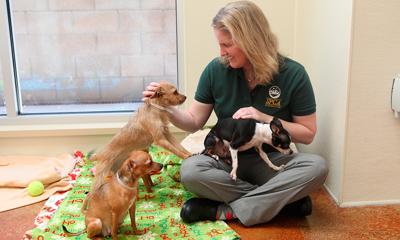
The dogs are scared and shaking and avoiding eye contact, in that “If I can’t see you, you can’t see me” way. I went and sat with them and didn’t make eye contact, and after a while I felt a little lick on my fingertips, and then another lick, and then a paw on my lap and the next thing I knew, I had a little one on my lap. They’re getting better with love and compassion.
What’s a good day like at the SPCA?
A good day is when everyone gets adopted and nobody comes in needing to be rescued. A boring day is a good day.
(0) comments
Welcome to the discussion.
Log In
Keep it Clean. Please avoid obscene, vulgar, lewd, racist or sexually-oriented language.
PLEASE TURN OFF YOUR CAPS LOCK.
Don't Threaten. Threats of harming another person will not be tolerated.
Be Truthful. Don't knowingly lie about anyone or anything.
Be Nice. No racism, sexism or any sort of -ism that is degrading to another person.
Be Proactive. Use the 'Report' link on each comment to let us know of abusive posts.
Share with Us. We'd love to hear eyewitness accounts, the history behind an article.