

The last time Amy Parenti spoke to her brother Jacob was over the phone, like they did every week. There wasn’t anything special about the conversation. He wanted to wish her husband good luck on the first day of a new job, and he wondered about Otto, her new puppy.
As always, she says, “we told each other we loved each other at the end.”
He was dead about a week later.
The call took place over a monitored phone from the Monterey County Jail.That’s where the 33-year-old Jacob Parenti died last Jan. 15. He’d been serving a two-year sentence for a drug violation, in addition to an eight-month sentence for possession of stolen property.
Before Jacob’s death, Amy was a Santa Cruz stay-at-home mom. Now she’s a passionate voice in a multi-pronged battle against the jail. She believes the jail – because of neglectful medical care – contributed to her brother’s death.
She’s not the only one concerned about care at the facility. Last May, the Monterey County Public Defender’s Office partnered with the American Civil Liberties Union (ACLU) and the San Francisco-based law firm Rosen Bien Galvan and Grunfeld, to file a federal lawsuit against Monterey County, the jail and the jail’s contract medical provider, California Forensic Medical Group (CFMG).
It’s a horror-show list of allegations being claimed. In one case, the suit alleges, the jail deprived a diabetic prisoner of insulin. In other cases, jail doctors delayed referring inmates to specialists. In another, an inmate was kept in a cell and not given food for 38 hours.
“My brother was not given a death sentence by the courts,” Amy says. “This jail staff sentenced him to death.”
She slams her finger on the table.
“His future was robbed from him and he was robbed from us,” Amy says. “There will never be an end to our anguish, to our horror. Never.”
After Jacob died in January, Sheriff Scott Miller asked the District Attorney’s office to investigate, a standard procedure in questionable jail deaths. Amy says her brother died from flu-like complications that could have been avoided with more attentive care. But an official coroner’s report says Jacob died from a drug overdose. It’s a fate not unheard of for incarcerated addicts, who can access smuggled drugs.
Miller was also struck by Jacob’s death personally: Jacob was a playmate of his own children when they were growing up. But on the facts of his death, Miller remains resolute. “He didn’t die from the flu,” Miller says. “I don’t know what the source of [Amy’s] information is. It seems most isn’t true.”
Whatever the case – and in more than just this case – something’s up at the jail. At least two recent deaths, not including Jacob’s, have been scrutinized by attorneys. In one of those cases, a mentally ill murder suspect committed suicide in his cell just days after his arrest. His mother has filed a claim that’s a precursor to a lawsuit.
Though the jail has constantly been under fire for poor conditions, officials maintain the situation is, overall, getting better. But opinions differ over whether real change is coming.
For Public Defender Jim Egar, the answer is no, at least not yet. By April 11, Egar, the ACLU and the San Francisco law firm will file an amended complaint seeking class-action status for any prisoner ever harmed by inadequate medical care at the Monterey County Jail.
• • •
For years there’s been trouble at the jail. And for years the Monterey County Public Defender’s Office has been trying to get to the bottom of it.
“It’s been a process of peeling an onion,” Egar says. “I was not aware of the deficiencies in medical care until I started looking at it in closer detail.”
There have been criticisms of chronic overcrowding, violence among inmates and insufficient staff, but these aren’t problems known only in the county’s law enforcement and policy circles. In 2006, the Weekly ran a cover story called “Hell Hole: The Monterey County Jail is an overcrowded pit of violence and despair. There is no plan to fix it.”
The public defender’s lawsuit claims the jail and county have failed on four measures: protecting prisoners from violence, providing adequate medical care, providing adequate mental health care and providing reasonable accommodations to prisoners with disabilities. Between suicides and deaths, 13 prisoners have died in the jail’s custody since 2005.
Also named in the suit is the Monterey-based California Forensic Medical Group. The private business is the jail’s medical service provider, contracted by the county to provide medical, mental and dental services.
By most accounts, CFMG is successful. It started in 1984 with a contract in Monterey County for adult and juvenile facilities, and has expanded to 65 facilities in 27 counties in California. The company is responsible for about 16,000 inmates; many counties have maintained contracts for more than a decade.
A 2011 letter of recommendation from Solano County Sheriff Gary Stanton says that after years of trying to hire a qualified physician and staff of nurses to provide medical services, the county hired CFMG in 2004.
“For any custody program struggling to provide comprehensive and cost-effective medical, dental and mental health services,” Stanton says in the letter, “I highly recommend contracting as a means of improving service, reducing liability and containing costs.”
In 2012, according to information from a Santa Cruz Sentinel article, Santa Cruz hired CFMG to “address ongoing problems with the county-run jail medical program, including recruitment difficulties and high turnover.”
The shift was to save the county $600,000.
Several Monterey County officials – including Egar, District Attorney Dean Flippo, and Robert Jackson, the program manager of the county-owned Mental Health Unit at Natividad Medical Center – provided letters of recommendation as part of the company’s bid for the contract. But those recommendations may have been premature.
Egar, who has been the county’s public defender since 2006, says he wrote his recommendation as a courtesy, before learning about the alleged deficiencies.
Says the lawsuit: “CFMG… provides deficient medical care in nearly every respect… [prisoners] fail to receive timely or appropriate treatment, resulting in unnecessary and prolonged pain, suffering, worsening of their conditions, and sometimes even death.”
• • •
The Monterey County Jail was built piecemeal from the 1970s through the ’90s as the need to house inmates grew. Expansion hasn’t tamed overcrowding. The lawsuit says for the past few years, the jail has routinely housed more than 1,100 inmates, though it’s built for 825.
One morning in March, Sheriff’s Commander Lisa Nash led a photographer and me on a tour through the facilities. Judging by descriptions in articles written years ago, our tour could have taken place any time in the last decade.
Here are some words used to illustrate the facility: “a portrait of institutional decay,” the Weekly wrote in 2006.
We walk from the lobby through a heavy door into the jail. Wires jut out of the ceiling, where a panel is missing.
Jail staff aren’t shy about the challenges of the facility. They are well aware of the limitations – and threats – of the environment.
“Jails, no matter where you go, are not the cleanest, healthiest places,” says Chief Deputy Sheriff Edward Lavarone. “You have people who are homeless, who have nasty drug or alcohol habits.”
Signs of wear are evident everywhere. Lavarone compares it to a car: Even if it’s new, if you drive it 24 hours a day, it’ll soon have problems.
Much of the jail is filled with violent inmates, some gang members awaiting trial and prison. According to jail stats, 7.4 percent of the unsentenced population is awaiting trial for murder.
The lawsuit says there were more than 150 violent prisoner episodes between January 2011 and September 2012. Fights can be exacerbated by weapons, from shanks to a “tomahawk” made from a razor and a long copper pipe. Most of the incidents required medical treatment; in 13 cases, inmates had to go to the hospital.
Even so, proper care isn’t always given, the lawsuit says. Dennis Guyot, who was beaten by another group of inmates in March 2013, filed 26 sick slips requesting medical care before he was taken to a neurologist for concussion symptoms. He started filing the slips on March 31, and wasn’t seen by a neurologist until June 7.
Soon we reach a safety cell, described as a “rubber room” in the lawsuit, although “rubber” is something of a misnomer. When Nash raps on it with her knuckles, it makes a knocking noise. This is the room where prisoners who might try to hurt themselves are kept.
There’s no bed or chair. The only thing in the room is a metal grate, the size of a floor tile, in the center of the room: the toilet. The lawsuit cites an alleged incident in which a man was put in the room with “feces on the walls and floors of the room” and “forced… to eat and sleep on the same floor where the toilet grate is located.”
The suit says during the 38 hours he was in the room, the jail’s own documents say that no meal was provided and water was only offered three times.
The bare room, Nash explains, is so inmates can’t harm themselves. But the suit says the conditions are traumatic to the mentally ill.
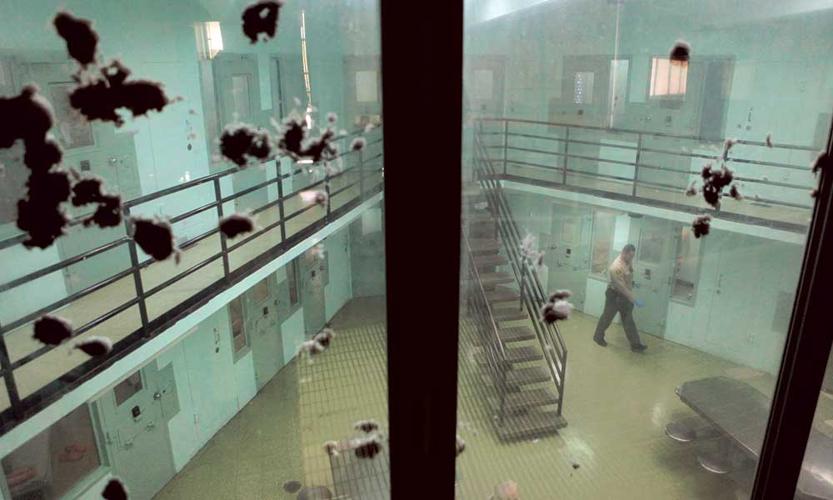
As we continue there’s more blight. Windows to some holding cells are cracked, like a car windshield struck by a baseball. We walk down a long, overhead hallway, lined with windows for viewing inmates below. Some have removed their shirts, revealing large tattoos. They live in dorm-style settings that went from single bunks to doubles to triples. Dorms designed for 48 now hold 70, Nash says.
Some of the windows are obscured by a thick layer of what looks like fungus. Spitballs, Nash says. Inmates get bored.

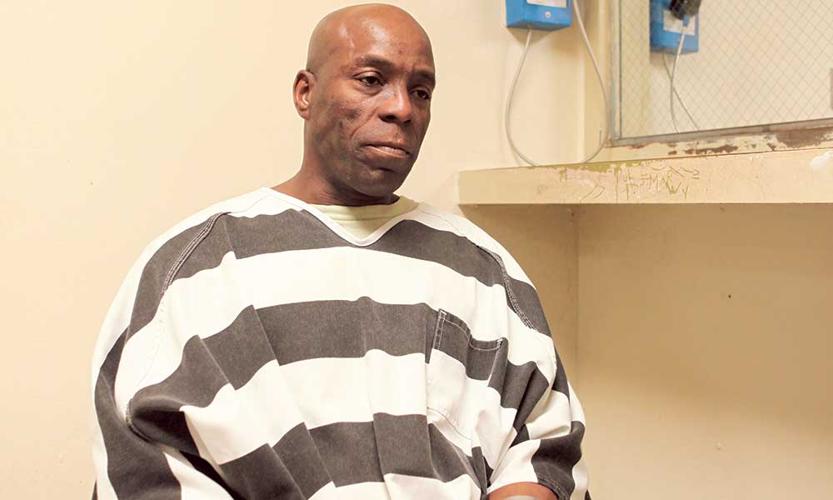
James Russell Scott, a long term prisoner, isn’t impressed by medical services in the jail. Inmates are often prescribed aspirin, even for more serious ills, he says.
In the jail I meet James Russell Scott, an inmate who’s about halfway through a seven-year jail sentence for drug violations. With good behavior, he only has to serve about half the full sentence.
“I’m really disappointed with the medical services here,” he says. “It seems like their remedy for everything is aspirin or ‘See me tomorrow.’”
The lawsuit mentions one case in which a patient was “provided with only ibuprofen to manage severe and mobility-impairing pain.” Scott says one guy he knows broke his hand and it was a week before he was sent to the hospital.
If inmates do want medical care, Scott says, the best bet is to call their lawyer.
“I’ve been practicing for 38 years. I’ve been in that jail hundreds, if not thousands of times,” says Miguel Hernandez, a Salinas criminal defense attorney. “In those years I’ve had clients complain they’re sick over and over again.”
Hernandez says he’s had to go to the jail’s head doctor, Taylor Fithian, who he’s known professionally for decades, dozens of times to ensure his clients are treated.
The attorney, though, defends Fithian: “I’d never accuse him of not treating or undertreating inmates who need medical attention.” Nevertheless, he acknowledges there’s a problem somewhere.
The lawsuit, 107 pages long, has dozens of examples of alleged inadequacies: There doesn’t seem to be a policy for maintaining records of sick slips; staff isn’t trained to provide adequate and timely care; inmates don’t get treatment because CFMG says they’ll soon be released or transferred; medical facilities are so small, care has to be provided in the hallway.
Hernandez sums it up: “The system seems horrific. I’ve never had this problem in other counties or jails.”
• • •
California Forensic Medical Group is headquartered on Monterey’s Garden Road, a stretch of office complexes near the airport. It’s on the first floor of a boxy building with wide, empty hallways.
CFMG was founded two decades ago by Fithian and Elaine and Dan Hustedt, who all still manage it.
None of them returned my calls. I dropped by the office, but a receptionist said they were all in a meeting.
According to its website, CFMG has served six counties – including Monterey County – for more than two decades, and 14 counties for more than a decade.
Monterey County’s current contract runs from 2012 to 2015. The county pays the company at least $4.8 million annually, in addition to $4.02 each day for each prisoner exceeding a population of 1,065.
The website also says the company has voluntarily gone through 102 successful accreditation processes for adult jails through the Institute of Medical Quality (IMQ), a nonprofit subsidiary of the California Medical Association. That gives it the most IMQ accredited programs in the state, though – according to a comparison of IMQ’s website and CFMG’s website – just 18 of the 65 facilities CFMG contracts with are currently accredited.
The Monterey jail was recently accredited by IMQ, but the two-year accreditation expired in 2011. The outdated IMQ certification plaque hangs prominently in the jail’s lobby. CFMG contacted the accreditation agency in 2013 to request a re-accreditation survey.
Over the past decade, California has been in serious trouble over how it handles medical and mental health care in correctional facilities. Lawsuits about the care of inmates in state prisons led to the massive reforms that are now forcing jam-packed prisons to uncrowd.
In 2005, state prison medical care was put under the supervision of a court-appointed receiver because, the court found, the system was “broken beyond repair” causing “an unconscionable degree of suffering and death.”
That was under a government-run system. But states with privatized health-care operations have also come under scrutiny. One report from an Arizona advocacy group says 50 Arizona prisoners died in the first eight months of 2013 – soon after the state’s prison health care system was privatized. That’s compared to 37 deaths in the previous two years.
Egar, Monterey County’s public defender, says whether care is county-run or contracted, the responsibility remains: “However the county wants to do it, it [has to] be done at an adequate level.”
• • •
Sheriff Scott Miller has a different view: Things are getting better. In terms of staffing and overcrowding, he has a point.
He wouldn’t speak about the lawsuit because it’s still ongoing, but he did talk about several of the issues surrounding it.
For one, he says, the Sheriff’s Office has hired – or is in the process of hiring – more than 60 staff members. One of those new positions is an ombudsman, a middleman between inmates and administration, including CFMG.
The position, Miller says, will ensure inmates have a voice and that their grievances are “given proper weight.”
The jail has also reduced its population. They’ve been running with less than 1,000 inmates since October, according Sheriff’s Commander Jim Bass. That addresses one issue in the lawsuit: an excessive number of inmates, which compromises the health of everyone, including staff.
“When I took over as sheriff the average daily inmate population was running above 1,200,” Miller says. “With the steps we’ve taken it’s running in the low 900s.”
In February, the jail got $89 million to build a facility to house up to 576 additional inmates. It’s on track to be completed in 2018.
“By the end of the year,” Miller says, “we should be good in terms of staffing and population.”

Windows of the Monterey County Jail have been vandalized with spitballs by bored inmates.
That means at least some of the lawsuit’s claims might be resolved. The jail and CFMG are working with the Public Defender’s Office to figure out a solution without going to trial. But either way, says Egar, change is going to come. Talks, so far, haven’t been successful.
“Whether we have to do it the hard way, through litigation, or the easy and less costly way through agreement, we won’t stop,” he says.
• • •
Three high-profile inmates, including Parenti, have died in the jail’s custody in the past year. Some aren’t the most sympathetic characters. David Stevens was the subject of a nationwide manhunt; he was arrested in Salinas last May for allegedly making child pornography and sexually abusing a child in the garage of his Salinas home. Joshua Claypole was accused of stabbing a cab driver to death in an attack police called random and unprovoked.
The appalling nature of an inmate’s crime, defense attorney Hernandez suspects, is why some don’t get care in the first place. “My personal belief is that… if you have a compassionate, humane correctional officer on the front line, [an inmate] will get their treatment,” he says. “You get a guy who’s a skeptic – hard nosed, jaded, doesn’t give a rat’s ass – they’ll just shine [the inmate] on.”
Hernandez was the attorney for Stevens, who died Jan. 23. Stevens, 59, told Hernandez he put in several sick slips without being seen. The coroner’s report, though, says Stevens was seen for a pre-existing condition, Hernandez says.
Comments on local news stories reveal how the public felt when his death was announced: “Now this is extreme karma,” wrote one commenter on the KSBW website. “Good riddance.” “I am so angry that this pig got the easy way out!” writes another. “The families did not get justice!”
The other case is that of Claypole, the 20-year-old Big Sur man accused of killing cab driver Daniel Huerta in Monterey.
When Claypole died, his attorney, John Klopfenstein, said CFMG evaluated Claypole’s mental state and then allowed him to go into the jail’s general population. He was put in a single cell, but didn’t get increased monitoring. He was found hanging from torn bedding tied to a vent.
Claypole’s mother and Amy Parenti have both retained the services of Lori Rifkin, an Oakland-based civil rights attorney, for possible litigation.
Despite the horrific nature of some inmates’ offenses, officials say proper treatment is crucial. The sheriff has a story that brings him a little closer than most to the subject: His son, Jacob Miller, is currently incarcerated on drug charges.
“I can personalize what kind of treatment we provide to inmates,” Miller says. “I speak with him on the phone almost every day.”
He says jails aren’t meant to release people in worse shape than they came in: “We know they’ll be back if they’re not better than they were – if we haven’t managed to make any kind of connection and meet minimal requirements as human beings.”
The lawsuit asks for 16 things, including ensuring medical staff is properly trained, prisoners get timely medical care and appropriate suicide prevention practices are in place. The parties were set to make intial appearances in federal court April 8.
“This doesn’t mean discussions will not continue,” says Egar. “It’s my hope that discussions with the county and CFMG will result in specific and enforceable remedies. But thus far we have not reached that point.”
(0) comments
Welcome to the discussion.
Log In
Keep it Clean. Please avoid obscene, vulgar, lewd, racist or sexually-oriented language.
PLEASE TURN OFF YOUR CAPS LOCK.
Don't Threaten. Threats of harming another person will not be tolerated.
Be Truthful. Don't knowingly lie about anyone or anything.
Be Nice. No racism, sexism or any sort of -ism that is degrading to another person.
Be Proactive. Use the 'Report' link on each comment to let us know of abusive posts.
Share with Us. We'd love to hear eyewitness accounts, the history behind an article.