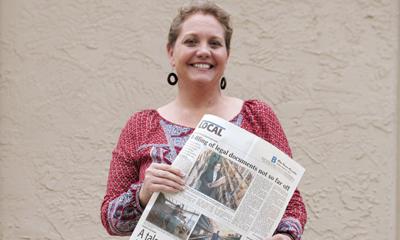
Sam Robinson, Ph.D. grew up the daughter of a Kansas farmer and spent summers moving cattle, hauling hay and planting wheat. As she got older, she yearned to do something different.
“For so long I was trying to distance myself from being this farm kid,” she says. “I didn’t want to be perceived like a hick.”
It wasn’t until later that she learned just how fundamental farming was to her: Today she’s an investigative reporter fascinated by the political economy of agriculture. But first she was a stay-at-home mom who spotted an ad to work for the local newspaper and soon found herself on staff selling ads. When she identified a need for a weekly paper in her area, she left to start her own – without having taken a single class in journalism.
By the time she had purchased and managed her second newspaper for two years, she figured it might be time to take some classes. Those classes turned into a doctorate in mass communications and media arts from Southern Illinois University.
After graduation and several articles for the Midwestern Center for Investigative Reporting were under her belt, she and her two children picked up and moved to Marina, where she is now a full-time professor of journalism and media studies at CSU Monterey Bay.
~ ~ ~
When did you decide to focus on agriculture as a journalist?
I was struggling to find a topic for my dissertation when my professor noticed talking about agriculture is what lit me up. My dad was a farmer and our family lived through the farm financial crisis of the ’80s. It really hit the Midwest hard and the people affected were not covered well by the media. My dad died before I moved into this phase of my life and he is with me every word I write. I know all the facts about agriculture and I love rural media so I decided to blend the two. Once I did, I was like, why wasn’t I doing this all along?
What trends do you see happening in agriculture today?
Agriculture producers are at a record low between the ages of 34 and 44. As farmers start to retire, the age gap will play a large role in the industry. Next-generation farmers and new farmers are important to recruit. But there needs to be more equitable access to resources. Today, 98 to 99 percent of farm owners in the U.S. are white men. How can we open that up to create a more diverse community?
What discoveries are most helpful to everyday eaters?
Learning nuances and vocabulary within agriculture is important. If you see something that says “natural” or “fresh” on packaging, it doesn’t really mean anything. Poop is “natural.” Poop is “fresh.” But we wouldn’t want to eat it, would we? Salmonella can be natural and it can be fresh but you don’t want to eat it. “Organic” means a three-year licensing process with the U.S. Department of Agriculture. “Cage-free” just means the chickens are not in cages, they can still be packed as densely and the building can still be completely enclosed. “Free-range” usually means the chickens have exposure to the outdoors. But if the chickens are getting antibiotics or feed grown with conventional herbicide, the meat and eggs are not organic. You can have organic chickens that are caged. You just have to know what you’re looking for.
Is there anything you won’t eat now?
I don’t eat cantaloupe much anymore. Unless it’s handled properly, it has a high risk of having listeria or salmonella. Listeria is a bacteria that thrives in a cold, dark environment so refrigeration makes it worse; that’s the danger.
How does your research affect you as a parent?
My son is 17 and my daughter is 15. I think I drive them crazy [laughs]. They are probably the only two high school kids who have been subjected to discussions about the political economy of soybeans. I’ve also written a lot of articles about salmonella. Now that I know how prevalent it is, my kids joke that in the store I’m like, “Don’t touch this!” and “Don’t touch that!”
What would your last meal be?
[Laughs.] I would probably have some grilled chicken, asparagus, my daughter’s chocolate chip cookies and cantaloupe because at that point it wouldn’t matter if it had listeria or not.
(0) comments
Welcome to the discussion.
Log In
Keep it Clean. Please avoid obscene, vulgar, lewd, racist or sexually-oriented language.
PLEASE TURN OFF YOUR CAPS LOCK.
Don't Threaten. Threats of harming another person will not be tolerated.
Be Truthful. Don't knowingly lie about anyone or anything.
Be Nice. No racism, sexism or any sort of -ism that is degrading to another person.
Be Proactive. Use the 'Report' link on each comment to let us know of abusive posts.
Share with Us. We'd love to hear eyewitness accounts, the history behind an article.