

In 2008, it was a pain in the ass to register for classes at CSU Monterey Bay. The website was clunky and hard to search, and the university knew it because students kept complaining about it.
Then red-and-black flyers with sharp, angular lines starting popping up around campus, that said, “It’s a revolution for your schedule.” The flyers guided students to a non-CSUMB website – ABetterSchedule.com – to register.
Turned out the rogue site was built by Kevin Miller, then a lowly office assistant in the social sciences department. He had no formal training in computer programming, but dusted off skills he’d taught himself as a teenager to build the site, with information he ripped from the legit (but mediocre) version.
Two days later, Miller got a phone call from CSUMB’s Chief Information Officer, Chip Leno, and Tech Support Services Lead Greg Pool. “They were like, ‘We want to take you out to lunch,’” Miller recalls. “I was like, ‘I’m either going to get a job, or I’m going to get in deep shit.’”
In the car, Pool turned around and told Miller they had a job opening – and they wanted him.
“He never bothered to ask permission,” Pool says of Miller’s scheduling site. “He was very bold and brash, and just did it himself.”
Now a veteran of the school’s IT Department, Miller’s ethos hasn’t changed. But his potential to change the way the Internet works has grown immensely.
Miller, a slight, scruffy, cardigan-wearing 33-year-old, has gone from programming better course scheduling to programming how the Internet works for people who are disabled, including the blind and those with limited motor skills.
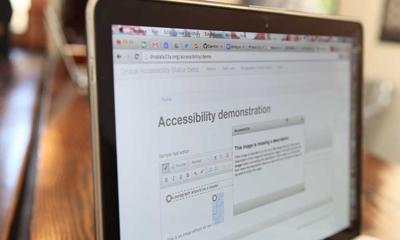
It’s a complicated process, but essentially, Miller’s programs can help the blind and vision-impaired “see” pictures and icons by making sure images are properly tagged and can speak to a user. Other aspects make sure those prone to seizure disorders aren’t exposed to rapidly blinking lights that might cause seizures to occur – a feature that I would later find out was born out of a personal tragedy.
When Miller started college in 1998 at CSUMB, the dot-com bubble was expanding, but he wanted no part of it. The self-taught programmer took one computer class, but it didn’t feel right.
“WEB ACCESSIBILITY IS A LEGAL OBLIGATION AND A MORAL RESPONSIBILITY. WHEN YOU DON’T DO IT, IT MAKES THE LIVES OF OTHER PEOPLE MORE DIFFICULT.”
“By the time I got to college, I got jaded and I didn’t want to do computer programming anymore,” Miller says. “It was a combination of being more socially aware, and having a lot of friends in social justice, and not being able to conflate that with the programming world. At the time, it was the domain of a very specific kind of person.”
He was the kind of guy who went to Seattle to protest the World Trade Organization in 1999. He was arrested in 2000 in Los Angeles during a critical mass bike ride. He didn’t eat for his three days in L.A. County Jail – he’s a strict vegan and there were no vegan options – and he was so fatigued upon his release that he was hospitalized.
Over the years, Miller found a way to weave his social justice perspective in with his tech skills. His motivation now, as it was then when he was designing the scheduling site – is making the Internet more helpful to people. The new software he’s developed has the potential to be worth a ton of money – though the social justice-minded hacktivist might never see any cash for his efforts.
But that’s part of Miller’s guiding principle.
“If someone else takes this, and makes an awesome product that further advances that goal of [web] accessibility,” Miller says, “I would be more than fine with that, as long as it was done in a collaborative way.
“If I don’t make a dime off it, that’s fine.”
And it’s quite possible he’ll never see a cent. Miller’s software might be better, but he received what he perceived to be a thinly veiled threat from someone at a conference where Miller was talking about his work. The person didn’t identify himself before commenting and walking away.
“Just to let you know,” that anonymous someone said, “we have a patent on this.”
< >
Miller can date his first professional foray into computer programming thanks to the OJ Simpson trial. That was the summer of 1995 before the Atascadero native started high school; he got hired through a family friend to help write printer command software for a law office, enabling them to print official seals on their letterhead.
“I was getting paid under the table for less than minimum wage, but at the time I didn’t care,” Miller says.
He then went to work for the Atascadero Unified School District, where his parents were both teachers, and helped create the district website.
After graduating from CSUMB in 2003 with a history degree, he worked a string of jobs – farming in Hawaii, selling fresh pasta at farmers markets, baking pastries at Sweet Elena’s – before landing an office assistant gig at CSUMB.
A convoluted career path isn’t uncommon for the CSUMB IT department, a melting pot of creative types.
“Very few of us have degrees in our field, because there were no degrees in our field,” says Pool, who hired Miller. “Kevin’s a historian, I’m a geologist, [one team member] is an MFA.
“That means Kevin can walk in pretty fearless, and look at a situation very creatively. Rather than, ‘I was trained this way, I can only look at things this way.’”
That fearlessness helped Miller tackle a question that was gaining national attention: Do rules about accessibility – and that includes everything from wheelchair-friendly restrooms and elevators in public buildings – also include the Internet? The landmark 1973 Americans With Disabilities Act was written well before the Internet as we know it existed, but even when the net went mainstream, accessibility wasn’t at the forefront of anyone’s mind.
That changed for the CSU system in 2008, after Congress amended the Rehabilitation Act of 1973 to clarify the civil rights of people with disabilities. That came 10 years after another amendment, which requires federal agencies to make their web materials accessible to people with disabilities.
A software scramble began to meet those federal amendments and Miller set out to develop his own solution.
He’s an unlikely tech hero, considering his low-tech, DIY taste: Miller doesn’t have a car, and commutes by scooter or bike; he listens to records; he knits his own mittens.
The updates to U.S. policy for Internet accessibility came out after Miller saw firsthand why it mattered. First, in 2006, he was subletting a room from a legally blind college student who jury-rigged an overhead projector with a magnifying glass to read books. Much of her coursework at CSUMB was online, and she routinely asked Miller to help her click on the login and submit buttons.
And a year later came the tragedy. In 2007, Miller’s younger brother died suddenly after he suffered a seizure while playing a video game. Although there’s no way to know for sure what killed the 25-year-old, flickering lights can trigger seizures in photosensitive people.
The backdrop of frustration and loss helped Miller see why accessibility was about more than just regulatory compliance.
“When we started writing guides to accessibility for the campus, I added, ‘web accessibility is a legal obligation and a moral responsibility.’ When you don’t do it, it makes the lives of other people more difficult,” Miller says. “It’s a responsibility to another human being.”
Losing his brother to a seizure and living with a blind student (disclosure: Miller also became my housemate after I started researching this story) helped set the stage for Miller to apply his nerdy side to a social justice cause.
He started building accessibility software called Quail, mostly on his own time. He’d set up in his CSUMB apartment with his Pomeranian mix, Kogepan, perched on his lap next to his laptop.
He built something functional, but stopped actively working on Quail for a few years. He put it aside and moved on to other things.
Then happenstance met luck. At a 2012 convention in Denver – DrupalCon (for developers who use the Drupal platform, which powers more than 670,000 websites worldwide) – Miller attended a talk by Jesse Beach, a developer who works for Acquia, a venture-capital-backed, Boston-based software company.
Beach had recently had her own epiphany at a tech conference in Toronto, where she realized blind programmers in the group couldn’t access any of the beautiful pages she’d been building. The pages didn’t speak to such users in the right way.
“I suddenly felt my assumptions about who was using this code melt away,” Beach says. “I saw the bigger picture of people who want to read a website, fill out a form, or register a vehicle.”
Sitting at DrupalCon, Miller listened as Beach described an accessibility tool that could solve those problems. It was Quail. He approached her after her talk. “I went up and was like, ‘That’s me, and I would love to restart it.”
On the two-day train ride home from Denver, Miller created a fresh blueprint for Quail. It’s licensed as open source, meaning no one actually owns Quail; software developers anywhere can fine-tune the code, and then users anywhere can build it into their websites for free.
Now Acquia, along with the Quality Institute Dutch Municipalities (the agency that manages websites for the government of the Netherlands), have taken the lead on getting Quail perfected. Quail will be integrated into Drupal version 7, meaning all websites built with Drupal – which include powerhouses like whitehouse.gov and energy.gov – will have Quail built in for accessibility when they upgrade from the current version.
That means Miller’s work will instantly become the blueprint for hundreds of thousands of high-profile sites.
< >
Unless you’re a programmer, computer code reads like gibberish. Quail is made up of lines like “id=”qunit-testrunner-toolbar.”
It’s named for the bird, though Miller decided it should stand for something only after naming it: Quail Accessibility Information Library.
“That was just me torturing an acronym out of a cute animal,” he says.
For anyone who posts content on a website – say a CSUMB department chair who’s trying to attract high school seniors to apply for admission, or a shop owner posting latest sales – Quail can come into play.
Think of the red squiggly underlines spell-check provides, drawing the eye to possible mistakes. Quail does the same for what are called accessibility errors. Examples: If a photo isn’t properly labeled so a blind person can interpret it if the webpage is being read aloud to them. Or if something flashes more than three times per second – which can cause seizures. Quail will highlight those mistakes and suggest how to fix them.
That helps when a user tries to register for classes or enroll in health insurance, but can’t use a mouse or see colors. (Miller’s assessment of the Weekly’s site: “Overall, you’re pretty good,” he says, though our photos aren’t properly labeled to make sense to a blind user.)
Cheryl Pruitt is director of the Accessible Technology Initiative for the CSU Chancellor’s Office. She says it remains a challenge to build in up-front accessibility for all 23 campuses before content goes live, rather than auditing what’s already posted after the fact.
Miller isn’t the only one making accessibility software. In 2010, all but two CSU campuses signed on to a contract with HiSoftware, a New Hampshire-based firm, to test their web content to see if it meets basic accessibility guidelines. (San Francisco State opted out, and so did CSUMB “because we have Kevin,” Pool says.)
“It’s not a trivial task to do what Kevin did. It’s fairly complicated,” Pruitt says.
“IF I FORM A COMPANY, I COULD GET RANDOMLY SUED. IT’S JUST PART OF THE LANDSCAPE.”
But the complicated idea is supposed to make things simple for the masses: Anyone should be able to post accessible content without getting bogged down in the technical world of web accessibility guidelines, a set of 300 or so standards.
“For accessible content, there’s a set of rules you need to know. Most people don’t know those rules,” Pruitt says. “If the tool knows the rules, it becomes easy… without worrying about what the rules are.
“That is the intent of Quail, and it is working.”
< >
There are important reasons why it matters that Quail is working. There’s the moral dimension that motivates Miller – making the web safer and fairer – but there’s also litigation.
The National Federation of the Blind has actively filed complaints and lawsuits on behalf of its blind members for about a decade. Most recently, they declared victory when the University of Montana and the U.S. Department of Education announced an agreement in March, under which the university will create and enforce comprehensive web accessibility guidelines to ensure blind students can keep up with homework assignments.

CSUMB will become the first higher-ed institution to integrate the newest version of Quail into its website, with a redesign that launches this summer.
The U.S. Department of Justice has taken note, joining in notable lawsuits, like the Federation’s successful legal challenge to H&R Block.
The Federation is also lobbying Congress for a bigger across-the-board fix, with an eye toward legislation. There’s bipartisan support for the TEACH Act, which would codify accessibility rules for higher-ed institutions.
All of this means demand, whether driven by compliance or morality, is likely to increase. That means if there’s a way to make money on Quail, Miller might be well-positioned to cash in.
Mark Driver, research vice president at Gartner, a major tech research and advisory firm, sees big potential for Quail.
“I could see several hundred million dollars worth of revenue for this kind of thing,” he says. “I don’t have a number, but it’s real money.”
Especially for someone like Miller, who’s accustomed to making his own pasta from scratch.
The low end of revenue for a small software company that develops a pay-for service on top of an open-source tool, Driver says, is likely to run about $5-10 million. The money could come from selling an additional feature – like an auditing tool to accompany Quail, which would stay free – or selling a souped-up version with help-desk support to an existing firm, like Acquia.
“The problem is walking that fine line between giving enough away through the open-source channels that you create a true community through critical mass,” he says, “and not giving so much away that there’s enough revenue on the table to go after.”
< >
United States patent number 7,536,641 doesn’t look like much at first. It was registered in 2009 by Palo Alto-based Ephox Corporation for its “web page authoring tool,” part of the infrastructure of popular sites like Facebook.
The patent employs a hypothetical dining establishment called “Campus Cafe” and a hypothetical owner posting daily specials to illustrate how the software is unique in letting anyone post information to the Internet. “The owner has no experience with the HTML language,” the patent states. “Nor does he have any knowledge about the infrastructure of the Internet.”
But Ephox’s tool, called EditLive, allows such users to post content – complete with squiggly red underlines indicating what might not be accessible to users with disabilities.
Miller knows Quail doesn’t do something entirely novel – it just does it more thoroughly, and better, than existing technologies. “There are pre-existing examples,” he says. “It’s not the cotton gin.
“Quail itself has the ability to be very disruptive to the many companies that provide subpar technology and charge a lot of money for it,” Miller says.
That’s because Quail itself costs nothing. That could change if he launches a business – and where there’s money in tech, there’s often a patent troll lurking.
Those are large companies that register patents for broad technological ideas, then sue when upstart developers actually try and create a business. It’s a situation in the tech world that’s gotten the ear of Congress. There are questions about whether the U.S. patent system – designed to encourage innovation – actually stifles innovation.
Miller presents regularly at the annual International Technology and Persons with Disabilities Conference, hosted by the CSU Northridge’s Center on Disabilities. After he presented on Quail last year, he recounts the unsettling conversation that took place after he got off stage.
That’s when someone wearing a suit approached him to casually reference their existing patent. It wasn’t someone Miller recognized, and no menacing lawyer letter ever followed. The anonymous someone never identified himself, and Miller’s not sure who it was or what company they were from. He’s had far friendlier conversations with other big players, like Ephox.
“A couple years ago, we were talking to Cal State University as a whole about having our product at low cost or no cost in agreement for having them help us build for Drupal or other projects,” Ephox sales rep Jon Hart says.
Still, the specter of a patent lawsuit looms. “There are patents out there that are so broad, they could apply to any technology. There’s no escaping that, and it’s unfortunately part of the industry,” Miller says.
“If I form a company, I could get randomly sued by any sort of patent troll, period. It’s just part of the landscape,” he says. “I’d rather just focus on making great product and delivering it to people.”
Miller is considering launching a business entity that could capitalize on some accessibility features. Specifically, it would run reports on the effectiveness of accessibility features, helping webmasters audit themselves. (Keeping the cute birds in the title, the business would be called Covey, meaning a flock of quail.)
He’s planning to enter Covey, an auditing tool for accessibility, in the Startup Challenge next year, hosted by CSUMB’s Small Business Development Center.
He’s hopeful that because a sizable chunk of Quail was written as part of his job at a public university, he might be protected from patent lawsuits as a government employee, but it’s hard to say.
For now, his focus remains on open-source work. While there’s big business potential and big money looming in the background, Miller’s more interested in making information available than securing a slice of the pie for himself by acting as the quiet architect of a more equitable Internet.
(0) comments
Welcome to the discussion.
Log In
Keep it Clean. Please avoid obscene, vulgar, lewd, racist or sexually-oriented language.
PLEASE TURN OFF YOUR CAPS LOCK.
Don't Threaten. Threats of harming another person will not be tolerated.
Be Truthful. Don't knowingly lie about anyone or anything.
Be Nice. No racism, sexism or any sort of -ism that is degrading to another person.
Be Proactive. Use the 'Report' link on each comment to let us know of abusive posts.
Share with Us. We'd love to hear eyewitness accounts, the history behind an article.