

Some families pass down heirlooms. Others pass down first names. The Westons pass down photography – or rather, an eye for photography.
That’s Weston as in Edward Weston, the acclaimed 20th century photographer. He, like his friend Ansel Adams, was famous for his crisp black and white images and a knack for transforming ordinary objects into sensuous mysteries. One of his most famous works is a photo of a pepper, gnarled and twisted as if shriveling into itself. The image is strikingly – or perturbingly – human. Another, a 1927 picture of a smooth and curvaceous shell, may well be described as erotic. “Nautilus,” as it’s called, sold in a New York auction for more than $1 million. His work ranged from still lifes to nudes, and many were taken in Point Lobos near his cabin, where his family still lives.
“Edward Weston’s legacy cannot be underestimated,” says photographer Huntington Witherill, who studied under Edward Weston’s son, Brett, as well as Adams. “He, together with a few other photographers in this area, established what’s known as the West Coast school of photography, which is known worldwide.”
Three subsequent generations of Westons have carried on the master’s photographic legacy, each traveling afield of Edward’s work to cultivate their own unique styles. Now the work can be seen as one. An exhibit of four Weston photographers’ black and white images will be shown at the Steinbeck Center from March 29 to May 31, along with the work of student winners of the annual Weston Scholarship.
The photographers featured are Edward Weston; Brett Weston; Kim Weston, son of Cole Weston (Brett’s brother); and Zach Weston, Kim’s son and a budding photographer.
“In one section of the exhibit, all four generations are put together,” Kim says. “We mixed it up. That’s pretty unusual. Galleries don’t do that.”
I meet Kim at Edward Weston’s cabin, where Kim has a studio and lives with his family. Kim, whose shining, ruddy face is set off by a crop of spiky bleached hair, wears a black shirt and plain blue jeans.
“This house is pretty famous for people who know photography,” he says, leading me through the squat, one-story building hidden in the woods off Highway 1. “It’s sort of like Mecca to them.”
Much of the home is preserved as Edward Weston had it. There’s the ancient wood desk where he worked, and a bookcase full of dusty hardbacks. On the glass door of the case, scrawled on a piece of paper is a note: “I do not lend books to my friends. I do not want to lose my books, or my friends. E.W.” That same note can be seen in old photos of the inside of the house.
On the walls are prints of Edward Weston’s photographs by Kim’s father Cole. Cole, Kim explains, was also a photographer, but won’t be included in the gallery because he worked primarily in color.
In the back there’s a tiny darkroom where Kim often brings his photography students. It’s filled with outdated tools, metal trays and big glass jugs that used to contain developing chemicals.
Then he takes me to a room in another building where he’s selected prints from each generation to show the evolution of Weston work. We start with Edward’s.
Edward’s photography in the early 1920s, Kim says, was theatrical and moody – the images a bit soft and out of focus, as was the style at that time. All that changed when he moved to Mexico, where he started experimenting with a new technique. The result was clear, sharp pictures, often images from everyday life. The range of work – cars, rocks, skies, buildings, vegetables – is tied together by high detail and rich texture.
His son Brett, though, developed a totally different style.
“This was his favorite type of work,” Kim says, lifting a print. It’s difficult to make out exactly what it is, other than an in-your-face shot of some littered objects.
“This is real simple,” Kim says. “It’s pine needles in the snow. Where Edward was more of a recorder – recording what he was seeing – Brett was an abstracter.”
He holds up another image: a close shot of a shredded building with gaping holes through the side.
“These are the things he really loved,” Kim says. “[He’s] using shape and lights and darks. He loved old abandoned buildings.”
Next up is Kim’s.
“I’m more of a storyteller,” Kim says. “For 30 years I worked in a studio.”
The first picture he shows me is of a girl in a ballerina costume lying on the floor. Above her is a cut-out horse that seems to be leaping through the air. The picture didn’t have any apparent meaning – the story is up to the viewer to discover.

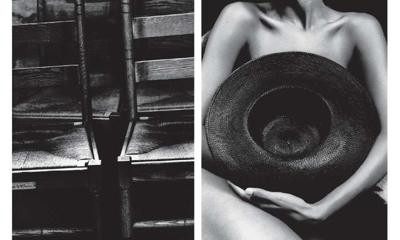
(L) “Cat in Hat” (2008) - Kim Weston (R) “Chairs” (2012) - Zach Weston
I recognized the horse from coming up the Westons’ driveway. The horse, now headless, had been creepily discarded outside.
Finally, we reach the youngest Weston. Zach, a 23-year-old California State University Monterey Bay senior, just got into photography a couple of years ago. His dad never pushed the art on him, he explains. He’s more into surfing. But after borrowing a camera to take a photo of a cat for his mother’s birthday, he grew more curious.
“I realized I really enjoyed it,” he says. “It was fun.”
Zach’s work, a mix of still life, nudes and landscapes, has a touch of his great-grandfather’s style, Kim says proudly. It also incorporates bits and pieces of previous generations. And it does catch the eye.
“His composition is flawless,” Kim says. “It’s really interesting that he is sort of a melting pot of all three of our styles.”
While photography certainly is an art, Zach doesn’t take an intensely artistic approach to it. He just likes doing it – and he hopes his audience gets something from it.
“Hopefully the work makes people think about what they’re looking at,” he says. “Stir up their own emotions and feelings.”
(0) comments
Welcome to the discussion.
Log In
Keep it Clean. Please avoid obscene, vulgar, lewd, racist or sexually-oriented language.
PLEASE TURN OFF YOUR CAPS LOCK.
Don't Threaten. Threats of harming another person will not be tolerated.
Be Truthful. Don't knowingly lie about anyone or anything.
Be Nice. No racism, sexism or any sort of -ism that is degrading to another person.
Be Proactive. Use the 'Report' link on each comment to let us know of abusive posts.
Share with Us. We'd love to hear eyewitness accounts, the history behind an article.