

The last time I saw Ed Leeper was at his home in Monterey. He died there Friday, March 21.
When I went by it was a sunny winter Saturday mild enough to slide open the door from his kitchen to the backyard – and its confluence of oaks, squirrels and “art” made from a collection of trophy fixtures, mannequin legs and rogue bolts.
I brought him a burger. He offered me a Heineken. We sat and sipped and ate. We talked about exploring Fort Ord, sailing to Mexico and staying sane.
That led to a project the former Army personnel officer wanted me to see.
He was always working on a project.
Unless he wasn’t, which made the self-titled “serial artist” a little crazy, and a little less alive.
That day he showed me three. He started by opening his office door to reveal a worldly and lived-in study that had been hammered by a cyclone of vintage art magazines.
Pages blanketed the floor, several layers of protest against – or celebration of – arts criticism. Some wedged into the cracks between the light and the ceiling; others landed in corners behind things.
The mess would madden many. “This kinda keeps my sanity,” he said.
He encouraged me to rip out pages from a stack of magazines. He told me some 17,000 individual pages had been thrown in the room, and invited me to toss a few hundred.
“On the way to 100,000,” he said.
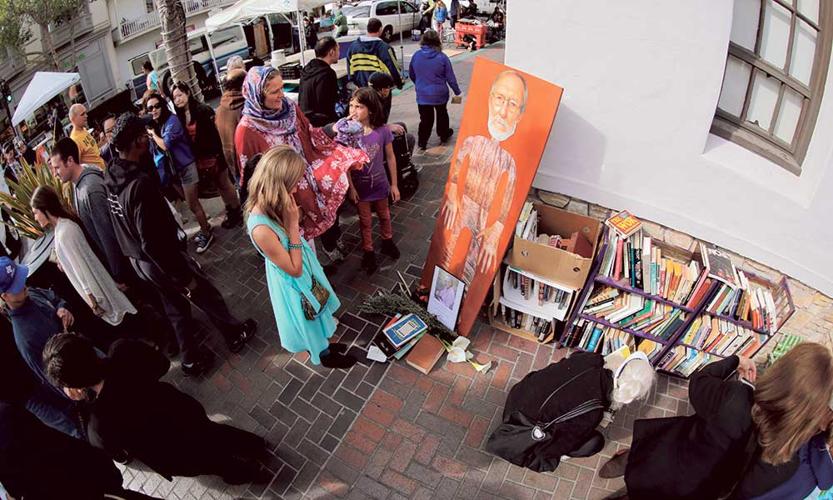
I recognized two of his techniques. One was ahead of its time: audience engagement. When he set up projects like his free mobile library “Liquid Books” at Tuesday farmers markets – and curious residents left with armfuls of literature and headfuls of conversation – he loved to say, “You just participated in an artwork.”
The other was his own form of Zen: transformation by repetition, purpose gained with process, joy in doing.
~ ~ ~
Leeper once put together a protest that planted 1,000 precisely-spaced individual crosses – which he personally cut and painted – into the grass at Window on the Bay, in recognition of the amount of American lives then lost in Iraq.
Another time he inscribed a 20-by-13-inch piece of heavy paper with 1,400 marks from a calligraphy pen, then did it again, and again, and again, until he had gone through 251 pens, stacked heavy papers well past 4 feet high and recorded 6 million marks, one for each of the Jews killed in the Holocaust. (View a slideshow and read the Weekly 2008 cover story at www.mcweekly.com/leeper.)
His work wasn’t always so serious. At one P.G. Art Center opening, he sat signing 1,000 certificates paying tribute to Thomas Kinkade: “In recognition of your service… promoting peace and stability for this Nation, the people of this Nation are forever grateful.” Another time he had 10 artists pee in a jar in which he pickled a portrait of Sen. Jesse Helms. He parked his old Toyota truck at conspicuous turnouts around Monterey Peninsula with big messages ranging from “Threat Level Normal” to “Pineapple Upside Down Cake” on its rack.

Leeper’s “Skin” replaced him alongside Liquid Books March 25. Below he poses for a 2008 cover reading “Ed Leeper,”A portrait of: ___ (pick one*) an innovator, an idiot, an artist, an eccentric. “
But whether his work was weighty or frivolous or literary, the reactions were consistent: questions and conversations.
I peppered him with both as we drove to the Last Chance Mercantile he loved, visited the land he called Hawk Shadow Military Sub-Station up Palo Colorado in Big Sur and grubbed pancakes with artists who met regularly at his place. I am close with his bright-yellow Chair of Awesomeness in the Weekly lobby, a handmade throne scrawled with hundreds of great thinkers’ names, won in an auction benefit. I paged through his dictionary-thick binders of “Other Works by Ed Leeper,” which included the time he read an entire Sunday New York Times, word by word, for more than 227 hours; counted out a half-ton of granite pebbles, 89,339 total; and wrote down every name from the 1959 set of Encyclopedia Britannica on the wall of his Hawk Shadow studio, some 14,794 names all told.
It all eventually boiled down to one question: Why?
He dodged that, saying much of his work doesn’t make sense, by design.
I figured his earliest and heaviest work, “6 Million” – which synchronized with him dragging and trucking stone and concrete weighing roughly 40 tons way up to Hawk Shadow for a monument to accompany the gray stack – would offer the clearest way to the why.
His first reply: “Why does anyone do anything?”
But he returned to the question later.
“I did it because it’s the best way to show people what 6 million is,” he says.
Show people he did, at colleges across the state. Then he added this: “I was taking something and turning it into something else.”
~ ~ ~
A big plastic tarantula crawls over a tube of generic denture cream, a heat-wrap compress and colorful layers of decorative do-dads. It seems to be heading toward a pink top hat, next to a rubber coin purse and a box of Hamburger Helper.
The scene is just a corner of project two from that sunny Saturday, a 5-foot-wide and surprisingly pink spread of limitless Dollar Store items. Leeper foraged and carefully affixed them in a pattern that’s both supernaturally bizarre and completely cohesive, turning a trunk full of bargain junk into a eye-catching cultural assemblage and a wind tunnel for questions: How can this fit? How did he pick these things? What would mine look like? How is that only $1? How can they charge $1 for that?! What does this say about us?
Across the room rested the third piece I’d see that Saturday. In “Skin,” Leeper’s youthful octogenarian face looks on from its place on a basic body cutout with disproportionately huge hands. But unlike the face and hands, the body is not ergonomically accurate. Instead it’s covered with a closeup photo of spotted and crinkled arm skin. Something feared – old age, wrinkles, decay – becomes something else: reality, identity, beauty, texture, mortality.
Leeper’s step daughter and fellow artist Kira Godbe discovered him next to “Skin” last Saturday. She came up the block to tell him how much he’d love The Grand Budapest Hotel, and found him in his favorite chair, legs crossed, eyes closed, head back, an article about late American painter Robert Rauschenberg, perhaps torn from the pages of an art magazine, in his hand.
He did two things the day he died. One, he had coffee with a friend. Two, he bought paint at the store for a project Godbe didn’t know he had going in the backyard. He left us the way he liked to live, the way he felt most alive, provoking questions, turning us into participants and turning himself into an art form, with another project in process.

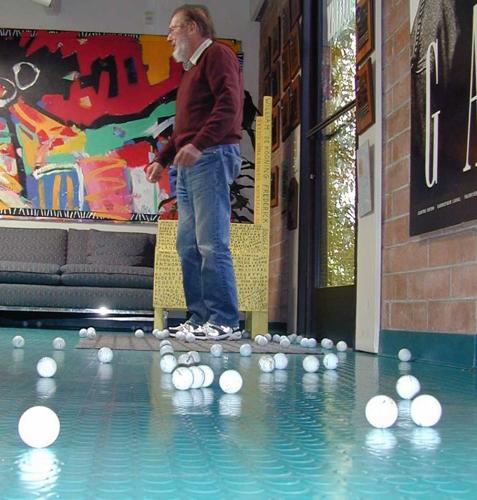
Ed Leeper's performance with golf balls in The Weekly's lobby in 2005.
(1) comment
Thank you for this article. I had forgotten some of the pieces you mentioned and it brought back memories. Ed did many projects and some of them I was lucky enough to collaborate on, with him. One project we thought up together; Crumpled Poetry. Even though he complained in the last few years that he was forgetting names he never forgot mine and would call me once in awhile up until the end.
I was very fortunate to videotape my last visit with him when he was throwing the Art in America's around -see youtube: Ed Leeper Throws Up. We had a lot in common artistically and were great friends because of it. My only regret is that I didn't create more with Ed (for my own conceits, not Ed's.)
My first Ed performance I attended was "Puke". Right after George W. Bush had gotten elected he held a performance at Morgan's coffee house (now East Village). He had a clock that was running backwards until GW was out of office. I was hooked!
Ed led a beautiful life including seeing every Cezanne in the U.S. with his lovely wife Elizabeth whom he never stopped missing many years after her death.
I am left with the urgent feeling that I must live a life as interesting as his in my old age.
Welcome to the discussion.
Log In
Keep it Clean. Please avoid obscene, vulgar, lewd, racist or sexually-oriented language.
PLEASE TURN OFF YOUR CAPS LOCK.
Don't Threaten. Threats of harming another person will not be tolerated.
Be Truthful. Don't knowingly lie about anyone or anything.
Be Nice. No racism, sexism or any sort of -ism that is degrading to another person.
Be Proactive. Use the 'Report' link on each comment to let us know of abusive posts.
Share with Us. We'd love to hear eyewitness accounts, the history behind an article.