Look at any Wes Anderson film and you’ll find a war story. In Rushmore, Max Fisher (Jason Schwartzman) brutally competes with Mr. Bloom (Bill Murray) for the affections of a certain female teacher, Rosemary Cross (Olivia Williams). Moonrise Kingdom shows how surprising consequences can emerge during the ongoing struggle between adolescence and adulthood. While not gushing with buckets of blood, each spills a few droplets to remind the viewer how fragile life can be.
It’s hard to fully consider Anderson’s darker inclinations because he buries them under such colorful and textural Easter eggs. But the violence has always been there – consider the long list of deceased pets that litter his canon. So, what do we make of The Grand Budapest Hotel, which may be Anderson’s first outright war film? Set in a fictional Eastern European country on the precipice of combat, this wonderfully manic fable pushes the nature of conflict (both individual and collective) to the forefront, almost uncomfortably so, within a rowdy triptych of storylines that fold over each other like an evolving cinematic origami.
It begins with a young woman marching through the snow in a public park, paying homage to the bust of a writer before sitting down to read his novel that shares the film’s title. From there, Anderson flashes back to 1985, when the enshrined author (Tom Wilkinson) discusses the labyrinthine nature of the story, only to be interrupted by his son, who nearly decapitates our narrator with a pellet gun. It won’t be the last time bullets whiz by a character’s head.
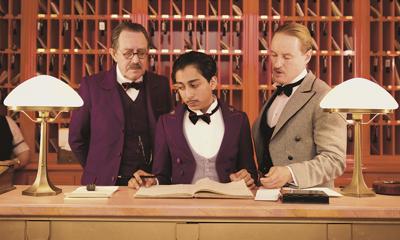
Once back on track, the older scribe recounts his 1968 journey to a downtrodden hotel in the country of Zubrowka. A grand palace of decadence long ago, The Grand Budapest is now in continuous disarray. The younger author (played by Jude Law) meets the hotel’s mysterious proprietor, Zero Mustafa (F. Murray Abraham), who then proceeds to confess his complicated origins over dinner. Set in 1932, this final narrative layer centers on the legendary hotel concierge M. Gustave (Ralph Fiennes), a slick and posh dandy who lords over young Zero’s (Tony Revolori) training as a lobby boy.
All of this unfolds at such an alarming rate that one would not be faulted for missing a detail here and there. The only other Anderson film that comes close to this kind of velocity isFantastic Mr. Fox, which has the advantage of being in stop- motion animation. Perhaps this makes The Grand Budapest Hotel an even nervier experiment. Anderson shoots each storyline in different aspect ratios, uses elaborate models and figurines for sets and marks key moments of the story with surprising bloodshed.
From all this chaos, Anderson seems to be finally grappling with the self-destructive nature of creativity. While never sloppy, Anderson constructs the film’s multiple plots to reveal the poetry of such stream of consciousness, the endless possibility of story.
The crazed adventures of Zero and Gustave M., which often occur in locations as diverse as the serpentine hallways of The Grand Budapest and the snowy Alps above, are always kept in check by the deep melancholy found in each narrator’s voice. This film may look, feel and sometimes sound like a powdery screwball fantasy, but it’s a requiem for many things: friendship, family and fortitude, just to name a few.
As the credits roll, Zero’s esteemed description of the aged hotel lingers most of all: “It’s an enchanting old ruin.” Anderson shares the same affection for the volatile nature of memory, which always seems defined by one kind of war or another.
The Grand Budapest Hotel (4) • Directed by Wes Anderson • Starring Ralph Fiennes, Tony Revolori, Saoirse Ronan, F. Murray Abraham • Rated R • 99 min. • At Osio Cinemas.
(0) comments
Welcome to the discussion.
Log In
Keep it Clean. Please avoid obscene, vulgar, lewd, racist or sexually-oriented language.
PLEASE TURN OFF YOUR CAPS LOCK.
Don't Threaten. Threats of harming another person will not be tolerated.
Be Truthful. Don't knowingly lie about anyone or anything.
Be Nice. No racism, sexism or any sort of -ism that is degrading to another person.
Be Proactive. Use the 'Report' link on each comment to let us know of abusive posts.
Share with Us. We'd love to hear eyewitness accounts, the history behind an article.