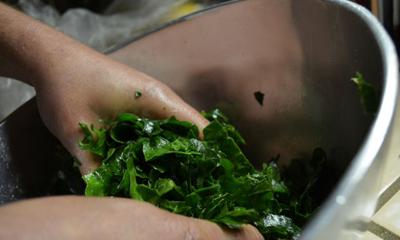
Given the great love many people have for kale, it seems appropriate that a massage turns out to be the best way to prepare it. A good rubdown can enhance the kale’s flavor as well as preserve its nutrient content.
Because lets face it, while kale is known as one of the world’s healthiest foods, when its virtues are enumerated, qualities like tenderness and sweetness aren’t usually emphasized. That’s why kale is usually cooked, as heat breaks down the plant’s cellular structure, tenderizing it, while turning complex carbohydrates into simple sugars, adding sweetness.
Increased edibility comes at a cost. As the bluish green of a living kale leaf fades into a navy shade of green, some fragile enzymes are killed. Live enzymes are known to be healthy in many ways, including as a digestive aid. A raw vegetable like kale is composed of cells that are still alive, enzymatically and other ways as well. Cooking kills the plant cells, destroying sensitive nutrients as well.
Massaging kale results in a compromise between raw and cooked, in which the best aspects of both methods are preserved. As you inflict manual loving trauma upon the kale leaves, the cellulose architecture of the cell walls is crushed. In this mayhem, some of those enzymes are released: Some go to work on the cell’s carbohydrate supplies, chopping them into simple sugars. As you rub, twist and knead the kale, it wilts down to a fraction of its former size.
By the end of this preparatory procedure you have a massaged kale that’s great in and of itself, but can also be a point of departure for the creation of many other salads.
Any kale will work. I like a mix of curly green kale and black kale, aka dino, aka Tuscan, aka Lacinato kale, aka the flat-leafed, extra dark kind. Wash the kale and shake it dry. Pull the leafy material off of each leaf’s stalk, and put the spineless leaves in a big mixing bowl.
Before I massage in earnest, sometimes I attack the de-stemmed kale pieces with scissors, snapping the sheets down to smaller pieces in haphazard fashion. One could also chop the leaves with a knife, or carefully sliver them with scissors. Or just rip it all to shreds with your bare hands.
The massage’s effect is enhanced by the application of salt, oil and citrus juice to the leaves. These ingredients help grind up the cell walls as they work their way into the leaves, establishing their flavor. Vinegar, while acidic, makes a serviceable substitute, flavor wise, for lime, lemon, orange or grapefruit, as long as it’s not overdone. And citrus, like kale, is coming into full season in winter. I like to use a mix of citrus, any one of which could be used alone except for orange, which isn’t bitter enough.
For a decent-sized bunch of kale, use about ¼ cup olive oil, a half-teaspoon of salt, and two tablespoons of citrus juice.
Mix these in, and proceed to squeeze, twist, wring, press, and maim the kale with your hands. The kale volume will shrink dramatically at first. By the time the kale is holding steady at about one fifth of the original volume or when it’s sufficiently beaten down to your liking, the massage can end.
You now have massaged kale, which you can start eating, or use as an ingredient in a more complex dish. After its massage, your kale is understandably loose, and ready to go in most any direction you wish to take it. But if you want to start eating, simply adjust the seasonings and go. I highly recommend toasted pumpkin seeds sprinkled on top.
As a salad, massaged kale goes well mixed with parsley (non-massaged), and the fiery pungency of raw garlic and onions. Cooked grains like quinoa or bulgur can be added. I like to toss in thin slices of blood orange, peel and all. The bitterness of the peel bridges the flavors of the bittersweet orange and the bitter-ish kale, while providing a juicy, colorful contrast. And despite the fact that massaging adds sweetness to kale, a little more is always welcome. Grapefruit chunks can also add bittersweet. Pomegranate is another fruit that makes a beautiful, delicious splash in massaged kale salad. A tablespoon or two of pomegranate molasses adds welcome tang and sweetness. Sweeter fruits like mango can be used, as can honey.
When your salad is assembled, taste and add more citrus or salt as necessary, and crush on some black pepper if you like.
Massaged kale can also be added to cooked food. Toss it on a hot dish and let it wilt, as is often done with spinach. Or toss it into a stir-fry at the last minute; it only needs to heat up, and can hang onto its raw, bright green color. You can also let massaged kale hang out in the fridge overnight, allowing it to soften and marinate.
In short, all of the many ways you have of enjoying your kale could be improved if you start by giving it a loving, tender massage. OK, it’s actually a rough, tenderizing massage. But let’s face it, kale responds well to tough love. So show your love is true with a good spanking. Then squeeze some acid on the wounds, and grind in some salt. It will be good for your relationship.
(0) comments
Welcome to the discussion.
Log In
Keep it Clean. Please avoid obscene, vulgar, lewd, racist or sexually-oriented language.
PLEASE TURN OFF YOUR CAPS LOCK.
Don't Threaten. Threats of harming another person will not be tolerated.
Be Truthful. Don't knowingly lie about anyone or anything.
Be Nice. No racism, sexism or any sort of -ism that is degrading to another person.
Be Proactive. Use the 'Report' link on each comment to let us know of abusive posts.
Share with Us. We'd love to hear eyewitness accounts, the history behind an article.