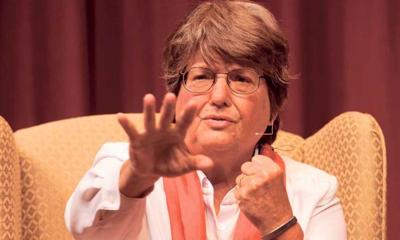

Read the full Q&A with Prejean here.
As the deadline for this story approached, I got a message from Sister Helen Prejean on my answering machine.
“Hey Arvin – Sister Helen Prejean. I’m coming to Monterey and I would love to speak with you at the Monterey Weekly. My whole life I’ve been waiting to speak with you at the Monterey Weekly!”
This was her response to my increasingly urgent messages regarding an interview. The playful voicemail made me laugh out loud. After all, just a few days earlier, she’d given an address at the Nobel Peace Prize Forum in Minnesota, where the Dalai Lama was also a noted speaker.
The message was my first non-Susan Sarandon (more on that later) insight into Prejean. She sounded kind and high-spirited, qualities that befit a woman in her line of work: She’s one of the country’s leading advocates against the death penalty. And she’s accompanied six people to their executions.
Prejean, who will speak at the Santa Catalina School March 20, is most well known for inspiring the 1995 film Dead Man Walking. The film got four Academy Award nominations and one win for Susan Sarandon’s epic depiction of the Catholic nun. Prejean’s book of the same title detailed her experience becoming the spiritual advisor to Patrick Sonnier, a man convicted in 1978 of raping a girl and murdering her and her boyfriend. During his term in Louisiana State Penitentiary Sonnier wrote to Prejean, who began visiting and counseling him; in 1984, she watched him die in the electric chair.
“Patrick Sonnier was strapped into the electric chair and I told him, ‘Look at my face when they do this,’” Prejean recalls. “I wanted him to have one face that saw his dignity when he was killed. That’s the transformative moment. I came out of that execution chamber – I didn’t know my whole life would change.”
After that, Prejean started campaigning to end the death penalty in the United States, one of a minority of countries that still practices execution. More than two-thirds of the world’s countries have abolished the death penalty, according to Amnesty International. In 2010 the U.S. had the strange distinction of being put on a list with the likes of China, Iran, North Korea and Yemen – the countries where most of the world’s executions took place that year.
According to the Death Penalty Information Center, 32 states allow the death penalty, including California.
“The Universal Declaration of Human Rights says everyone has the right to life. No one should be subject to cruel and degrading torture,” Prejean says. “Torture is intrinsic to taking the life of a human, no matter how humane you claim the method of killing is going to be. Humans have imaginations. Inside their minds they die a thousand times before they die.”
Prejean says her experiences have led her to believe that the death penalty is just that – state-approved torture. And the moral road of killing for justice can take strange twists.
“There was a case in Oklahoma where a guy was scheduled to be executed,” she says. “He took an overdose of pills and was unconscious. So they brought him to the hospital, pumped his stomach, and two weeks later the state killed him.”
Since California reinstated the death penalty in 1978, 63 death row inmates in the state have died from natural causes, 23 have committed suicide and 13 have been executed (another one was executed in Missouri). There are more than 700 on people California’s death row, giving the state the highest number of condemned inmates in the country.
Prejean is now working on her third book, River of Fire: My Spiritual Journey.
“It’s the… journey that led me to poor people and to death row,” she says. “My understanding of the gospel of Jesus deepened to more than being prayerful and being close to God. Rolling up my sleeves, getting involved where there’s human suffering and injustice and changing it – that what the journey’s about.”
The advocate hopes to inspire that same sense of critical contemplation among the young women of the Catholic school.
“I’m going to bring them into the story, bring them into the place of horror of two innocent teenagers getting killed. Stand with them in their outrage,” Prejean says. “Then I’m going to bring them over to what it means for the state to kill people. They’re not going to get any watered-down version. I’m going to bring them to both sides – I hope they go into deeper reflection.”
(0) comments
Welcome to the discussion.
Log In
Keep it Clean. Please avoid obscene, vulgar, lewd, racist or sexually-oriented language.
PLEASE TURN OFF YOUR CAPS LOCK.
Don't Threaten. Threats of harming another person will not be tolerated.
Be Truthful. Don't knowingly lie about anyone or anything.
Be Nice. No racism, sexism or any sort of -ism that is degrading to another person.
Be Proactive. Use the 'Report' link on each comment to let us know of abusive posts.
Share with Us. We'd love to hear eyewitness accounts, the history behind an article.