
Rollin Pickford, who died in 2010 at age 98, was as loved as he was prolific. He was also a curious and constant fixture on the Peninsula, as well as his hometown of Fresno, where his art was so influential he inspired the term “San Joaquin Valley School of Watercolor.”
His work will be a popular part of a new round of art shows Pacific Grove Art Center is preparing in time for this Friday’s Wine, Art & Music Walk, so visitors will see a nearly random medley of work throughout the night.
“We always have such selective groupings,” says Alana Puryear, executive director of the PGAC. “Our committee sometimes does shows with themes.”
That’s not the case with this Friday’s show, taking place in PGAC’s five galleries – which is not a knock, as it just means more surprises and juxtapositions.
Like that of photographer Joe Ravetz. His portfolio is as diverse as the work of five photographers who have never met, but there are themes that tie his series together, like people obscured by the blurred light of movement.
More variety comes from a place called Strouse and Strouse, a co-op gallery around the corner from PGAC made up of 17 artists.
“They wanted to do a really large group show,” Puyear says, “to combine a lot of the people they didn’t have the capacity to show all at once.”
The show called Poems to the Sea comprises another group effort, these folks ruminating on the local seascape, inspired by artist Cy Twombly. Like the similarly sized Carmel Art Association, PGAC is not afraid to fill their walls with a diversity and an abundance of names, but there are two solo shows worth reflecting on. One comes from Pickford. His PGAC solo show was curated by his daughter, Melissa Pickford, who is also the director of the Monterey Peninsula College Art Gallery (where they’re showing what looks to be a compelling solo show of Rose Sellery, 11am-4pm Tue-Fri until Feb. 28).
“It’s hard to find the words,” Melissa says when talking about her father. But that doesn’t last. “He was the most compassionate, wonderful, attentive father a young woman could dream of having.”
He did art for 85 years, honing his style to a Zen-like ethic of letting the water flow on the canvas where it wants to go. That led to a style that’s part plein air and part storybook, the colors of his native San Joaquin Valley and adopted Central Coast landscapes leaching into each other, manipulating light as if it were another color pigment.
“He was a true plein air artist,” she says. “He loved walking.”
His last show at PGAC was in 2007 and the community came out in force to show their admiration for the local fixture who ambled across the P.G. landscape with a straw hat, bucket and chair. Half his paintings sold then. For this Friday’s homage show (also the date of Melissa’s birthday), she’s assembled more than 30 paintings, mostly coastal, some soothing, some dynamic, and some family treasures not for sale. On March 22, she will return to show and talk about a PBS documentary her brother made on their father called Master of Light. Apparently there’s plenty to talk about.
“He was very slow moving, methodical, peaceful, but he was able to produce upwards of 30,000 watercolors, hundreds of oils, and 85 years of sketchbooks,” she says.
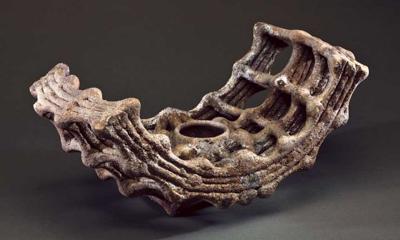
Andy Ruble is another artist showing solo work. His sculptures are infused with something like an obsession with Buckminster Fuller’s ideas on tensegrity, also called the “architecture of life.” (Fuller was an architect, futurist and theorist best known for his geodesic domes.)Ruble accomplishes a hybridization of organic structures (like bones and pollen) and architectural structures (like bridges and ships). The results are striking.
“Buckminster’s idea of using minimal material for maximum strength,” Ruble says. “I’ve always wanted to push the [sculptural] material as far as it will go.”
Another of his inspirations for this exploration comes from hearty desert life.
“The cholla cactus is all over the Southwest,” he says. “When dried out, it looks like a skeleton. It’s one of the strongest structures for its weight. You can step on it without damage.”
Clay sculptural pieces like “Structure with Appendage” and “Ritual Vessel 3,” suggest tensile strength while conceding to rust and deterioration. They reference Roman aqueducts but are useful as vessels only in that they carry Ruble’s ideas into the mind of the viewer.
It’s that kind of curious and investigative thinking that has translated into shows at Santa Cruz’s Felix Kulpa Gallery, teaching gigs at MPC and Foothill De-Anza, and awards from the California Clay Competition and the coveted $20,000 Rydell Visual Arts Fellowship. There are a dozen sculptures, which look like geometric lattices or skeletons bent into hammock or boat shapes. Tracing the origin of his ideas even further back, Ruble suggests: “My family has 500 acres on the back side of Mount Hamilton, and my sister and I would find bones and bring them back and reconstruct them into fantasy animals.”
Now that sounds like the seeds of a fascinating backstory.
(0) comments
Welcome to the discussion.
Log In
Keep it Clean. Please avoid obscene, vulgar, lewd, racist or sexually-oriented language.
PLEASE TURN OFF YOUR CAPS LOCK.
Don't Threaten. Threats of harming another person will not be tolerated.
Be Truthful. Don't knowingly lie about anyone or anything.
Be Nice. No racism, sexism or any sort of -ism that is degrading to another person.
Be Proactive. Use the 'Report' link on each comment to let us know of abusive posts.
Share with Us. We'd love to hear eyewitness accounts, the history behind an article.