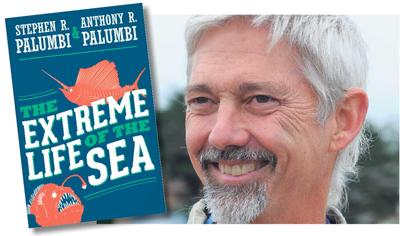
This friend of mine is a gifted crafter and fabulous cook, but I’d never describe her as the science type. So I was surprised when she settled into my couch with Stephen and Anthony Palumbi’s new The Extreme Life of the Sea.
“Dude,” she said. “I just read about rockfish older than the atomic bomb.”
Carbon-14 released by the 1954 hydrogen bomb test on Bikini Atoll etched a signature in deep-sea fishes’ ear bones, she explained, and that helped researchers figure out yellow-eye rockfish could live past 100, reproducing all the way.
My friend followed me into the kitchen, reciting more from a chapter on the sea’s oldest residents – like how scientists can calculate the ages of bowhead whales by the orientation of amino acids in their eyes. “That is so cool,” she said.
But when she got to a section about newly hatched sea turtles running for their lives toward the sea, her face scrunched up. “‘This is no sugar-coated scene from a Miley Cyrus movie,’” she read. “‘It is a macabre hybrid of the Battle of Dunkirk and the Katyn Massacre.’ What the hell? Now I don’t even care about the baby turtles.”
Her reaction hits on the strongest and weakest elements of Extreme Life. It’s easily digestible in small bites, celebrating the science fiction-worthy weirdness of the vast seas. The Palumbis avoid academic jargon, instead achieving a coffee-shop tone that infuses popular science with OMG freak facts and lots of metaphors.
Most of the comparisons – like describing the viral DNA coiled inside marine bacterial cells as “a plastic snake in a fake can of nuts” or relating a lobster’s caridoid escape reaction to the Looney Toons roadrunner dash – bring out the full flavor of the science. But where they are a little too precious, they distract.
Stephen Palumbi is director of Stanford University’s Hopkins Marine Station in Pacific Grove. Not only does he probe the secrets of whale DNA and climate-stressed coral reefs, he’s also a talented storyteller who helps produce a broad body of marine-science media.
“I JUST READ ABOUT ROCKFISH OLDER THAN THE ATOMIC BOMB.”
His last book, The Death and Life of Monterey Bay, told the history of our local shoreline’s ecological resilience.
Extreme Life is a collaboration with his son Anthony. Princeton Press had invited Stephen to write a book on the life of the sea, but he didn’t have the time.
“Just as I was about to send that email, I thought, Oh, Tony does,” Stephen says. The 29-year-old Stanford grad, who’d been spottily employed in video gaming since 2006, needed to get his writing off the ground. He posts a sci-fi serial on his blog, I Drop Things, and is working on a novel. But he’d never had a book published.
“I had no idea how to write a science book,” he says, “but I was just desperate enough to decide this might work.”
They came up with a system that involved lobbing drafts back and forth. Stephen found the topics, Anthony wrote a draft, Stephen added the anecdotes and hard science, Anthony de-nerded the language, Stephen fixed factual errors.
“My father is an excellent communicator, and he writes the way he speaks,” Anthony says. “But where the language gets pretty is probably me.”
The chapters are organized by superlatives – “The Earliest,” “The Deepest,” “The Strangest Family Lives,” etc. – and those are further chunked into sections, usually mini-portraits of species holding the titles. The book can read by opening to random pages or from front to back.
The Palumbis are juicing up the release via multimedia, with an e-book featuring embedded videos, a Tumblr blog and a Twitter hashtag (“ExtremeLifeOTC”). They anointed Feb. 3-8 “UnShark Week,” positioning it opposite The Discovery Channel’s Shark Week to focus on anything but sharks—the myriad uncelebrated marine creatures that are often more badass.
Extreme Life is part of an emerging genre with as much potential to blow readers’ minds as 2001: A Space Odyssey. Even more so, because these creatures are real. Call it sci-nonfi.
“We wanted to make the story of life on Earth very powerful and personal,” Anthony says. “The reason the extremes matter is because they define the boundaries of what is possible. That is an interesting question to apply not only to us, but to the universe.”
(0) comments
Welcome to the discussion.
Log In
Keep it Clean. Please avoid obscene, vulgar, lewd, racist or sexually-oriented language.
PLEASE TURN OFF YOUR CAPS LOCK.
Don't Threaten. Threats of harming another person will not be tolerated.
Be Truthful. Don't knowingly lie about anyone or anything.
Be Nice. No racism, sexism or any sort of -ism that is degrading to another person.
Be Proactive. Use the 'Report' link on each comment to let us know of abusive posts.
Share with Us. We'd love to hear eyewitness accounts, the history behind an article.