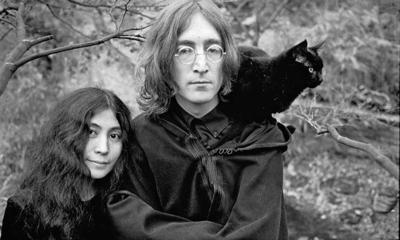

An art gallery show of John Lennon’s visual work seems destined to carry with it joy, nostalgia and a twinge of sadness. Lennon was a brilliant and compassionate songwriter, a synthesizer of the collective mood, an artist who loved humanity.
Few people walking the earth have more cause for sadness in the wake of his death than Yoko Ono. But it’s been more than 30 years, and on the phone from New York, she doesn’t sound sad. It’s the day after she’s played a rare Amnesty International concert on the same Brooklyn stage as The Flaming Lips, Lauryn Hill, Imagine Dragons, Bob Geldof, Tegan & Sara, Blondie, Madonna and recently released Russian dissident artists Pussy Riot. And she sounds happy.
Which is the prevailing mood of All We Need is Love, the collection of 100 limited edition lithographs, serigraphs and copper etchings of John’s simple drawings and handwritten song lyrics, showing at Carmel Plaza for just three days. For more than 20 years Yoko has been packaging Lennon’s art in various permutations and sending it to galleries and empty spaces across the world, donating part of the proceeds to nonprofits along the way (this time, the Food Bank for Monterey County). This week marks the 50th anniversary of the Beatles landing in and conquering America, starting with the Ed Sullivan Show. It’s not the only important date. The show opens Valentine’s Day, and that, too, seems to make Yoko happy.
“I felt someone had to show his artwork,” she says. “I’m looking for a gallery all the time, not just to shelve it. I want people to get together. It’s for the peaceniks, so they can discover each other. For a lot of people it’s a meeting place.”
She talks in an enthusiastic flurry through a Japanese accent, but her will is clarified by people who facilitate what she says and does. Rudy Seigel is one of them. He’s a producer of All We Need is Love and has been working with Yoko, and Lennon’s estate, for 11 years. They bring in lights, walls and a sound system, they play music during the art show, from early Beatles stuff like “Drive My Car” to later Beatles stuff like “Revolution,” from solo songs like “Working Class Hero” and “Instant Karma!” to songs from John and Yoko’s albums, like John Lennon/Plastic Ono Band. It’s the music, as much as the memories, that gets people.
“It’s really heavy for people, 33 years after he died,” Seigel says. “You get a room full of people, young, rich, poor, old, get them in front of the artwork, it’s very powerful. People cry.”
Yoko seems to be carrying on the memory of Lennon as faithfully as if he were alive and smiling on her, but she seems not defined by it. She admits she let part of herself be consumed by Lennon’s personality and fame, but she’s kept her identity as an artist awake and busy. In her travels across the globe she carries a fidelity to his memory, a love strong enough to transcend his mortal life.
“John was very concerned about the world, of course,” Yoko says. “He was speaking to his fans with his art. Being an artist myself, I know how he must have felt. I’m doing a lot of John’s stuff. I always want to make sure I do it. That was his suggestion and I appreciate that. It expresses confidence in me.”
He was right to believe in her power to promote his visual art. Lennon attended art school before becoming a Beatle. But she was a much stronger contemporary artist when they met in 1966, already established in avant-garde circles in New York and London while his simple line drawings were ridiculed as a celebrity vanity project. From working in the influential Fluxus movement of the ’60s to a retrospective at the Whitney in 1989 to a Golden Lion Award for lifetime achievement from the Venice Biennale in 2009, Yoko has never strayed far from the center of the contemporary art world. She’s indulgent to give his earnest and witty drawings so much attention, like she’s protecting that vulnerable part of him that always felt inadequate in the art arena. Her own work occupies a big stage, while her ego stays well-managed.
“I don’t think I’m in the avant-garde of culture,” she says. “That’s an expression critics use to comment on me. I’m just an artist who likes to do my thing. I find my way and I do it.”
Maybe it was that kind of humility, introspection and purpose that an impulsive and extroverted Lennon needed as grounding. In the combustion of his fame, music, charisma and death, his reputation shines so bright that the man behind it all gets obscured. He did not always achieve the heights of idealism his songs reached for. Yoko seems to remind us that Lennon was, first, a man. He had to know pain and failure to be able to see and cherish the beauty that he did. In “Mother” he delivers a primal and anguished song of an abandoned child. In “Jealous Guy” he cops to feelings of insecurity and fear. “Cold Turkey” is a harrowing song about his real-life withdrawal from heroin. He could be angry and violent, he could be unfaithful, he could be cruel.
“BEING SOUL MATES, WE DIDN’T HAVE TO EXPLAIN TO EACH OTHER.”
“He is edited in such a way that you would like him to be,” Yoko says. “It’s easy to do that when someone’s passed away. I don’t think John was an impeccable person, instead he was a person who was trying to do good. If you really want to follow his life in that way, you shouldn’t spend so much time looking at other people, and create your castle within yourself.”
John and Yoko were as known for their political activism almost as much as their music or art. Beyond their famous bed-in, Lennon was almost deported by Richard Nixon for his political leanings and influential place in the culture. In “God,” Lennon sang that he didn’t believe in Jesus, Buddha, Zimmerman (Bob Dylan), kings, yoga, the Bible, etc., instead, “I just believe in me.”
“I think it’s a good lesson,” Yoko says. “It turns out not all policemen are great people. All religions are not that great. Each time we have incredible respect for politicians, we have to learn that politicians are human beings too, not gods. We have to do our thing, be ourselves and be someone that we can rely on.”
John and Yoko’s relationship was consuming, circuitous and layered. She was blamed for the Beatles breaking up. She was envied by women. The couple split up in the ’70s for 18 months, during which time Lennon lived with another woman (with Yoko’s consent). She’s endured a disheartening number of personal tragedies. She sends a letter to the parole board every time the man who shot and killed her husband comes up for a parole board hearing, asking them not to grant his freedom.
So self-reliance seems a safeguard. But it doesn’t account for the hope that she shared with John and continues to cultivate in the form of activism for peace, AIDS, the environment and human rights. She sent an open letter to the “Japanese Fishermen of Taiji” to try to persuade them to not go through with another slaughter of dolphins, documented in the film The Cove. It was cc’ed to the prime minister of Japan, but Yoko says the response was an “incredible silence.”
“Of course I have hope,” she says. “I think that’s most important, as an activist. I hope I can say I’m an activist. I think these days most people are. The numbers of us are increasing. We want to do something for the world and locally, too. I’m sharing it in many ways, through Facebook, Instagram, Twitter.”
Which is a different kind of communication than she had with the man at the center of this coming art show.
“We understood each other so well,” Yoko says. “Being soul mates, we didn’t have to explain to each other.”
Maybe John Lennon’s most iconic song is “Imagine,” an achingly simple chord progression that lives on in songwriting heaven, accompanied by lyrics as bold as a revolution and as plaintive as a prayer. The music video begins with John and Yoko walking along a woody lane, the camera following behind them, and maybe it can’t be helped that it reminds us of their last walk in Central Park on that wretched day in December of 1980. But keep watching, through the pleasant part where Yoko opens the blinds to their expansive white living room, to when she sits next to him on the piano bench as he finishes the song, and she looks at him, coy and enamored and waiting. Then he mugs at her, and she grins, and they kiss. It’s a rare piece of pure joy.
To inquire about what transpires between two people in love suggests an intimacy and trust. Maybe because of the construct of fame, maybe because it’s been so long, it feels almost okay to ask if Yoko still talks to Lennon, either in her mind or out loud.
“Yeah, I do,” she says.
What do you tell him?
“I don’t want to share about it.”
Understood. She’s shared him so much, it’s reassuring that she keeps part of him for herself. Listening to Lennon’s songs, maybe songs that will be played at his art show this weekend, some of them speak directly to Yoko. In “Hold On” he sings “Hold on Yoko, Yoko hold on/ It’s gonna be alright/ You’re gonna make the flight.” In the next verse he sings: “Hold on world, world hold on/ It’s gonna be alright/ You’re gonna see the light.” That’s for the rest of us. He gave us valuable gifts that have outlived him. That’s why we can’t forget him.
(1) comment
February 13, 2014
The so-called Artwork of John Lennon exhibition and sale, owned by Yoko Ono, run by her business associates Legacy Fine Art & Production Inc., consists of -non-disclosed- posthumous [after 1986] colorized and altered forgeries with counterfeit John Lennon chopmark/signatures in bogus editions that are being offered, for sale for hundreds to thousands of dollars each, as original works of visual art ie., lithographs, serigraphs and etchings.
So, what proof is there to support these allegations?
FIRST, Legacy Fine Art & Production Inc. states on their website:
"At the time of his death, John had saved and preserved several hundred drawings that he considered important. In 1986, Yoko Ono began releasing limited editions of some of the meaningful drawings, using only fine art printing techniques, with the goal of re-establishing John Lennon as an important artist of his time." http://johnlennonartwork.com/faq/
John Lennon tragically died in 1980.
U.S. COPYRIGHT LAW
The dead don't sign and number editions. That factual perspective is confirmed by U.S. Copyright Law, which in part, states:
"A 'work of visual art' is— (1) a painting, drawing, print or sculpture, existing in a single copy, in a limited edition of 200 copies or fewer that are signed and consecutively numbered by the author, or, in the case of a sculpture, in multiple cast, carved, or fabricated sculptures of 200 or fewer that are consecutively numbered by the author and bear the signature or other identifying mark of the author;"
http://www.copyright.gov/title17/92chap1.html#101
SECOND, Legacy Fine Art Production Inc. states on their website:
"Serigraphs use a silkscreen to reproduce fine lines and colors. Stone lithographs are hand-pulled on a printing press using stone plates with the image transferred to the fine art paper. Each artwork was released in the medium most suited to capturing the original drawing." http://johnlennonartwork.com/faq/
U.S. CUSTOMS INFORMED COMPLIANCE MAY 2006
The dead don't create lithographs, serigraphs and etchings. This factual perspective is confirmed by U.S. Customs Informed Compliance May 2006, which in part, states:
"The expression “original engravings, prints and lithographs” means impressions produced directly, in black and white or in color, of one or of several plates wholly executed by hand by the artist, irrespective of the process or of the material employed by him, but excluding any mechanical or photomechanical process." To confirm, click on this link: Works of Art, Collector's Pieces, Antiques, and Other Cultural Property -05/01/2006
In other words, John Lennon's black & white drawings reproduced result in black & white reproductions.
THIRD, Legacy Fine Art Production Inc. states on their website:
"Continuing a collaboration that was at the heart of their relationship throughout their life together, Yoko Ono, a world-renowned artist herself, chose colors that she felt would enhance the meaning of the original drawings." http://johnlennonartwork.com/faq/
WORK OF VISUAL ART -EXCLUDES- COPIES THAT ARE COLLABORATIVE
The dead don't collaborate, much less approve the posthumous alteration and colorization of posthumous reproductions from John Lennon's lifetime black & white drawings. This is confirmed in the Visual Artist’s Rights Act (H.R. bill 5316), which amended the Copyright Act of 1976, and was signed into law on December 1, 1990. In the 1995 The Visual Artist’s Business and Legal Guide compiled and edited by Gregory T. Victoroff, Esq., attorney Katherine M. Thompson specifically addresses issue of “collaboration” in the 1990 Visual Artist’s Rights Act. On page 28, the attorney wrote: “The VARA amends the Copyright Act to create a definition for a “work of visual art.” According to Section 602, -excluded are items - that generally exist in multiple copies and are collaborative in nature.”
Rhetorically, does Yoko Ono really believe that she can collaborate with the dead John Lennon or does it seem that Yoko Ono and her business associates Legacy Fine Art & Production Inc. believes and acts on the belief that the rule of law and the laws of nature do not apply to them?
FOURTH, Legacy Fine Art Production Inc. states on their website:
"Each limited edition fine art print is authenticated by John Lennon's embossed signature, the embossed printer and publisher's mark, Yoko Ono Lennon's hand-signature, and John Lennon's personal chop mark." [a.k.a.] "Artists in the Orient sign their works with an individual patented stamp known as a chop. John Lennon's [to the left], which is hand-stamped in red on each edition, was designed by him to read "Like a Cloud, Beautiful Sound." http://johnlennonartwork.com/faq/
DEFINITION OF SIGNATURE
On page 1387 in the Seventh Edition of Black’s Law Dictionary, the term -signature- is defined as: “A person’s name or mark written by that person or at the person’s direction.” In other words, the dead don't sign, much less apply their chop-mark signature.
CALIFORNIA CIVIL CODE
In the State of California, California Civil Code 1738-1745 requires the following disclosure for reproductions: “California law provides for disclosure in writing of information concerning - whether the multiple is a reproduction” {when} “offered for sale or sold at wholesale or retail for one hundred dollars ($100) or more, exclusive of any frame."
http://codes.lp.findlaw.com/cacode/CIV/5/d3/4/1/1/s1738
The potential penalties for violation of California Civil Code statutes may include but not limited to -refund-interest-treble damages-court costs-expert witness fees-attorney fees- and potential $1,000 fine per occurrence.
So, would Yoko Ono and her business partner Legacy Fine Art & Production Inc., with the sale of -non-disclosed- posthumous [after 1986] colorized and altered forgeries with counterfeit John Lennon chopmark/signatures in bogus editions, be potentially participating in "The act of fraudulently making a false document or altering a real one to be used as if genuine" which is one legal definition of -forgery?
Finally, without full and honest disclosure to these contentious issues of authenticity with this so-called Artwork of John Lennon exhibition, how can the public give informed consent on whether to attend this fraud, much less purchase one of the tens of thousands of -non-disclosed- posthumous [after 1986] colorized and altered forgeries with counterfeit John Lennon chopmark/signatures in bogus editions that are being offered for sale for hundreds to thousands of dollars each?
Caveat Emptor!
Gary Arseneau
artist, creator of original lithographs
Fernandina Beach, Florida
Welcome to the discussion.
Log In
Keep it Clean. Please avoid obscene, vulgar, lewd, racist or sexually-oriented language.
PLEASE TURN OFF YOUR CAPS LOCK.
Don't Threaten. Threats of harming another person will not be tolerated.
Be Truthful. Don't knowingly lie about anyone or anything.
Be Nice. No racism, sexism or any sort of -ism that is degrading to another person.
Be Proactive. Use the 'Report' link on each comment to let us know of abusive posts.
Share with Us. We'd love to hear eyewitness accounts, the history behind an article.