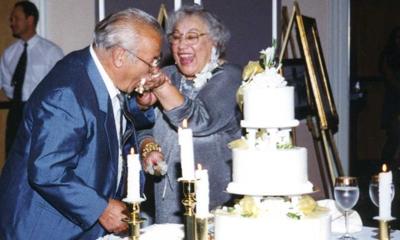
Nora Ephron’s best work – which includes Meg Ryan’s fake orgasm scene in a crowded deli in When Harry Met Sally – has nothing on the incredible true story of George Macaluso and Phyllis Dorio.
It may be the rom-com of all rom-coms.
This epic tale begins sometime in 1940. George Macaluso worked as a sheep farmer in the Sicilian region of Vicari as World War II was in full swing. Italy had just entered the war and Macaluso was an ideal addition to the Italian Army under the regime of Benito Mussolini. Before he was drafted, the 19-year-old farmer had never ventured outside of his rural municipality, located in the province of Palermo. In the years that ensued, Macaluso was stationed in Greece and throughout Africa, which is where his stretch in the Italian Army came to a close: He was captured in Tunisia by Americans in 1943 and brought to the U.S. as a prisoner of war. He was held briefly at Fort Benning in Georgia before arriving at his final destination on California’s Central Coast.
The Italian POW arrived at the U.S. Army’s Fort Ord on the Monterey Peninsula in 1944. The war was still kicking with momentum and the entire country was eager to help the effort any way it could: There was an order issued for Americans to ration butter, meat, cheese, canned foods, cooking oils and even shoes. And many people tried to make the international POWs feel more at home while they were detained on U.S. soil – Fort Ord alone was home to an estimated 1,000 combined Italian and German POWs.
According to Macaluso, the living conditions weren’t all that bad, considering he was being held against his will thousands of miles away from his home and considered something of a criminal.
“As a POW I was given shoes, clothes and fed,” he recalled in 2001. “I was treated better as a prisoner than a soldier in the war.”
Additionally, Fort Ord POWs were given a privilege that wasn’t even granted to black soldiers living on base – authorization from the Provost Marshal to leave the base for Sunday dinner. Once a week, prisoners got a home-cooked meal and a few-hours break from the monotonous daily routine on base. The POWs could only partake in this benefit if they had a distant relative or friend of the family available to host them. In Macaluso’s case, he found in the Dorios a family of first-generation Italians who sympathized with the Italian POWs. No one really knows for sure how Macaluso ended up eating Sunday dinners at the Dorio house – some say that he had an aunt he was close to back in Italy and she sent a letter addressed to “U.S Army Post, California” begging for any nice family to take care of her nephew while he was in America.
And that letter happened to find its way into the hands of Phyllis Dorio’s grandmother, Rosalie Balestreri.
Macaluso never questioned how or why he ended up at that particular house – he just savored the home cooking and being back in reality. Around his fourth Sunday dinner, Phyllis, who lived just down the street, decided it was time to meet the foreigner her grandmother picked up. Macaluso, 24 years old at the time, felt a warm rush shoot up and down his spine the instant he laid eyes on Phyllis’ profile in the late afternoon sun. He was smitten with the 17-year-old, and she didn’t seem to mind his company.
Neither spoke a word of the other’s native tongue, but it didn’t matter; love’s mighty grip had already clenched tightly. Sunday was their favorite day and they looked forward to it every other day of the week.
But they both knew they had to play it cool or Macaluso wouldn’t be allowed off base again. Aside from loving gazes (which couldn’t be helped) at each other from across the dinner table, their feelings for one another were kept under wraps.
Macaluso and Dorio wouldn’t have minded if the war went on, because when it ended, Fort Ord immediately began releasing POWs to be sent back to their home countries. What should have been a joyous occasion for Macaluso was overshadowed by his broken heart. He hadn’t even shared a tender kiss with Phyllis before he was taken out of state, all the way to Tooele, Utah, where POWs were “transitioned” before they were sent home. That’s when the love letters started. Hundreds of them – Phyllis sometimes left lipstick imprints on the envelope (to Macaluso’s delight). Macaluso’s first letters (most are still preserved by his daughter, Josephine Ramras) were written in Italian, so Phyllis filled her grandmother in on the secret relationship and used her as an Italian translator.
Meanwhile, Macaluso utilized fellow Italian POWs who knew English as his personal translators. He eventually picked up enough English to pen his own messages of amore. A couple of authentic (and tear-stained) samples are below.
Tooele, Nov. 23, 1946
Your very nice letter has arrived today. I am very glad that you are very good. I am fine too. Sweet Phyllis in your letter you said you have a good dinner and you wish I could have it with you. I say to you thanks. Be happy Phyllis.
Sweet Phyllis I love you very much and miss you very much because I love you very much.
Thousands of kisses in one.
Love always,
Giorgio
The letters continued after Macaluso returned to Vicari and went back to farming with his brothers. They also grew in intensity and clarity.
Vicari, March 18, 1946
My Darling,
Oh Phyllis you don’t know how much I love you. Phyllis I love love love love you and I miss you very much. To you much kisses I send. To you all my kisses and my love that I am yours.
Love always,
Giorgio
PS Thousand kisses in one.
Macaluso’s straightforward prose exuded a love-steeped gravitational pull that drew his “Sweet Phyllis,” and her mother Anna, to Italy by boat in June of 1946. They tied the knot in Palermo and followed with a rowdy, three-day celebration in Trappeto, Italy, the birthplace of Phyllis’ father, Matteo. After spending their first 10 months as husband and wife in Italy (yes, with the mother-in-law in tow) the newlyweds returned to Monterey in 1947, where they settled and raised their three children: Matteo, Josephine and Anna. The siblings all still live in Monterey County.
For someone who had only known life as a farmer, a soldier during wartime and then a prisoner during wartime, George quickly adapted to his new trade as a squid and sardine fisherman (up until the year 2000, George spent nearly every summer king salmon fishing in Naneck, Alaska; in 2001, he was named Grand Marshal of the Santa Rosalia Fisherman’s Festival in Monterey).
The former POW was a born hustler and did whatever it took to make a buck. When the local fishing industry slowed down in the early 1950s, he jumped professions again and also managed to become a U.S. citizen around the same time. George worked as a foreman for GUY Construction until 1967; he was involved in building area landmarks including the Monterey Conference Center and the Lighthouse Avenue tunnel.
“My father was incredibly strong,” his eldest daughter, Josephine Ramras says. “Honest and always a hardworking man.”
Phyllis’ work ethic was comparable: She was punching the clock at a Cannery Row cannery by the time she was 13. Following a short stint in her late teens as a laundress, she found her way back to the cannery, where she worked on and off for 40 years – after the last cannery on Cannery Row closed in the early 1970s, Phyllis packaged squid in Sand City.
“She would have done anything for her kids,” Ramras says.
Even in retirement, the Macalusos were tireless workhorses, especially if food was involved: As active members of the Italian Catholic Federation, they served up to 700 people per sitting at the annual Lenten fish dinners. (Phyllis also made desserts.) George was in the Jovanotti Old Men’s Club, a group of guys that regularly volunteered their cooking services for fundraisers and events all over the Peninsula – they also cooked lunch at El Estero Lake every month, free and open to the public.
In addition to spending their retirement as a couple of gastronomes who loved feeding their community, George and Phyllis continued an annual tradition that still lives on today: Every year, around the time of Memorial Day weekend, the entire family and their friends reserve a few campsites next to one another at Pfeiffer State Park in Big Sur and camp out for a week or two.
Josephine’s favorite memory of her parents isn’t her mom’s famous marinara or the Saturday morning strolls with her dad down to Fisherman’s Wharf. It’s a recollection of the countless little acts she and her siblings witnessed on a daily basis that let them know their parents never took each other for granted.
“They were always so loving to each other,” Josephine says.
Phyllis passed away in 2005 and George followed in 2007 (from a broken heart, some say). They rest side-by-side at the San Carlos Cemetery in Monterey. But their story, and their love, lives on through their children, five grandchildren and seven great-grandchildren. Whoever is available gathers every Sunday for dinner.
(0) comments
Welcome to the discussion.
Log In
Keep it Clean. Please avoid obscene, vulgar, lewd, racist or sexually-oriented language.
PLEASE TURN OFF YOUR CAPS LOCK.
Don't Threaten. Threats of harming another person will not be tolerated.
Be Truthful. Don't knowingly lie about anyone or anything.
Be Nice. No racism, sexism or any sort of -ism that is degrading to another person.
Be Proactive. Use the 'Report' link on each comment to let us know of abusive posts.
Share with Us. We'd love to hear eyewitness accounts, the history behind an article.