
Black History Month started as a week-long celebration, so the fact that it’s grown to a month signals progress. But even more progress would be if African American history were woven into the big fabric of American history instead of segregated within books and calendars. As some have said, Black History Months’ existence suggests we’re not ready, as a country, to wholly embrace black history. Instead we pay a pittance of tribute so, as Theodore Johnson writes on the Huffington Post BlackVoices blog, “Once March arrives, the nation will collectively pat itself on the back for having done its due diligence.”
But there are ways to escape homilies; there are real stories about battles for the soul of our country. The Peace Resource Center is hosting screenings and talks of three films from the Direct Action Monterey Network (DAMN, a “forum for anarchists, feminists, socialist and other anti-authoritarian revolutionaries”).
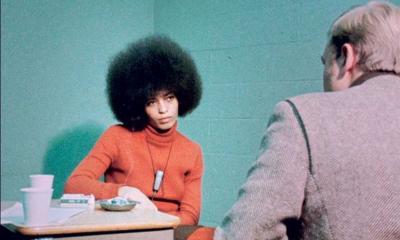
The Black Power Mixtape 1967-75, playing Friday, Feb. 7, comes first. In the 1960s and ’70s, Swedish journalists came to the U.S. to report on and shoot footage of the Black Power Movement as it was happening. They shot years of interviews, speeches and rallies by Stokely Carmichael, Huey Newton, Angela Davis, Eldridge Cleaver, Bobby Seale – the young intellectual and strategic leaders of the movement. Then the footage disappeared for 30 years. It was uncovered by filmmaker Goran Hugo Olsson in a cellar beneath the Swedish National Broadcasting Company and he resurrected it in the form of a 2011 mixtape film – with commentary by musicians like Erykah Badu and Talib Kweli, and UCLA history professor Robin Kelley – put to music of the time as well as our own.
The juxtaposition evokes German documentarian Nick Broomfield’s Biggie & Tupac, but real journalistic integrity keeps Mixtape focused and hot music keeps it fresh.
“MARTIN LUTHER KING JR. IS AN INFINITELY GRACIOUS AND PATIENT MAN. I AM NOT.”
The film begins in 1967. Among establishing shots of black neighborhoods, crowded lecture halls and activist offices, the film crew find their main subjects. Stokely Carmichael, a former leader of the Student Nonviolent Coordinating Committee and the Black Panthers, credited with coining the term “institutional racism,” is calm, charming and eloquent:
“Martin Luther King Jr. is an infinitely gracious and patient man. I am not.”
In 1971 the film crew finds communist and feminist UCLA professor Angela Davis, on the FBI’s 10 Most Wanted List, locked up and awaiting trial for conspiracy in an armed courthouse escape plan in which four people were killed. The subtitles read: “Her professors said she was the most gifted student they’d ever had.”
When the Swedish film crew asks her about violence, she is incredulous.
“People ask about violence [in the Black Power Movement],” she says, “and they have no idea about the history of black people in this country. When you talk about a revolution, most people think violence. But more important are the principles.”
Just as that begins to pique more interest in Davis’s life and political saga, more of her comes Feb. 21 in the second film, the documentary Free Angela and All Political Prisoners, which The New York Times calls a “snappily edited, archivally wallpapered recollection of fearless behavior in the face of an antsy establishment.” It sends the viewer deep into a moment in which ideas mattered and had effects in the real world, like prison breaks as a rebuke of a racist criminal justice system. Speaking of which…
The third film, American Violet, playing Feb. 28, is a narrative film based on a true story. It stars Nicole Beharie as Dee Roberts, a single mother of four kids in the projects, who is charged by the district attorney of Hearne County, Texas, of selling drugs. Railroaded into only rough choices, she fights back with the help of the ACLU. Its able cast is padded with solid talents and familiar faces, including rapper Xzibit, Charles S. Dutton, Tim Blake Nelson and Michael O’Keefe, but it’s Beharie and Alfre Woodard (as Dee’s mother) who really shine and elevate it.
The injustice at the heart of the movie is one in which a criminal justice system is incentivized to lock up poor black people in exchange for funding from the federal government. The D.A. sets up SWAT sweeps in black neighborhoods, arresting people en masse, then offers deals in exchange for guilty pleas, with the threat of full-on prosecution in a county not known for looking kindly on black people. It’s a racket. Guilt or innocence be damned.
And though American Violet is a traditional political drama that feels like Dead Man Walking, its emotional story about this insidious system (in real life, that DA was re-elected again and again until 2012) matters. Oh, it matters.
There. Three ways that show how black history is alive, meaningful and universal. It’s joyful stuff. Not joyful in a sanctioned or packaged manner, or in the usual story arc, or as in the absence of pain. But joyful as in how human beings, degraded, cheated, persecuted, can and did and will keep fighting for liberty. That kind of joy. How American.
THE BLACK POWER MIXTAPE 1967-1975 screens 7pm Friday, Feb. 7, at Peace Resource Center, 1364 Fremont Blvd., Seaside. Free (donations welcome). A Black History Month artists reception takes place 5-7pm Thursday, Feb. 13.
(0) comments
Welcome to the discussion.
Log In
Keep it Clean. Please avoid obscene, vulgar, lewd, racist or sexually-oriented language.
PLEASE TURN OFF YOUR CAPS LOCK.
Don't Threaten. Threats of harming another person will not be tolerated.
Be Truthful. Don't knowingly lie about anyone or anything.
Be Nice. No racism, sexism or any sort of -ism that is degrading to another person.
Be Proactive. Use the 'Report' link on each comment to let us know of abusive posts.
Share with Us. We'd love to hear eyewitness accounts, the history behind an article.