It was one of the best worst tunebugs of the ’80s, from an all-girl jangle-pop group out of Southern California: hot women with big hair and breathy voices, performing a song with crazy lyrics and even crazier dance moves to go along with it:
“All the old paintings on the tomb/ They do the sand dance, don’cha know?/ If they move too quick (Oh-Way-Oh)/ They’re falling down like a domino… Foreign types with their hookah pipes sing: Way-oh-way-oh-way-ooo-aaa-ooo… Walk like an Egyptian.”
Walk like an Egyptian.
Walk into the bedroom of Anne Marie Hunter and your eyes immediately go to the enormous framed records on the wall adjacent to her bed. A silver album, commemorating the fact that The Bangles had sold 1,000,000 copies of the 1986 song “Walk Like An Egyptian.” And under the glass, there’s an engraved silver placard thanking Anne Marie Hunter for her help making the song such a smash hit.
Hunter wasn’t a Bangle. But if you’ve seen the video, you’ve seen her work. The funky dancing, with random people moving their arms to mimic the way figures held themselves in ancient Egyptian paintings: That was her choreography.
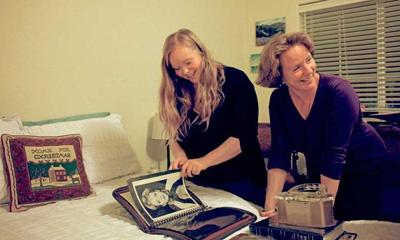
Hunter’s blue eyes sparkle as she tells the story, demonstrates the dance and shows her guests pictures of the band rehearsing and posing. They sparkle, too, as she tells the story behind the other silver record on the wall – this one, from rocker Lita Ford, thanking her for teaching her some signature moves as well for the video of “Kiss Me Deadly.”
“Although, really, Lita didn’t need to learn much,” Hunter says, raising her arms and gyrating to mimic Ford on stage. “She was always wild on stage, just roaring.”
Still more stories. She once flew to London at the behest of a friend to help Luciano Pavarotti get into shape for a European tour. She found the famed tenor was a little more hands on than he needed to be for exercise. (“He wanted me to do a lot more with him than pushups,” she says, “and I told him, ‘Not gonna happen, Pavo.’”)
More stories: She and her husband Kurt left a thriving talent agency Kurt co-founded in Hollywood along with Peter Burke – son of famed composer and Reprise Records musical director Sonny Burke – so they could move to Monterey County and Kurt could take a job in waste management. (“Talent management, waste management,” she says with a shrug and a laugh. “Really they weren’t all that different.”)
And once they came to Monterey County 23 years ago, with Lita Ford driving the Hunters’ infant daughter up the coast in her convertible while Kurt and Anne Marie drove the moving van, there’s the story of how Anne Marie ended up working with every local theater company in the region, teaching, choreographing and directing at the Western Stage, Pac Rep, San Jose Rep and Monterey Peninsula College before she ended up as the fine arts department chair at the Stevenson School.
Such a lively woman. Such a great sense of humor. Such good memories.
In a few years, Anne Marie Hunter likely will retain none of it.
We are standing in her bedroom of the assisted living facility Cottages of Carmel, where Anne Marie Hunter moved four months ago. At age 55, she is about 15 months into living with a diagnosis of Alzheimer’s disease, one of the younger people in the county to receive that diagnosis and the third successive generation in her family – first her grandmother, then her father – to be diagnosed.
“I want to talk about it because I think it’s the cancer of today. Everyone seems to be getting it, and what does it mean?” she says. “When my grandmother had it and my dad had it, nobody talked about it. You didn’t tell anyone. There was a stigma attached.”
Talking about it won’t cure her, but the way Hunter figures it, if one person can see the signs, in themselves or in someone they love and get some help, it’s one less person who has to struggle through it on their own.
“Besides, any time for me to talk about me is a good time,” she says, and laughs.
This is a story of plaques and tangles and neurons, of a disease that is the sixth leading cause of death in the U.S., but the only one of the so-called leading causes of death that has no treatment, cure or way to slow its progression, according to the nonprofit Alzheimer’s Association. So many baby boomers will get it, in fact, that the association calls the boomers “generation Alzheimer’s” and Alzheimer’s “the defining disease of the baby boomers.”
An estimated 5.3 million Americans are diagnosed with it, and the disease costs an estimated $172 billion a year. But the National Institutes of Health spend only about $480 million on researching it, compared to more than $6 billion it spends on cancer research and $4 billion on heart disease.
There’s also no one-size-fits-all response when it comes to Alzheimer’s. How it shows itself in one patient won’t be how it shows itself in the next.
“From the time of diagnosis, there’s an average of eight years [of life],” says Sherry Williams, regional director of the Alzheimer’s Association. “But we also have folks who are diagnosed and 17 years later, they’re still alive.”
It’s likely the disease – which will eventually kill Anne Marie Hunter by slowly shutting down her brain’s ability to communicate with the rest of her body, robbing her of her ability to speak, hold her head up, control her muscles and swallow – had been percolating in her for a decade or maybe even two before symptoms came on in earnest. That’s how it works, or at least how experts think it works: Researchers still aren’t sure how the disease process begins, but during the preclinical, pre-symptom stage, toxic changes are taking place in the brain, according to the National Institutes of Health.
“Abnormal deposits of proteins form amyloid plaques and tau tangles throughout the brain, and once-healthy neurons begin to work less efficiently. Over time, neurons lose their ability to function and communicate with each other, and eventually, they die,” according to the fact sheet on Alzheimer’s from the NIH’s Institute on Aging. The damage then spreads to the part of the brain essential in forming memories.
Neurons die and the brain shrinks and at the end, the brain damage is unsurvivable. As the Alzheimer’s Association tracks it, while more than 5.3 million people have Alzheimer’s, it’s impossible to know how many people are in that no-symptom, preclinical stage.
Anne Marie’s older daughter, 24-year-old Alison Hunter, and her 18-year-old sister, Emily, knew something was wrong with their mother. They just didn’t know what that something was.
Their father, Kurt, had died in 2007 of brain cancer that was diagnosed only about five months before he died, and there was natural depression and malaise that went along with that. The family then lost their home to foreclosure and moved into a rental, and there was natural depression and malaise over that too.
“I was trying to keep everything OK. I had a younger daughter, and Alison was away at college and my husband was dead. I kept the pedal to the metal and did my gig and my girls were great and we were going to make it,” Anne Marie says. “My sisters and brother were in Southern California, but my life was here and I was doing what I was doing and I didn’t want to leave.”
Anne Marie had never been a neat freak; a little bit of clutter – papers, books, magazines, grade sheets – was part of her routine as a mom, a choreographer, a theater director and an art teacher.
But when Alison Hunter came home from the University of Oregon in July 2011, ready to graduate with a degree in communications, the normal mess had become something more.
“She was hoarding. There were papers everywhere, unpaid bills, it was so bad I didn’t know where to start,” Alison says. “She had to leave teaching the summer program too, because her boss saw she was forgetting things, and thought maybe it was stress and that she needed some time off.”
Between July 2011 and November the following year, things went quickly from bad to worse. Anne Marie Hunter started forgetting appointments. She forgot how to use her computer. She forgot how to do her grades. She forgot staff meetings.
“It was a full year of going, ‘What are we going to do?’ We had talks about who we should see and went back and forth about what to do next,” Alison says.
The first doctor Anne Marie saw thought it might have been menopause. There were no signs of deterioration at all on a brain scan. Her daughters made their way to a support group, and someone there recommended they take their mom to Dr. Alejandro Centurion, M.D., a Carmel Valley neurologist. He reviewed her history, and gave her an exam and confirmed what the girls thought they already knew.
They cried anyway.
“We knew it was Alzheimer’s,” Alison says. “We knew because our grandfather had it and our great-grandmother had it too.
“It was really hard in the beginning,” Alison says. She pauses, collects her thoughts and continues. “It’s still hard every day. It’s been two solid years of grieving this and I’m slowly coming out of that.”

1. Memory loss that disrupts daily life. One of the most common signs of Alzheimer’s, especi…
The Alzheimer’s Association tracks seven stages of Alzheimer’s, and 10 warning signs that you might have the disease. (As the joke goes, once you read the warning signs, you’ll be convinced you have it. See sidebar, this page.)
“We are seeing more early diagnosis, because physicians are becoming more educated and families are seeking help more quickly. In the past, people have received their diagnosis and waited three years before reaching out because they’re able to cope,” Williams says. “But then suddenly they’re in the middle of stage three and we see them in crisis. Early intervention is so important. It’s the key to managing Alzheimer’s.”
Williams describes the stages. Stage one, there’s no impairment and the person doesn’t experience memory loss. Stage two is very mild, and the person may have memory lapses, but it’s on the level they can overcome and there are no symptoms. Stage three, there is mild cognitive decline, usually of a level that family and friends notice. Then comes stage four, with moderate cognitive decline (think the inability to keep a checkbook or remember recent events). Then the patient moves into decline where memory worsens, personality changes and they need significant help and supervision.
Then the last stages. Severe decline. The final stage, when the person’s ability to respond or carry on a conversation can be lost.
“Every person is an individual and some show signs earlier or later,” Williams says. “There’s no set path. Each stage overlaps the other.”
Anne Marie is in the third stage and moving toward the fourth. She’s abundantly good-humored. (“Her doctor says she’s the most upbeat Alzheimer’s patient he’s ever seen,” says Hunter’s best friend and sister-in-law Elizabeth Stacey, director of advancement at the Esalen Institute.) But Alison, who works full-time as a sales assistant at KION, says she can see how the decline has taken place.
“From April to August, I saw more confusion, but I think a lot of that had to do with the moves we were going through,” Alison says. “Now she’s at a steady place and she’s feeling more comfortable with herself. But she’s been asking a lot of questions, repeating herself more.
“This disease is going to progress and it’s hard to see those changes. It’s gradual, but sometimes you really recognize them,” Alison continues. “I have her right now and I’m appreciating that. I’m loving the fact that she is here right now and I have her right now. But it’s not as quick as my dad.”
Assisted living at Cottages of Carmel runs about $3,500 a month. The family had few assets left following Kurt Hunter’s death and the foreclosure. But they’re able to finance Anne Marie’s stay at the cottages of through the sale of a lakeside cabin Kurt Hunter had purchased. Anne Marie had paid into a disability program that provides her with a monthly income. And generous (and anonymous) donors have paid for Emily’s first semester at University of Southern California.
“Moving her here was a hard choice to make. But I was working full time and running home in the middle of the day to check on her because she was on her own and it just wasn’t the right environment for her to be in,” Alison says. “Most of the time, she was alone.”
Now, at Cottages of Carmel, she’s the facility’s action-adventure girl. She’s almost always on the go, and when she’s not, she’s being courted by other patients hoping she’ll turn that bright smile on them.
“She wasn’t happy about it in the beginning. Nobody would be. There’s only one other person there her age, but she’s singing to people and doing things she loves,” says Alison, who now lives in Marina and sees her mother three times a week. Stacey, Hunter’s sister-in-law, and brother, Pete Marien, live nearby as well and often see her on Sunday mornings – they swim and have lunch. And Stacey drops by during the week as well.
“It’s a better environment than keeping her at home,” Alison adds. “She’s not isolated. She can feel surrounded by people who care.”
Anne Marie Hunter rises early most mornings – “I like to, I always have,” she says – and moves through days that are packed with activities. She doesn’t use a computer much anymore, but her social schedule is alive: Friends from town take her to lunch, she swims regularly and former students from all over the county come to visit. A college friend recently commented how hard it was getting in to see her because of her busy schedule.
She beds down with her memories – her rock star choreographer past, a book of glamorous head shots from when she was auditioning for roles too. And there are times, she admits, when she worries. “I worry I won’t be here to see my children have children,” she says, and then laughs and points to Alison: “So hurry up! I need a grandchild!
“I worry about the stigmatism of this disease, because people don’t know why it happens. There are so many unknowns and it’s so individual and that’s what makes it tough. That’s the thing that bothers me,” she says. “And with that, it’s important to talk about it so people understand.”
As for what she hopes and for what keeps her going: There are her daughters, of course, who at 24 and 18 are handling things many people in their 40s don’t have to deal with. Alison takes care of the finances, managing social security payments, disability payments, her mother’s accounts, making sure the bills get paid and making sure there’s enough money for her mother’s long-term care. Emily, Alison says, thinks she wants to major in music management at USC.
“I hope I can still be the crazy-positive self I’ve always been, because that’s what allows me to be happy,” Anne Marie says. “I try not to sweat the small stuff. If you were a nice person in life, this disease is going to be much easier, because you have daughters who love you and friends who will care for you.
“If you were a jerk in life, well, maybe you’re going to be a jerk with Alzheimer’s.”
(0) comments
Welcome to the discussion.
Log In
Keep it Clean. Please avoid obscene, vulgar, lewd, racist or sexually-oriented language.
PLEASE TURN OFF YOUR CAPS LOCK.
Don't Threaten. Threats of harming another person will not be tolerated.
Be Truthful. Don't knowingly lie about anyone or anything.
Be Nice. No racism, sexism or any sort of -ism that is degrading to another person.
Be Proactive. Use the 'Report' link on each comment to let us know of abusive posts.
Share with Us. We'd love to hear eyewitness accounts, the history behind an article.