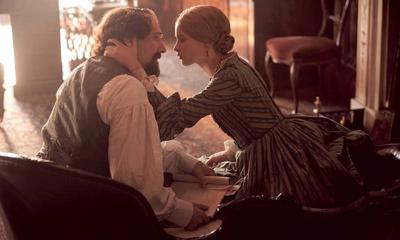
Adapted from 1991’s The Invisible Woman: The Story of Nelly Ternan and Charles Dickens by Claire Tomalin, screenwriter Abi Morgan’s (Shame, The Iron Lady) The Invisible Woman is the second and best film directed by Ralph Fiennes, who also stars as the acclaimed author.
Dickens was 45 and Ternan 18 when they met during a 1857 staging of The Frozen Deep. But the flashback-rich movie begins in 1883, 13 years after Dickens’ death, with Nelly immersed in an unhappy marriage and unable to move past her previous affair.
As an actor, Ralph Fiennes is at his most frenetic, his Dickens being the life of the party: ebullient, egotistically charming yet immensely flawed, to the point of hypocrisy in one scene in which he simultaneously proclaims his moral superiority while humiliating those around him.
The movie expertly combines brilliant dialogue and epic silent scenes, all exquisitely captured by cinematographer Rob Hardy. Besides the central Dickens-Ternan relationship, the tortured Mrs. Dickens (a perfectly cast Joanna Scanlan) is the personification of dignity in the midst of an embarrassing heartbreak.
The Invisible Woman isn’t your usual steamy and passionate cheating drama.Dickens and Ternan take their time in their courtship. The movie’s only sex occurs during a clumsy Victorian bed scene that conveys the carnal element was of least importance for these two – they were united by literature and a tremendous loneliness which only got more difficult around most other people. The pair’s witty banter and intimate confessions drive most of the attraction here. Despite Dickens’ self-centeredness and Ternan’s ongoing struggles between societal conventions and true love, you get a glimpse of their immense hearts. When Dickens and Ternan finally confess their love, they do so in such a tender way that it’s almost shocking.
With hardly anything left to prove as an actor, Fiennes’ film makes a strong case for him as a director, after his Coriolanus (2011) was accurately described by Variety as “Shakespeare by way of Michael Bay.” In contrast, The Invisible Woman is a wonderful film for lovers of literature. Despite its dark, forbidden-love subject matter (and a desolate look at the destructive nature of infidelity), the film manages to end on a bright note when Jones delivers an excellent, Dickens-less scene that says it all without the need of words.
The Invisible Woman (4) Directed by Ralph Fiennes • Starring Ralph Fiennes, Felicity Jones, Kristin Scott Thomas, Joanna Scanlan, Tom Hollander. • Rated R. • 111 min. • At Osio Cinemas.
(0) comments
Welcome to the discussion.
Log In
Keep it Clean. Please avoid obscene, vulgar, lewd, racist or sexually-oriented language.
PLEASE TURN OFF YOUR CAPS LOCK.
Don't Threaten. Threats of harming another person will not be tolerated.
Be Truthful. Don't knowingly lie about anyone or anything.
Be Nice. No racism, sexism or any sort of -ism that is degrading to another person.
Be Proactive. Use the 'Report' link on each comment to let us know of abusive posts.
Share with Us. We'd love to hear eyewitness accounts, the history behind an article.