
When Monterey County Weekly was hatched 25 years ago, we didn’t use laptops, mobile phones, tablets, the Internet, Facebook or Twitter. Some of those mainstays of modern life didn’t exist yet, but that’s because those who would imagine them into existence, in some cases, were still in elementary school. Or diapers. Or unborn.

Back then we depended on typewriters and white-out, some first-generation personal computers storing data on floppy disks, and fax machines and voicemail. Fast forward and my phone has more technology than the spaceship that took Neil Armstrong and Buzz Aldrin to the moon – GPS, a high-resolution camera, video player, live-time weather radar and the Monterey Bay Aquarium’s Seafood Watch guide.
It’s an extraordinary time to be alive.
The principles and mission that helped get the Weekly here – from a fledgling startup struggling to make payroll to one of the community’s most important media companies – remain the same: devotion to outstanding journalism; commitment to strong writing, compelling photography and graphic design; support of innovation and expansive arts and culture; dedication to delivering consistent value to the local business community and obtaining great results for our advertisers; and the desire to create a spirited organization where our employees can flourish.
The Weekly has been a victory for collaboration over personal ego, for collective creativity and tenacity over reactionary impulse, strident self-righteousness and whim. We’re not petty or sensational when it comes to our work. Rather, we’re committed to traditional standards for what makes quality journalism – as we leap feet-first into the tech-crazed world.
I’m happy to report, despite so many negative reports about newspapers and print publishing, the Weekly remains robust, profitable and in high demand.

Every week monstrous printing presses run at mesmerizing speeds to produce 36,000 copies of the Weekly. It is still exciting to feel the presses rumble. Some 900 locations countywide end up with a stack of Weeklys shortly thereafter. Then it’s into your hands and your home. Hopefully after that it becomes personal, and your life is better for it.
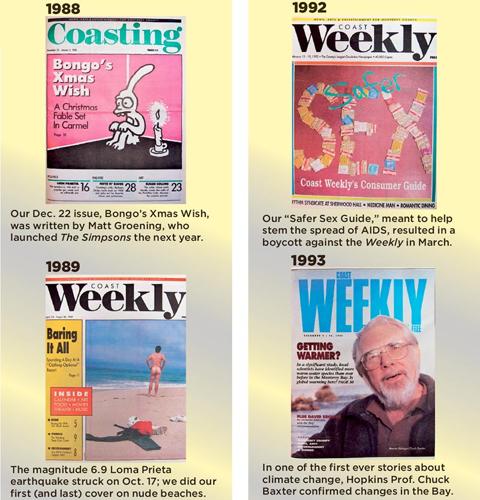
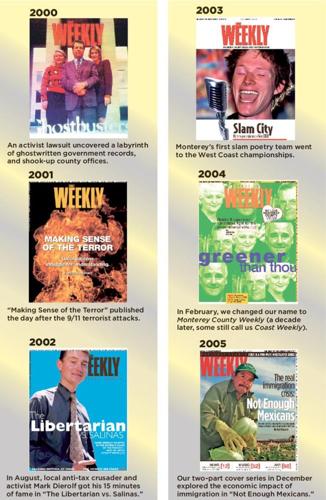
When we started in 1988 we were in the shadows of dominant local media. The two dailies’ editorial staffs dwarfed ours. Perhaps because we were unpredictable, often irreverent and feisty, maybe because we were independent and not driven by outsiders, because we insisted our writers have voice in their storytelling, you found us, and we found our place.

We’re glad we’re not in the daily newspaper business, with their free-falling circulation and loss of readership.
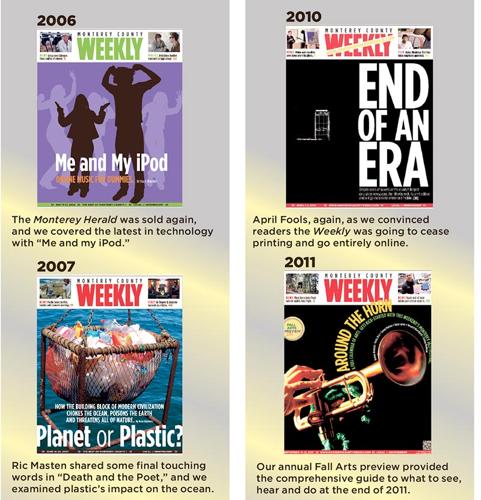
And we’re surprised that we now have twice the average press run of the Monterey Herald, and nearly four times that of the Salinas Californian. Looking ahead, it’s unclear whether dailies will recover from this downward spiral. My sense is the consolidation of media companies has been at the core of this reset. Our daily counterparts got leveraged to the hilt as the result of mergers and acquisitions. Their rampant expansion forced their local teams – many of which have talented and committed journalists – to pay more attention to the bottom-line than quality journalism. They’ve slashed editorial staffs, taken local control away from publishers and incrementally decreased the quality of their product.
I believe one of the reasons for our vitality is that we not only have a deep appreciation for all the people who make up our community tapestry, but we’re deeply committed to the best for that community. We live here, this is our home and we want to be good neighbors.
We’ve energized to execute our company mission. We take on the fun parts of being local journalists and relish the difficult parts, too. Our commitment to long-form narrative has only gotten stronger. We have never wavered from challenging the perpetrators and powerbrokers, because that’s our job. We raise hell; hopefully, we simultaneously raise the bar.
Since day one my staff and I have celebrated our triumphs and suffered through those moments when we’ve completely blown it. And you’ve been there with us, mostly encouraging us on. Thank you for being there with us on the journey.
I continue to be in awe at how all this works, at times even seamlessly, that our reporters and designers and sales and distribution team and business and tech geeks can manage all the details to create and deliver the Weekly as you’ve come to expect – reliable, smart, useful, hopefully wise and occasionally even funny.
Not a day goes by when we don’t deliberate how to chart the course ahead, to create a new and improved Weekly, to stay current with technology and remain profitable, to reach new audiences and retain existing ones. We deliberate over what the future holds – for media, the county, the country, even the planet – and how we might continue to make a difference for all.
We know the technology revolution is just beginning, a fact both daunting and exciting. A terabyte of storage now costs less than a decent pair of shoes. It’s hard to imagine the entire contents of the Library of Congress can be stored in hard drives that occupy a little more space than a microwave oven. In 1988, we didn’t have terabyte in our lexicon.
Technology will go faster than our ability to handle it. The environment, national and international security, the economy, food, agriculture, the arts and culture – not a single institution will be spared in this revolution.
We’ll do our best to put it all in perspective.
If you consider that today Tesla auto owners receive emails from the company to schedule service – service that takes place remotely during the night while their owner sleep – well, imagine what 25 more years could bring us. Every parent worries about their teenager texting while driving. In 25 years there is a good chance none of us will be either driving or texting, because our robots will handle both. (You read that right: robots. Considering there are more than 5,000 of them on the campus of Carnegie Mellon University alone, the revolution has most definitely arrived.)
Privacy will be under siege as our every digital footprint gets recorded, and perhaps shared. And while we may easily adapt to a driverless-car whisking us to the cafe while our custom-researched news of the day is read to us, the way we interact with each other, and all the various institutions that make a cohesive community, will be in transformation.
My hunch is the way the news is gathered and reported may even be improved. But there are some huge downsides, particularly if the trend torward media consolidation continues.

The stories from chain-owned media have become more “friendly,” more generic and less edgy. After the 9/11 attacks, Clear Channel sent out a memo to its 1,200 radio stations ordering 165 “lyrically questionable” songs not be aired, including the Beatles’ Lucy in the Sky with Diamonds and Bruce Springsteen’s I’m on Fire. To me, that’s censorship. At the start of the Iraq war, most mainstream news organizations agreed to cover the war as embedded journalists, under the watchful eye (and censor) of the U.S. military. Again, the powerful limited access to information.
This is an unacceptable shift in the larger media world. Media needs to be independent, ought to foster debate, and air opposing points of view.
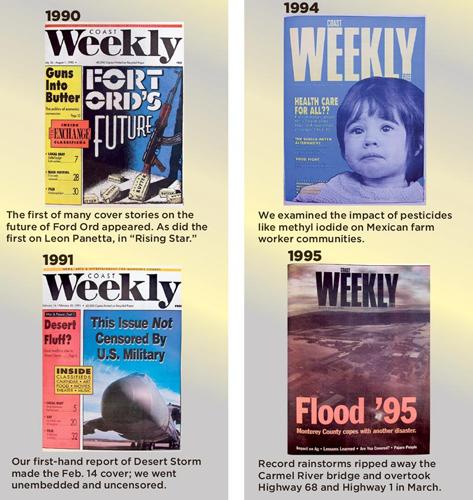
It surprises many readers when I tell them the Weekly sent a reporter to both Kuwait to cover Desert Storm and then to Iraq to ensure Monterey County received a local, independent report. We syndicated those stories to help defray some of the costs. In both efforts our reporters went unembedded, and they returned safely. We were the only local media willing to send a reporter to both war fronts.
Comcast, all the local TV stations (KSBW, KION, KCBA), the Herald, the Californian, almost all the commercial radio stations including KWAV, KPIG and KDON, and most every other “local” media is owned by a company whose headquarters are elsewhere. That bothers me. That ought to bother you, too.
Even though I have no clue what’s ahead for media companies like the Weekly, I am convinced the community as a whole will need independent journalists and thriving independent media organizations as the future greets us. That’s always been my bias, but it seems more relevant now and looking ahead than ever before.
Most worrisome to me is whether any of us will be reading, or reading much, in 25 years. My guess is that we’ll have the stories read to us or the reading will be short snippets. What happens to long-form narrative or longer investigative stories, or all the magazines or books… well, that remains to be seen.
Thankfully, one of the benefits of the new technology has been the arrival of new independent voices in the form of blogging, sharing of photos and videos, tweets and comments. There is a huge dedication to publishing opinions and ratings. This is exciting, and all new. Citizen journalism is sure to get stronger.
But we won’t be able to fully trust what some anonymous blogger tells us, or some story your smartphone or robot pulls up. The special interests and public relations specialists are hired to generate reports that contradict positions they oppose. We will all need the skills of a seasoned reporter to make sense of it.
More troublesome is that individuals can easily be overpowered by the powerful, daunted by the prospect of challenging the institutions and people who are behind them.

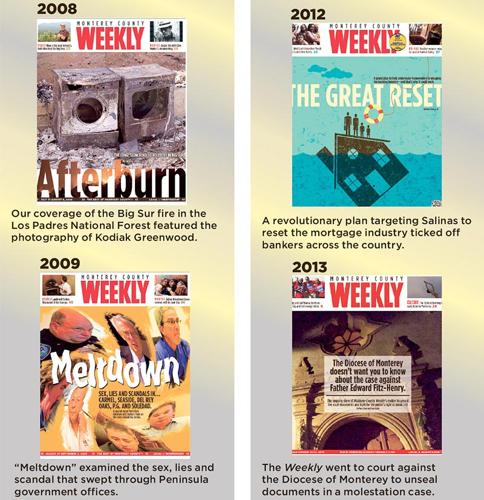
We know this firsthand because we’ve been in numerous disputes with some high-paid attorneys over the years, demanding we “correct” stories even when we’ve got it right. This year the Weekly and the Diocese of Monterey have been battling in Monterey County Superior Court – their high-paid attorney versus our First Amendment specialist – in our demand that the court unseal key documents the church doesn’t want you to read. It’s an expensive battle we’re still fighting because we all have the right to know what the church knew and when, and what they did with that knowledge.
A healthy, independent media organization can carry the voice of many in these times, and not be pushed around. The public’s right to know cannot to be taken for granted.
In 2038, my hope is that before we each head home to our energy-efficient pods – each with its own organic rooftop garden – we’ll stop by one of the Weekly’s red racks and pick up the new edition. In that edition I expect to find a great calendar with Hot Picks, Squid’s savory observations and substantive stories and ads.
In those days ahead we’ll have just as strong a need for spending time with our friends and partners, sharing a meaningful conversation while criticizing the incompetence of Congress, the mystery of the opposite sex, and the glitches of our latest personal servant-robots.
I promise I’ll do my best to help the Weekly to remain committed to delivering the best of Monterey County. We’ll continue to strive to improve and to meet our mission: to inspire independent thinking and conscious action, etc.

I hope I’ll be alive to see it all. In the meantime, sometime today I need to go to the grocery store, cook dinner, feed the dog, recharge my phone and do dishes before I take the recycling out. Life will continue, the mundane and the profound.
See you next Thursday – in print, sooner online or on your mobile device – and soon enough on your wristwatch. Press a button and the new Weekly will be projected onto the wall of your home.
If that’s our future, so be it. Just as always, enjoy the Weekly, as it grows and changes, in all its forms. Keep sending us your letters, comments and criticism.
Thanks again, for all your support, friendship and readership.
BRADLEY ZEVE is founder and CEO of the Monterey County Weekly and its first editor and publisher.
25 NOTABLE AWARDS
CALIFORNIA NEWSPAPER PUBLISHER’S ASSOCIATION (CNPA)
General Excellence >> First Place | 2011
(Large Circulation Weeklies)
Coverage of Environment >> First Place | 2011
Investigative or Enterprise Reporting >> First Place | 2005
Page Layout & Design >> First Place | 2004
Page Layout & Design >> First Place | 2002
Feature Story >> First Place | 2002
Writing >> First Place | 2002
Feature Photo >> First Place | 1999
Display Advertising >> First Place | 1997
Agriculture/Resource Reporting >> First Place | 1993
Agriculture/Resource Reporting >> First Place | 1991
ASSOCIATION OF ALTERNATIVE NEWSWEEKLIES (AAN)
Beat Reporting - Environment >> First Place | 2013 | Kera Abraham
Political Column >> First Place | 2012 | Mary Duan
News Story - Short Form >> First Place | 2011 | Kera Abraham
Innovation >> First Place | 2006 | Jessica Lyons
Ad Design >> First Place | 1998 | Pablo Reiter & Kevin Jewell
Investigative Reporting >> First Place | 1996 | Kate Campbell
NATIONAL NEWSPAPER ASSOCIATION (NNA)
Best Review >> First Place Tie | 2004 | Rick Deragon
Best Review >> First Place Tie | 2004 | Ryan Masters
Best Performing Arts Story >> First Place | 2004 | Sue Fishkoff
SOCIETY OF ENVIRONMENTAL JOURNALISTS
Small-Market Reporting >> First Place | 2010 | Kera Abraham
AMERICAN ASSOCIATION FOR NUDE RECREATION
Best Feature Article >> First Place | 1992 | Chuck Thurman

(1) comment
Wow! 25 years! Wish I could have been there for the celebration!
I just read your post today Bradley, and appreciate with your thoughts on the future of journalism (and thoughts on the future in general), wise insights!
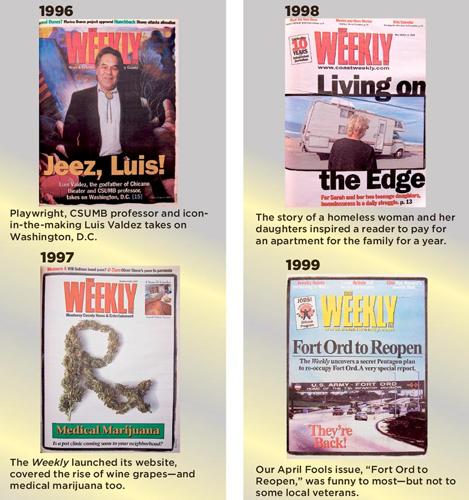
I will always remember what a blessing it was to one of the "Loma Preita refuges" who ended up in Carmel working at the brand new Coast Weekly Newspaper.
Thank you, I am proud to have been part of those early days. Best wishes, Julie Harger Cordero
Welcome to the discussion.
Log In
Keep it Clean. Please avoid obscene, vulgar, lewd, racist or sexually-oriented language.
PLEASE TURN OFF YOUR CAPS LOCK.
Don't Threaten. Threats of harming another person will not be tolerated.
Be Truthful. Don't knowingly lie about anyone or anything.
Be Nice. No racism, sexism or any sort of -ism that is degrading to another person.
Be Proactive. Use the 'Report' link on each comment to let us know of abusive posts.
Share with Us. We'd love to hear eyewitness accounts, the history behind an article.