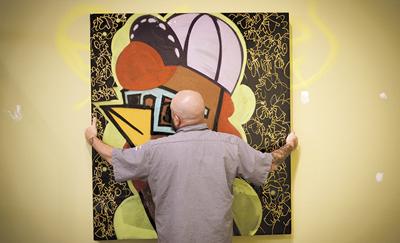

Liam Da Leo is not the real name of the Salinas graffiti artist whose solo show opens this Friday at the National Steinbeck Center. He says he doesn’t want his real name disclosed because he’s on probation.
He was born and raised in Salinas. His father drove ag trucks, his mother worked in “the cooler” packing vegetables, so there was a lot of movement up and down California per season. There was also fighting in the lead-up to his parents’ divorce, so Liam, now 30, would escape the turmoil by finding quiet at the train tracks of the Salinas Amtrak station two blocks away. That’s where he saw it.
“Almost all of [the cars] had graffiti on them,” he says. “It blew me away that people were painting on the train, using them as canvases. And that they would move around, these cargo trains.”
Growing up, gangs and tagging were everywhere, but this was different, artistic and flamboyant—especially one piece on a plump grain car called a “gray belly” by someone named Pear.
“It said ‘Salinas’ above his piece. Someone from Salinas was doing that level of art on the train.”
He started practicing, drawing, watching, mimicking and spray painting. He got arrested; he tested his mom’s faith. But he was getting better. In 2010 he got into his first exhibit, a solo show at SOMOS Gallery in Oldtown. He tried to stay anonymous at the opening, but he was asked by youngsters to sign their black books, their sketch pads. He did six more shows at SOMOS and one at Cherry Bean.
But the show at the Steinbeck Center is another level: 45 pieces painted on street signs and wood panels—which come cheaper than canvas—and on the museum walls. There are pieces he calls “remixes,” his own painted twists blended into thrift store paintings (like the work of Chris McMahon and Thryza Segal). There’s a part of the gallery where the work is attached to street poles, “like you’re walking down the street.”
“My art is like graffiti-influenced pop art with figurative cartoons,” he says. That includes portraits of women; Chespirito, a Mexican comedian; and Pedro Infante, his grandfather’s favorite actor, from the golden era of Mexican cinema.
“Everybody in the crew has lost a girlfriend over it.”
He also crafts religious iconography, zombified portraits with eyes blanked white, San Francisco-style lettering, a replica of a train car. It’s mostly acrylic, painted with a brush, with throw-ups (fast but elaborate lettering) on one side of the gallery. The artwork is buffing—covering up—the graffiti work. The show is called Respect Through Sacrifice,which is also the name of the Salinas graffiti crew Liam came up in. He explains the sacrifice: “Doing the work, going out and painting night after night, painting trains, going to jail, hard times with the family over that. Everybody in the crew has lost a girlfriend over it.”
Though Liam’s graffiti work is self-taught, gleaned from a communal and secretive subculture, he’s also studied and practiced in graphic design at Brooks College in Long Beach. He worked at Telemundo as a web master and headed its graphics, was a broadcast engineer for Univision, does touch-up and color correction work for photographers, and he tutors kids three days a week in CHISPA’s after-school program. He’s a professional.
He calls what he does “vandal art,” which he describes as akin to carving initials and a heart into a tree. But he says the show also represents a compromise between the Steinbeck Center, as an art institution giving graffiti their blessing, and a street artist who’s going straight.
“The artist has to change,” he says. “You have to see what’s really going to last for you, what you’re trying to accomplish. To be honest, the only thing I’m trying to accomplish is making my mom proud. I just want her to finally be like, ‘It was all worth it. My son’s an artist.’”
When the show opens during Oldtown’s First Friday Artwalk (which includes breakdancing, Dia de los Muertos and an author talk at the Steinbeck), it will be the first time Liam’s mom sees his solo exhibition in that 3,000-square-foot Ag 2 Gallery.
Meanwhile, graffiti and street art are enjoying (or suffering, depending on one’s point of view) another conflagration of mainstream attention.
Deborah Silguero, the Steinbeck Center’s curator of exhibitions and collections, suggests graffiti has earned stature by being employed in advertisements. She sees similarities in Liam’s bubble lettering to the work of local cartoonists Gus Arriola and Hank Ketcham, and links graffiti to ancient Greek and Roman origin.
“This is the kind of work Steinbeck would really like,” she says.
But all the references to mainstream pop or high culture or commercialism seem like attempts to give graffiti culture a kind of respectability it doesn’t ask for.
“We don’t use graffiti as an offensive mode,” Silguero says. “It’s an art form showcasing underlying social and political messages. That’s what we’re approving.”
The Steinbeck Center has put on an exhibit of youth and street culture before: What the Deck, skateboard art of Sept. 2009. But this is an overture of a different demographic—younger, more street.
“It’s opening the doors for the community here in Salinas,” Liam says.
RESPECT THROUGH SACRIFICE opens 5-7:30pm Friday, at National Steinbeck Center, 1 S. Main St., Salinas. Free. 796-3833, www.steinbeck.org.
(1) comment
Cool. Will be checking this out.
Welcome to the discussion.
Log In
Keep it Clean. Please avoid obscene, vulgar, lewd, racist or sexually-oriented language.
PLEASE TURN OFF YOUR CAPS LOCK.
Don't Threaten. Threats of harming another person will not be tolerated.
Be Truthful. Don't knowingly lie about anyone or anything.
Be Nice. No racism, sexism or any sort of -ism that is degrading to another person.
Be Proactive. Use the 'Report' link on each comment to let us know of abusive posts.
Share with Us. We'd love to hear eyewitness accounts, the history behind an article.