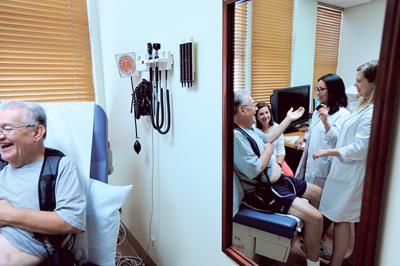
Here’s a surprising statistic: Cardiovascular disease is the underlying cause of a third of Monterey County deaths each year.
Perhaps more surprising: cardiovascular disease has long been the leading cause of death in the county – and the same goes for the country, which shows similar stats.
Though the rate of these deaths has been trending downward nationwide (it decreased 29 percent between 2001 and 2009), the numbers are still strikingly high. And, doctors say, many of these deaths are premature or avoidable.
Dr. Richard Gray, medical director of Community Hospital of the Monterey Peninsula’s Tyler Heart Center, says heart problems are the leading cause of hospital admissions for people 65 and older. One in five of those patients is likely to be readmitted within a month.
“I would say we have lots of work to do,” Gray says. A lot of that work falls on people to do the right things for their health.
Here are five tips to keep your ticker ticking:
1. Heart failure doesn’t just affect old men.
That’s a common stereotype, according to Gray. “It is the most common cause of death by far, several fold more than the highest form of cancer,” he says. Heart failure can even kill young mothers. A condition called postpartum cardiomyopathy affects women who just delivered a child. It comes on a few days to a week or two after childbirth, presenting serious symptoms like swollen ankles, fluid in the lungs, and shortness of breath. As if the pain of childbirth wasn’t enough.
2. Walking works.
Everyone know’s exercise is good for you, but it doesn’t have to be all-out Bikram yoga or contact football to have an effect. Walking works as well. Dr. Dipanjan Banerjee, a cardiologist at Stanford Medical Center, recommends 30 minutes of exercise five times a week. If you can’t find time to squeeze in half an hour a day, break it up into chunks, he says. Three ten minute laps makes things seem more palatable to a busy schedule.
3. Consistency is key.
Banerjee says, “You should only exercise on the days that you eat.” In other words, three or four times a week may not cut it. One tip he gives his patients is to start a routine.
“The earlier you start the easier it’ll be,” he says, “and the more consistent you are the easier it’ll be.”
4. Diabetes leads to heart failure.
Adult onset diabetes is a serious problem in Monterey County – it could affect as high as 6 to 8 percent of the population, Gray says. But the condition can be prevented or pushed back with a little work. One important factor here is diet: It’s crucial to limit foods that are high glycemic and calorie dense. For example, a piece of white bread with jelly is much worse for you than a piece of wheat bread with peanut butter.
5. Check around.
George Grimm, the subject of this week’s profile, had an advanced operation to install a left ventricular assist device [LVAD] into his heart. That’s the kind of procedure that can only be done in a handful of hospitals in the state, Gray says. And according to Banerjee, Grimm’s physician at Stanford, it’s a treatment that some doctors and patients may not be aware of. It would be wise to get a wide variety of options before settling on one medical plan, Grimm advises.
(0) comments
Welcome to the discussion.
Log In
Keep it Clean. Please avoid obscene, vulgar, lewd, racist or sexually-oriented language.
PLEASE TURN OFF YOUR CAPS LOCK.
Don't Threaten. Threats of harming another person will not be tolerated.
Be Truthful. Don't knowingly lie about anyone or anything.
Be Nice. No racism, sexism or any sort of -ism that is degrading to another person.
Be Proactive. Use the 'Report' link on each comment to let us know of abusive posts.
Share with Us. We'd love to hear eyewitness accounts, the history behind an article.