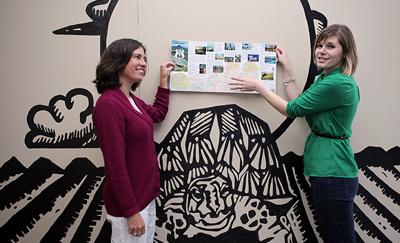
Elizabeth Welden-Smith’s sea-green copy of the Grapes of Wrath is dog-eared and littered with pencil strokes. The paperback’s condition is fitting, given its owner curates public programs at the National Steinbeck Center in Salinas. And it’s necessary, considering what Welden-Smith’s been doing all summer.
For months, she’s been planning a sprawling road trip to celebrate the 75th anniversary of John Steinbeck’s Pulitzer Prize-winning novel, published in 1939. The trip will reconstruct the journey of the Joads, the Dustbowl-era tenant family at the center of the story, who rode their rickety truck from Oklahoma to California in search of a better life.
The Steinbeck Center team, including a film crew and three artists, will cram into a single RV for their 10-day trip, which starts Oct. 4 in the Joads’ Oklahoma hometown of Sallisaw, then winds through Texas, New Mexico and Arizona before settling – like the family – into a migrant labor camp in Arvin, Calif. Along the way, they’ll partner with museums and universities, record oral histories and blog from the dusty trail.
“We were looking at how to make the Steinbeck festival relevant today,” says Colleen Bailey, the center’s executive director. She’s talking about the annual May festival that’s attracted Steinbeck lovers for more than three decades. “What did Steinbeck do when he wanted to freshen things up? He went back and listened to the stories of the people.”
That’s the team’s aim, too. The stories they collect will be presented at next year’s Steinbeck Festival.
To map the Joads’ route, Welden-Smith turned to the text. But planning it out was no easy ride.
In the 75 years since Steinbeck wrote the book, a lot has changed – and not just with things like the Civil Rights Movement and the dawn of the Internet age. The pre-1957 version of Route 66 has undergone vast transformation. Welden-Smith drove it twice to prepare.
“I had to figure out which parts of Route 66 were dirt, which parts you couldn’t take the RV into,” she says.
When she hits the road again in October, three artists will join her: Octavio Solis, an award-winning playwright who wrote the stage adaptation of Steinbeck’s The Pastures of Heaven; Patricia Wakida, a linoleum-block artist whose research into the Japanese internment of World War II sparked her interest in what people pack when they’re forced to quickly relocate; and P.J. Palmer, a filmmaker working on a documentary about Steinbeck’s friend, marine biologist Ed Ricketts.
Palmer and his film crew are taking the lead on collecting the oral histories. “In many ways, Steinbeck took the temperature of the country,” he says. “We’re going to do the same thing.”
The crew may find similarities between then and now: a sick economy, a worn people, a tense country.
“Re-reading [The Grapes of Wrath] today, it is so relevant. Terrifyingly relevant,” Welden-Smith says. “You could literally pull out sections of the book, and it’s like he’s writing about today.”
Take the most recent financial mess – what economists have often called the worst economic downturn since the Great Depression.
“The language he uses about the banking system is horrific,” Welden-Smith says. “He’s writing about it in a way you think, ‘It’s so bad, it’ll never happen again.’ And here it is, happening again.”
In one scene, Steinbeck writes: “The bank is something more than men, I tell you. It’s the monster. Men made it, but they can’t control it.”
Steinbeck contended that some things, like the unfailing capacity of financiers to repeat mistakes, don’t change. The team expects to encounter some hardscrabble stories of financial pain and economic misery. But they’re looking forward to uplifting tales as well.
“The other thing that doesn’t change is humanity and our ability to have compassion for our fellow man,” Welden-Smith says.
That too is a central component of Steinbeck’s works. His novels garner empathy for the worker, the migrant farmer, the low-down and roughed-up, the educated and kind.
“Partly what we wanted to talk about is what keeps people going,” Bailey says. “The Joads went through so much in that book, but somehow they keep putting one foot in front of the other. Not only are they trying to survive, but they’re trying to create life for their children and for their family. They’re looking out for other people.”
That’s not just Steinbeck’s story – it’s America’s.
(0) comments
Welcome to the discussion.
Log In
Keep it Clean. Please avoid obscene, vulgar, lewd, racist or sexually-oriented language.
PLEASE TURN OFF YOUR CAPS LOCK.
Don't Threaten. Threats of harming another person will not be tolerated.
Be Truthful. Don't knowingly lie about anyone or anything.
Be Nice. No racism, sexism or any sort of -ism that is degrading to another person.
Be Proactive. Use the 'Report' link on each comment to let us know of abusive posts.
Share with Us. We'd love to hear eyewitness accounts, the history behind an article.