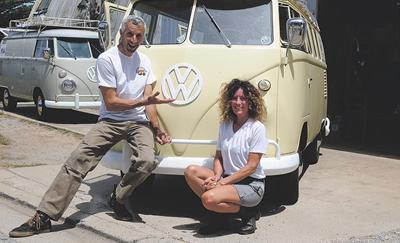
At 16, Jim Fowler vowed never to work on Volkswagens again. Now 52, he has run the Get Hot Bug Shop in Pacific Grove for nearly 30 years – and just turned the key on an unprecedented museum dedicated to the iconic VW bus. On a bus.
In high school, Fowler’s stepdad Ron moved the family to Prunedale and started a florist business where he delivered arrangements all over the Peninsula using three VW buses. The business became so successful, the buses couldn’t hold up to the wear and tear.
“At 13, he threw a book at me and said I needed to learn how to maintain them,” says Fowler, who quickly advanced from changing oil to replacing clutches. “I would come home from school and there would be a list of things to do to each bus. I hated it.”
But after a few years away from VWs, and still tinkering around, Fowler was working at a grocery store in Monterey when his co-worker’s girlfriend needed her VW clutch fixed, only she couldn’t afford the $400 bill. Fowler reluctantly showed them how to do it themselves.
“The most amazing thing happened when we were done,” Fowler says. “He gave me money. I had never been paid to work on VWs before.”
A light bulb – or an interior dome light – went on. He built up his own shop, which he moved to Pacific Grove in 1985. Today he occupies a space as special as the VW bus, a metal hangar behind the American Tin Cannery.
“The terror dome,” he says.
The mechanics of Volkswagens are also special, like their owners, he adds.
“The people who drive VWs just seem to be a little more easier going,” he says. “They understand that we are all flawed and we all have shortcomings, just like our cars.”
Fowler says the very simple design of the Volkswagen engine is economical and eco-friendly. It is air-cooled, meaning the car does not have a radiator, nor does it use anti-freeze. An air-cooled engine pulls in ambient air and pushes it down over the engine when it’s warm.
“There is just a lot less to go wrong, because it is very straightforward,” he says. “There is nothing extra that you don’t really need.”
It was this fascination that prompted another idea with a friend, former gallery owner and independent art curator Lisa Coscino. They started Flying ACE, a mobile Volkswagen museum focusing on sharing his favorite car – the Volkswagen – and the impact it had on mid-century American culture.
They found the perfect venue for the museum in Coscino’s 1960 muted yellow Volkswagen bus she long ago named “Lemon Drop.” The two friends are lemon-dropping in on public art events and vintage car shows; Flying ACE showed for the first time at the Pacific Grove Art, Wine & Music Walk on Lighthouse Avenue July 19. Their next appearances come this week, as they move from event to event spreading bus love.
Coscino’s fascination with the make came more organically than Fowler’s.
“I grew up with Herbie the Love Bug,” she says. “My dad drove his bus from Chicago to Los Angeles for the opening of Disneyland in the mid-’50s.”
She has owned mostly VWs in her life and recently went back to them after her current car proved to be unreliable.
“I dream about Volkswagens,” Coscino says. “Jim and I came up with the idea of restoring mid-century culture, using the VW as symbol of mid-century mobility.”
In 2012, Coscino was curator at the Museum of Monterey and had a show called “Music, Love and Flowers” and felt a VW bus would be perfect for the lobby. She had an old one in her garage and wanted to get it fixed up, but it wasn’t in proper shape to be shown in a museum. Her current mechanic recommended Fowler for all-things-vintage VW and he lent his 1966 Camper Conversion for the show. The two VW hounds became good friends and the VW in the lobby was a huge hit.
“That VW brought lots of touching stories from people about their history with their cars,” she says. “This one thing spurred all this nostalgia.”
The Lemon Drop is loaded with notes, photos, old Volkswagen ads, magazine clippings and scale models of old VWs. One corner enjoys a connection to Carmel Valley’s Bernardus Lodge: Its owner, Ben Pon, is son to Ben Pon Sr., who imported the first Beetle to the United States in the late 1940s and is credited for the drawing that inspired the VW Type 2 Transporter, better known as the VW bus.
“I really think museums should be community spaces and there is a great opportunity to talk about care of these simple engines,” Coscino says. “My car is 53 years old and it’s my daily driver. If I want it to be around in 50 years, someone is going to need to know how to take care of it.”
(0) comments
Welcome to the discussion.
Log In
Keep it Clean. Please avoid obscene, vulgar, lewd, racist or sexually-oriented language.
PLEASE TURN OFF YOUR CAPS LOCK.
Don't Threaten. Threats of harming another person will not be tolerated.
Be Truthful. Don't knowingly lie about anyone or anything.
Be Nice. No racism, sexism or any sort of -ism that is degrading to another person.
Be Proactive. Use the 'Report' link on each comment to let us know of abusive posts.
Share with Us. We'd love to hear eyewitness accounts, the history behind an article.