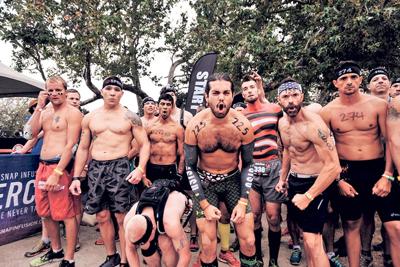
I didn’t expect the screaming.
Not that it isn’t understandable. The man next to me is trying desperately to hold onto the rope ripping skin from his hands, since it’s tied to a 5-gallon painter’s bucket filled with cement that he’s pulled almost all the way to the top of a 30-foot structure. Once it’s there, he’ll have completed the second-to-last obstacle out of more than 25 – over the course of 12.6 miles – leaving only 50 yards and four large men with pugil sticks between him and the finish line. But his calf is cramping painfully, and he can’t stretch it without letting go of the rope.
So he’s screaming – and begging for someone to help him stretch his leg. If he drops the rope, he has 30 draining “burpees” as a penalty before he can proceed. Like one race official says, “There isn’t an out.”
Other unexpected elements appeared at last weekend’s “Monterey Beast” race at Toro Park, like spear throwing, vomiting, smoke bombs, tractor tires and the sheer number of people who pay hundreds of dollars for the privilege to experience extended periods of pain.
But confronting the unexpected is the whole point of the Spartan Race series, the unforgiving and increasingly popular obstacle races which include 650,000 folks taking on 34 races nationally and another 30 worldwide in 2013.
“The fear of the unknown is a powerful fear,” Spartan spokesperson Carrie Adams says. “We don’t release the course map. We don’t even say how long it is. People have to think, ‘I’m just going to the start line. I have to finish.’ That does work some magic on you.”
• • •
One day Spartan’s founder, former trader Joe DeSena of Vermont, asked one of his racers what kind of events she liked to do. When Adams – who would go on to join the company – told him 50-mile super marathons, he had a simple reply.
“That’s cute.”
Sounds facetious. It was also real.
“He wasn’t being condescending, he wasn’t being mean,” Adams says. “He was just reacting given his experience.” That’s the kind of perspective one acquires after doing the 135-mile Badwater ultramarathon through Death Valley, the Lake Placid Ironman and 100-mile Peak supermarathon in Vermont – in 10 days.
DeSena says his experience with the 70-mile overland eco challenge called The Death Race seeded Spartan’s DNA.
“We know that deep down inside people need to be tested, pushed, and compete to achieve a feeling of accomplishment and, ultimately, greatness,” DeSena says. “We provide the venue for that to take place.”
Outside Magazine recently named the Spartan the best obstacle race of the year.
“Anyone who completes the Beast not only gets through races more easily,” DeSena adds, “but gets through life more easily.”
Empowerment is a critical theme with these Beasts, top to muddy bottom.
“The more time you spend with Joe,” Adams says, “the more what you think is possible is not even the beginning of it.”
• • •
Of all the things that proliferate at a Spartan Beast – bare chests and back tattoos, Camelbaks and military types – the most overwhelming ingredient is dirt. It gets in your ears, in your eyes, in your socks and in your snot. It gets so into your shorts that they still weep muddy water after 10 rinses.
“You definitely earn your mud,” Adams says.
Two minutes into the race, a big sloshing mud pit precedes mounds of soil to crawl over. Later, three swaths of mud as long as 50 yards – with barbed wire 20 inches above – are made muddier by staffers with fire hoses. Dusty dirt clouds consume slippery downhill trails – some of which aren’t actually trails, but sketchy shortcuts through brush to connect roads – and rise behind tractor tires as they’re dragged along.
Of all the challenges, though, the most brutal is a different type of earth. It’s tougher than scaling an 8-foot wall. It’s more draining than climbing a 20-foot rope out of a mud pit to slap the bell at the top. It’s more demanding than pulling cement blocks up and down a slope by a chain. It’s the Toro Park terrain itself: rugged, rocky and ruthlessly steep. One race official called the circuit the second meanest ever made. Maybe so, but it’s hard to imagine a steeper one. As another official says, “If there are hills in a race, we will find them.”
That included the crushing mile-long (yes) hill at the heart of the race. After I reached the top of almost straight-up Barlow Canyon Trail – past the signs that read “Almost there” and “Just kidding” and passing fitter athletes who I learned later were wisely banking some energy – I threw up.
While you might not know what’s coming at the start, as you climb Toro’s hills, the next tough trail becomes visible on the neighboring mountain, etched like cruel calligraphy writing a will-shaking fate. Looking at one, I couldn’t help but think This fitness is a form of sickness.
• • •
The Rocky music was a hint this next barrier would be bastardly.
We had just climbed an inverted wall when it became audible and the accompanying task came into view: filling a huge bucket with decomposed granite and carrying it up and back down a slippery dirt hill on a skinny trail without putting the bucket on your shoulder.
Rocky’s voice comes over the speaker. “Lemme tell you something you already know: The world ain’t all sunshine and rainbows… ”
Racers stumble on the hill, fingers desperately clinging the bottom of the bucket. Many stop, chests heaving.
“It’s not about how hard you can hit. It’s how hard you can get hit,” Rocky continues, “how much you can take and keep moving forward.”
Some of these Beasts travel across the country for a chance to scale cargo nets and monkey bars (30 burpees if you fall). Some tell me on the course they do it to stay fit, others just to see if they are fit enough. The first flight of athletes to finish does it professionally, as part of the Spartan racing’s aim to make obstacle competitions their own sport.
Those Spartan leaders have their own motto when it comes to why folks do it: “You’ll know at the finish line.”
They’re only partly right. You also know when the group you’re in screams “I am a Spartan!” as you run through the smoke bombs at the start. You know when your knees start screaming on the hills. You know when the volunteers and crowd scream for racers to keep climbing. You know when you subconsciously scream after your spear sticks in its target on your one-and-only attempt, no burpees needed. You know when the poor cramping Beast to your left screams for help. And you know when you keep on moving, looking for the next hill.
THE SACRAMENTO SPARTAN BEAST happens on Oct. 26 at Van Vleck Ranch in Sacramento, Calif. $110-$205. www.spartanrace.com
(0) comments
Welcome to the discussion.
Log In
Keep it Clean. Please avoid obscene, vulgar, lewd, racist or sexually-oriented language.
PLEASE TURN OFF YOUR CAPS LOCK.
Don't Threaten. Threats of harming another person will not be tolerated.
Be Truthful. Don't knowingly lie about anyone or anything.
Be Nice. No racism, sexism or any sort of -ism that is degrading to another person.
Be Proactive. Use the 'Report' link on each comment to let us know of abusive posts.
Share with Us. We'd love to hear eyewitness accounts, the history behind an article.