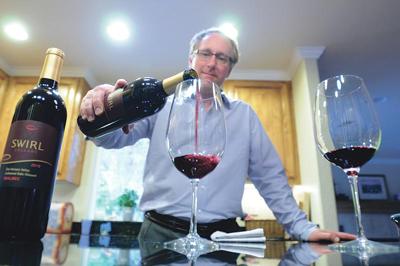
Monterey Malbec has such a nice ring to it, but good luck finding one. Overshadowed by the “Big Three” of the Santa Lucia Highlands – Chardonnay, Pinot Noir and Syrah – the oft-overlooked Malbec grape is sadly underrepresented in Monterey’s cadre of excellent wines.
Not so elsewhere. By French law, Malbec is one of only five grapes from which world-renowned red Bordeaux must be made. In neighboring Cahors, Malbec is the grape, and wines from this region must contain at least 70 percent Malbec. In Argentina, Malbec is the king, and nearly synonymous with wine.
One would think a grape so important elsewhere would make its way onto the California wine-growing scene and into some of Monterey County’s best bottles. There have been some attempts, like Galante’s ’09 Ace High, Château Julien’s ’07 Private Reserve, and a few blends, but by and large, local wineries have eschewed the varietal.
Enter David Ginn and his newly released Swirl Cellars 2010 Lockwood Oaks Malbec. Sourced from a single vineyard in the San Antonio Valley – Monterey County’s newest (2006) and southernmost AVA (American Viticultural Area) – the wine is 100-percent Malbec and a pure expression of the varietal. Surviving 100-degree days and 50-degree drops nightly, stressed vines yield robust grapes with richly colored skins, concentrated flavors and ample tannins, making for rich, full-bodied wines.
Like his favored grape, Ginn is a relative underdog among established local heavyweights, yet the affable DLI graduate (who speaks Russian) and self-taught oenologist will tell you he’s enjoying the challenge. That’s surprising given Ginn is truly an “accidental winemaker.” While living in Salinas and working as a financial analyst for UC Santa Cruz, Ginn’s housemate Jimmy Gipe received a call from a friend who had taken a job in SoCal – and was abruptly leaving six barrels of wine, aging in a ramshackle shed off Highway 101, in their care. Ginn, then a beer guy who rarely drank wine – and certainly knew nothing of winemaking – decided to look into it.
After purchasing the book From Vines to Wines, the two began a quick study that Ginn describes in retrospect as an OCD-driven, head-butting process of trial and error. The results? Three barrels so bad even their creators wouldn’t drink them, and the other three produced two gold medals and one silver at the 2002 Sonoma County Harvest Fair.
“People loved them,” Ginn recalls. “They asked, ‘How did you do it?’ and I said, ‘I don’t know.’”
Ginn laughs now, but he goes on to say the initial success “got him hooked.”
Over the next several years, Ginn and Gipe refined their craft, experimenting with different varietals, blends, and winemaking methods, tapping the generous advice of another friend who had previously worked in Bordeaux, and even taking weekend jobs in Scheid’s tasting room. They were learning and having fun, and their enthusiasm kept it fresh and exciting – they were willing to try almost anything if the grapes presented themselves, which ultimately included everything from Temperanillo to a Petite Sirah-Viognier blend.
Later, as Gipe’s attention focused elsewhere, Ginn went to work for Constellation Brands (owners of Blackstone Winery and many others), applying his finance background to the numbers behind the wines while capitalizing on access to winemakers.
Eventually Ginn’s friends, enamored with his homemade wines year after year, began suggesting he start his own label. Ginn finally agreed, but now admits, “I was scared to death because, being a financial analyst, I knew how dumb it was.”
The timing was ultimately serendipitous, though, because the fallout from the 2008 recession soon made the financial analyst business less palatable, while simultaneously granting unprecedented access to professional winemaking facilities as less fortunate boutique wineries went out of business.
For his inaugural vintage, a small and financially safe production of 77 cases, David chose Malbec because of its quality source and his natural predilection for “oddball varietals,” joining the ranks of local varietal pioneers Eric Laumann of Ludwig and Cambiata wineries and Joel Burnstein of Marilyn Remark.
When asked about the future of his label, Ginn quips, “As long as it remains fun and I don’t go broke, I’ll keep going.”
The 2010 certainly works wonderfully with leaner beef cuts like filet mignon; lamb; game meats like venison, bison, elk and wild boar; pancetta – or bacon-wrapped pork; roast duck; barbecued anything; and bordelaise and peppercorn sauces. With the ’11 Malbec going to bottle, and the slightly larger ’12 vintage in barrels, Swirl Cellars appears to have staying power. Ginn says he’ll let the quality of the grapes dictate future varietals, though you can count on Swirl Cellars to keep it interesting.
SWIRL CELLARS WINES ($18) are available at Terranova in Monterey, Grove Market in Pacific Grove, or Star Market in Salinas, or at d.ginn@sbcglobal.net or 710-0621. Also available at Passionfish, la Balena, Mission Ranch, il vecchio and Fifi’s restaurants.
(1) comment
This is a FANTASTIC wine! Happy to see it at Il Vecchio and Bay of Pines. Looking forward to the next vintage.
Welcome to the discussion.
Log In
Keep it Clean. Please avoid obscene, vulgar, lewd, racist or sexually-oriented language.
PLEASE TURN OFF YOUR CAPS LOCK.
Don't Threaten. Threats of harming another person will not be tolerated.
Be Truthful. Don't knowingly lie about anyone or anything.
Be Nice. No racism, sexism or any sort of -ism that is degrading to another person.
Be Proactive. Use the 'Report' link on each comment to let us know of abusive posts.
Share with Us. We'd love to hear eyewitness accounts, the history behind an article.