
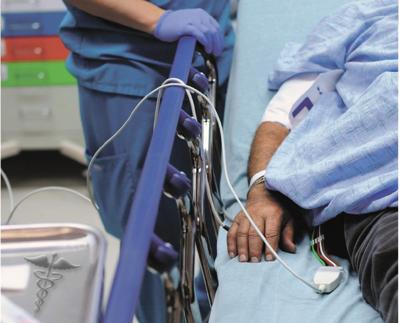
Where the man’s mouth had been, there was just ragged bloody tissue. He had no tongue or lower jaw. The shotgun blast wasn’t deadly, but it did tear off the front of his face.
Paramedics arrived and radioed for helicopter paramedics. The ambulance drove him to Natividad Medical Center in North Salinas, where a CalSTAR helicopter would meet him and fly him to the nearest trauma center, San Jose Regional Medical Center, 50 miles away.
He was alive, but bleeding could clog his airway or swelling could seal it completely during the 21-minute flight. As Natividad’s Emergency Department Director Craig Walls, M.D., says, “A whole number of bad things can happen in that situation.”
The man remained conscious the entire time, communicating with paramedics and doctors by writing. Before loading him into the helicopter, a surgeon at Natividad dissected the man’s neck, and inserted what’s called an endotracheal tube so he could breathe. Twenty minutes later, he was taking off just outside of Natividad’s emergency room doors.
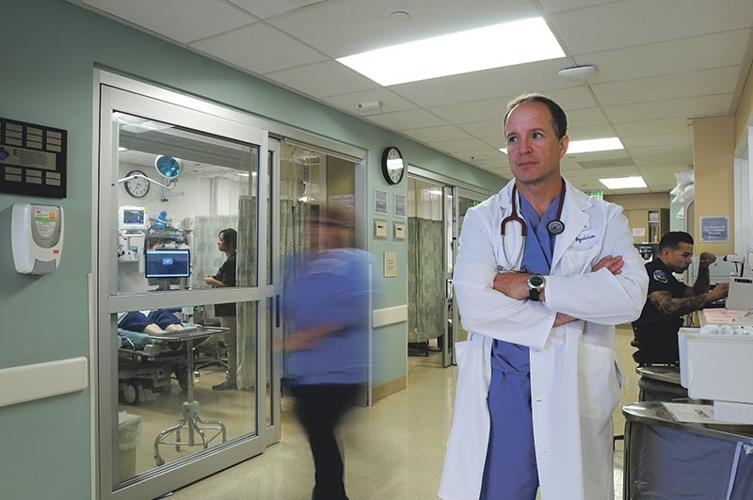
Walls tells the story with surprising calm while working the ER on a Friday night – usually the busiest time, but it’s an unusually quiet night. The highlight: when a delighted Walls successfully deploys a suction cup to extract a yellow pellet from a child’s ear. Duly inspired, docs trade stories of cockroaches crawling into ear canals – a surprisingly common thing – with a constant chorus of babies wailing in the background. Corrections officers come and go with inmates handcuffed to hospital beds. It’s not until a nurse says “peanut butter” and “possible anaphylaxis” that there’s much excitement, as one doctor leaps from his seat to examine a crying, rashy toddler.
Word comes a man was shot on East Market Street in Salinas but died on scene – meaning no trauma victims that night. If he’d survived, like all trauma victims who risk bleeding to death, the decision-making protocol today is generally to get them out of town as fast as possible, because there’s no designated trauma center locally, where on-call doctors and technicians stand ready any time a disaster happens.
The county intends to change that, and this month receives two competing proposals – one from Natividad, the other from Salinas Valley Memorial Healthcare System – on why each considers itself the right place to treat people who can just barely be saved.

Treat Local: Dr. Dave Ramos of Memorial Hospital wants to see costly treatment dollars stay in the community rather than get spent in San Jose.
The man who lost his face to a shotgun blast survived. Medical bills like his could help a hospital do the same. But even as the two hospitals compete against each other, aiming to win the bloodiest patients, they’re not sure how many of them there will be, how much they’ll pay or even how many lives they’ll save.
• • •
Three days after Dave Ramos, M.D., joined the ER staff at Memorial Hospital in 1998, a motorcyclist riding 100 miles per hour on Blackie Road flew off his bike at a curve, hit a berm, then thudded into a telephone pole. He’d been moving so fast that all his clothes were torn off as he flew through the air.
In those days, trauma victims regularly landed in the ER, says Ramos, now emergency department medical director at Memorial.
“What happened to those chests I used to cut open regularly?” Ramos asks. “I like that stuff.”
A 2005 county trauma plan happened. That plan formalizes the policy that first responders send patients to the nearest designated trauma center.
THE MAN WHO LOST HIS FACE TO A SHOTGUN BLAST SURVIVED. MEDICAL BILLS LIKE HIS COULD HELP A HOSPITAL DO THE SAME.
Trauma is damage to the body by force, whether that’s the force of a weapon like a bullet or a knife, or a car windshield. It’s the graphic stuff depicted in vivid slow-mo detail on forensic crime TV shows. Many trauma wounds are internal and invisible, what Ramos calls “a bad piñata party.”
There are plenty of medical emergencies that merit speedy attention at the ER – anaphylaxis, heart attacks, strokes – but trauma injuries are those that suddenly disrupt human anatomy, and usually require surgery to stop bleeding.
And they require that surgery fast.
Paramedics determine within 30-60 seconds whether someone’s suffered a trauma, then aim to get them into an operating room within the “golden hour,” the short 60-minute window that gives the best shot at survival. Without that rapid response, blood pressure rapidly drops and patients risk dying or suffering permanent brain damage.
In other words, there’s no waiting around in the ER. Doctors and nurses attend immediately to these desperate patients, and a trauma coordinator oversees the rapid dance that must occur between different docs diagnosing internal injuries, neurosurgeons evaluating possible head injuries and the operating team.
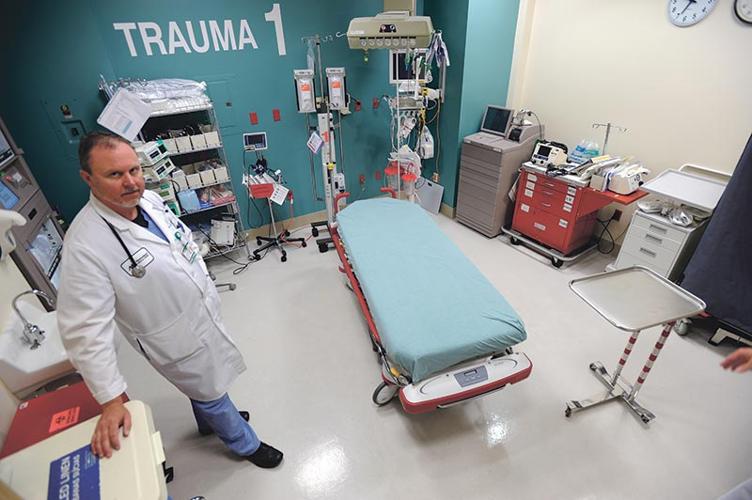
Most differences between a regular ER and a trauma center are invisible to patients, but on-call specialists are on site 24/7, and some simple practices – like rearranging the furniture in a trauma bay – make it easier and quicker to grab supplies.

Treat Local: Dr. Craig Walls of Natividad Medical Center wants to see costly treatment dollars stay in the community rather than get spent in San Jose.
Only the closest trauma center to most of Monterey County is almost 30 minutes away, even by chopper.
• • •
A map of California trauma centers shows 29 carefully planned regional systems with two notable gaps: one in Solano County, and another, much larger one, in Monterey County.
“There’s this black hole along the coast where we have trauma centers in Santa Clara County and Santa Barbara County, and in between there are none,” says Kirk Schmitt, director of Monterey County’s Emergency Medical Services Agency.
It’s up to local jurisdictions – in this case, the Monterey County Board of Supervisors – to vote on which hospital becomes a trauma center. Then the American College of Surgeons, which developed the modern training and criteria in 1980, verifies whether a hospital meets their rigorous standards.
The county put out a request for qualifications last year, and Natividad and Memorial each paid a $15,000 application fee and signaled an intent to respond by the deadline, Aug. 16.
At that time, a secretive review process begins. Four out-of-state health care industry professionals, selected by Schmitt, have been chosen to review the two hospitals’ proposals (which will remain confidential), and recommend the better candidate to the Board of Supervisors.
The identities of the reviewers will also be kept confidential. “We don’t want undue pressure or harassment put on them by lobbyists or other individuals,” county Purchasing Officer Mike Derr says.
The four-person panel will be compensated $6,000 each, including their travel for site visits to each hospital. (A fifth individual gets $4,000 to facilitate the process.)
They’ll pore over each hospital’s readiness to meet protocols according to the American College of Surgeons’ standards for a level II trauma center. (Level I provides more on-call specialists, like pediatrics, and serves as a research hospital; Monterey County is aiming for level II, which offers fewer specialists, but provides immediate life-saving trauma care for most incidents.)
If one hospital or the other wins designation, it means all of those patients – the county estimates about 650 a year – would be directed there.
Three-quarters of a mile from Memorial’s ER, there’s an office building parking lot where they propose to land helicopters for trauma patients that need to be flown in. After landing, patients would take an ambulance ride to the ER, adding precious minutes to their transit time.
Natividad, meanwhile, has a helipad just about 100 yards beyond its ER doors, and can wheel patients from a helicopter directly into the trauma bay. Natividad officials pitch this as one of their competitive advantages in the selection process, since Memorial’s already got a deep bank of specialists – including a neurosurgery team that Natividad may try to woo away if it wins the county’s designation.
Natividad Chief Medical Officer Gary Gray, M.D., acknowledges the helipad would likely be used in just a small fraction of cases, but he says the whole idea of trauma care is readiness and speed even for those rare hypotheticals. “The primary strength is having it there when you need it, which is not relative to how many times you use it,” he says.
Another contrast between the two hospitals, though subtle: the cultural take on trauma and trauma prevention.
“Trauma is an epidemiological illness,” Ramos says. “It runs in families. The same mom who didn’t put her kid in a carseat, that kid will do the same.”
Doctors and staffers at Memorial often talk up outreach to stop texting while driving or driving drunk.
The vibe is different at Natividad, where the ER is full of corrections officers watching inmates cuffed to their hospital beds. When Walls talks about trauma, there’s a creeping sense of resignation – prevention efforts seem more like a pipe dream.
“The majority of the trauma we see here is violence right here in East Salinas,” Walls says. “It’s a very rare patient who falls off a cliff in Pinnacles.”
When Walls thinks of prevention, he considers efforts like the Wraparound Project in San Francisco, where former gang members will attend to victims at the bedside in hopes of intervening – not outreach on why it’s a bad idea to text and drive.
Despite their cultural differences, the two hospitals have quietly renewed talks of a possible merger a year after Memorial’s board of directors flatly rejected an offer by Natividad to join forces.
Both hospitals have top-notch, dedicated doctors and medical staff, and a will to up their game. They’ve each already invested in improvements to speed up operating room procedures in an effort to prove themselves to the county’s review panel. And they each talk up the benefits becoming a trauma center would generate for all patients: Quicker lab and X-ray results, for example, would likely improve patient experience, and the overall quality of the ER.
After the county’s panelists visit each hospital, Derr and Schmitt will take their recommendations to the County Board of Supervisors, which gets the final say on how to proceed. If the process moves along as scheduled, a trauma center could be up and running as early as Jan. 1, 2015.
In 2010, the Monterey County Grand Jury – which watchdogs local government and services – prodded for urgency, reporting, “A local trauma center is long overdue.”

Feeling the Pain: Less than 5 percent of their ER patients at Memorial Hospital today are trauma patients. “If Natividad gets [the trauma center designation], it will hurt a little bit, but it’s not like it’s going to hurt that much,” CEO Pete Delgado says.
The seemingly safe assumption is that a local trauma center would help save lives – but some debate even that.
• • •
As a bullet or shard of glass strikes human flesh, the margin between life and death can be as small as a millimeter. Doctors aware of the tiny margin of error gather information and deploy treatments with utmost precision. So it’s fair to assume some precision when evaluating how many people could actually be saved if Monterey County had its own trauma center.
“BLUNT INJURIES USUALLY HAPPEN TO INDIVIDUALS WHO ARE INSURED, SHARP INJURIES TEND TO HAPPEN TO PEOPLE WHO ARE UNDER-INSURED.”
But the doctors closest to the project won’t go there.
Ramos can’t recall any examples of lives that might’ve been saved if only SVMH had been a trauma center and saved invaluable transit time.
“Maybe because I’m arrogant,” he says. “You’re asking me a question that subconsciously I have a blind spot to.”
Walls agrees. “You’re not going to have anyone tell you someone died because we didn’t have the right stuff,” he says. “I think it’s just a question of improved care. There’s no calculus that says, ‘X many lives will be saved.’”
What we also don’t know: how the severely wounded patients who go to the out-of-county trauma centers fare today. Santa Clara Valley Medical Center could not provide figures on how many Monterey County patients they treated for trauma died, and if they fared better or worse than local patients. San Jose Regional Medical Center did not respond to request for those figures.
Closer proximity, though, helps get a patient to the operating room within the golden hour, meaning better odds for survival, according to doctors. The U.S. Centers for Disease Control, responsible for gathering and reporting federal data on illness and injury, agrees. CDC reports receiving treatment at a trauma center can improve the chance of survival by 25 percent.
But there is no county trauma registry, a data hub for the various hospitals that treat local trauma patients that shows how they do. Shmitt says that would change if there’s a designated level II, which would also crunch those numbers. For now, experts don’t know, or aren’t telling.
Hospital officials talk up other benefits of local trauma centers: easier family visits, cheaper medical bills. Transport alone can exceed $30,000, according to the grand jury.
But Santa Clara County Chief Executive Jeff Smith, a physician who’s also that county’s top government administrator, doesn’t think Monterey County needs its own trauma center. In fact, he thinks three is one too many for Silicon Valley, and hopes to revisit the county’s designation process.
“I was surprised when I heard Monterey County was interested in a trauma center,” Smith says. “We have more trauma centers here than we actually need, which means it’s quite easy for us to absorb the patients from Monterey.”
Besides that, Smith’s not sure there are enough patients – and with enough insurance – to make a trauma center in Monterey County viable.
“That’s not to say it couldn’t be done,” Smith says, “but in order to make a trauma center profitable, or at least not lose lots and lots of money, the total number of patients needing care has to be fairly significant.”
• • •
In a presentation to the County Board of Supervisors in April, consultant Steve Valentine, president of the Camden Group, laid out a challenging economic time for health care. “Many hospitals have really struggled to keep their expenses in line with much more difficult revenue streams that are coming,” he said. Valentine is the latest in a long list of consultants, hired both by the county and Memorial, offering up dire predictions for how the business is about to be upended as health care reform rolls out.
The way hospitals get paid is changing. The guiding principle of health care reform is that it’s cheaper to keep patients out of the hospital, to incentivize wellness – but the way health care has traditionally functioned is by billing patients for care they receive when they get sick. In short, more patients has translated to more revenue.
There are also big changes coming for health insurance, and how many pennies-per-dollar insurance companies will pay back hospitals for what they bill. Until the new health care exchanges, where people can go to buy insurance, go live, no one knows exactly what the new reimbursement rates will be. But industry experts expect hospitals to get less than what they do today.
That helps explain why Memorial and Natividad, facing a treacherous business future, are willing to invest big in the opportunity to serve trauma patients. SVMH estimates an expense of $2-$4 million to staff and equip a trauma center. Natividad isn’t willing to provide an exact figure, but a 2011 business plan Powerpoint presentation shows the anticipated cost is $20 million.
Now, two years later, Natividad CEO Harry Weis says that number is probably 20 times too high.
If they know what it will actually cost and how much revenue they’ll generate, they’re keeping it quiet.
“There’s a cost associated with trauma,” says Gray, Natividad’s chief medical officer – even if that cost projection ranges anywhere from $1 million to $20 million. “We’re comfortable that despite the investment we’re able to meet patient needs and generate new revenue.”
Those numbers will stay confidential in the hospitals’ responses due next Friday, where each is required to provide “a definitive statement regarding their financial ability to perform the requirements,” according to the county’s request for qualifications.
While there’s no universal figure for how much it costs to run a trauma center, it’s certainly expensive, due to staffing costs alone. A trauma surgeon, as well as specialists like cardiothoracic surgeons, neurosurgeons, orthopedic surgeons and radiologists, need to be available 24/7. Not just by pager, but actually on the hospital campus.
Also unknown: exactly how much revenue comes with taking care of trauma patients.
In car accidents, car insurance kicks in to help pay for medical care. But for penetrating injuries, like those in shootings or stabbings, patients have just their health plan to fall back on – if they have one.
“Blunt injuries usually happen to individuals who are insured, which is a crass way of saying it,” Smith says. “Sharp injuries tend to happen to people who are under-insured.”
Usually, there’s far more accidental than violent trauma, blunt injuries like car crashes and falls – which is better for the bottom line. That’s the case at UC Davis Medical Center, for example, where the ratio of blunt to penetrating trauma is about 6:1.
Not so in Monterey County, thanks to events like those of the past two weeks, which have seen a devastating run-up of violence in Salinas. Among the 241 trauma patients who were flown out of Monterey County last year, the ratio was was 2:1.
In short, while both Salinas hospitals are eager to capture more cash from trauma patients, how much cash there will be to capture is another uncertainty.
Maybe that’s appropriate. If there’s one unifying fact of trauma injuries, it’s uncertainty. Internal injuries are often hard to diagnose, and survival is often up in the air.
Hence the high stakes and exacting skills that come into play as doctors and surgeons react swiftly and precisely – with as much concrete data as possible. That surgical precision contrasts dramatically with the vague – and often absent – figures that hospitals are banking future revenues on.
(2) comments
If a patient wants better and quicker medical services, he should choose to treat his problems at a private clinic. For example, the nursing homes in Brownsville, TX are private, but here come only older people who need special care and 24 hours attentions because of their medical problems.
Everybody should support and help the local hospital services, of course, if the person can. But nowadays, increasingly more people go to private clinics to treat their medical problems. For instance, at http://www.usatc.com/ the clinic provides physical therapy for pain or for other conditions that can be treated in this way.
Welcome to the discussion.
Log In
Keep it Clean. Please avoid obscene, vulgar, lewd, racist or sexually-oriented language.
PLEASE TURN OFF YOUR CAPS LOCK.
Don't Threaten. Threats of harming another person will not be tolerated.
Be Truthful. Don't knowingly lie about anyone or anything.
Be Nice. No racism, sexism or any sort of -ism that is degrading to another person.
Be Proactive. Use the 'Report' link on each comment to let us know of abusive posts.
Share with Us. We'd love to hear eyewitness accounts, the history behind an article.