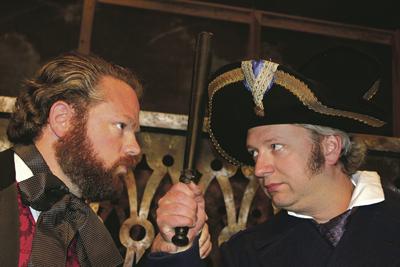

Les Miserables is one of those Broadway musicals that defines the Broadway musical – big, populist and sentimental. Based on Victor Hugo’s massive historical novel of the same name, the stage version – music by Claude-Michel Schonberg, story by Alain Boublil, lyrics by Herbert Kretzmer – went on to win over audiences like a conquering army, picking up eight Tony awards in its path. It’s at or near the top of lists of the longest-running, the most grossing, the most performed of musicals, recently commemorating its 25th anniversary.
Maybe because of its popularity, exemplified by the T-shirts and posters of Émile Bayard’s 19th-century illustration of little waif Cosette (and the recent blockbuster movie starring Hugh Jackman, Russell Crowe and Anne Hathaway), Les Miz gets dismissed as pop entertainment. And it is. But it goes all out for its laughter, tears and blood.
Monterey Peninsula College Theater has aimed well with this production to reopen their main theater after two years and $9 million of renovations.
The story starts in 1815 France, when convict Jean Valjean (Sean Boulware) is released after 19 years for a minor crime and resolves to live more nobly. It weaves in many characters’ lives and stories of personal dramas, dangers and loves, encompassing politics, religion and justice. It crescendos at the barricades of the 1832 Paris Uprising, and concludes on a bittersweet coda.
Along the way we get to know a vast cast including Valjean and his tenacious nemesis, police inspector Javert (Rob Devlin); the tragically fallen Fantine (Michelle Boulware) and her daughter Cosette (Hadley Sprague as a child, Lori Schulman as a young woman); the idealistic student revolutionary Marius (Dale Thompson) and his friend Eponine (Kayle Wilson as a child, Megan Root as a young woman); plucky little urchin Gavroche (Isaiah Boulware, who yells: “Think you know what poverty is? Follow me! Follow me!”) and many others. We get to know a strata of 19th-century French society, delivered through smart lyrics and sung through in song. And song is what Les Miz is all about.
There’s a song about the light of life swallowed up by poverty and desperation in the canonical “I Dreamed a Dream”: “I dreamed that love would never die/ I dreamed that God would be forgiving.” (This is the one that might have won Hathaway her Oscar.)
The ascending arpeggio strings during Jean Valjean’s first solo offer Boulware a ladder to stand tall and blast out “Who Am I?” That’s followed by one of several sad numbers, “Fantine’s Death/ Come to Me,” a duet between Fantine and Jean Valjean; that’s interrupted by “The Confrontation,” a dueling duet between Valjean and Javert with rock opera allusions, ending in a sort-of medley that brings back the “I Dreamed a Dream” melody.
The acting is solid and the music and singing is excellent, but it isn’t groomed to banality or produced to the pomposity of, say, the big 25th Anniversary concert performance at London’s O2 arena. It’s clear what some grit gives to one of the most gleefully wicked songs, “Master of the House,” sung with comic relief by the thieving Thenardier inkeeper couple. Chris Beem takes the lead with a dagger of a smile, dancing with the clackety movements of a marionette: “Master of the house/ Keeper of the zoo/ Ready to relieve ‘em of a sou or two.”
His wife and partner in graft, Madame Thenardier (Jennifer L. Newman) gets her go at the song: “I used to dream/ That I would meet a prince/ But God Almighty have you seen what’s happened since?”
Look at the source novel – this is deceptively mature fare.
When danger is imminent, the revolutionary fighters sing a song of nostalgia in “Drink With Me” that looks back at the impressive amount of life that’s passed through the musical thus far. It’s followed by another arresting solo, Valjean’s prayer “Bring Him Home” and Sean Boulware makes it soar with beauty and melancholy. Eponine does a duet dripping with musical naivete that offers an aching glimpse at the joy and tragedy of human kinship. Apply too much reality, and you might smirk through all these emotional musical moments.
The direction by Gary Bolen is assured, the choreography by Susan Cable is deft and at times daft, and the musical direction by John Anderson, who conducts his unseen orchestra in the pit, is a nearly three-hour engagement with the action. The story is densely layered, but through the expedient lyrics, a new revolving stage, elaborate costumes and evocative lighting, it communicates clearly at all times.
Victor Hugo, a revolutionary who helped change the destiny of his France, strived for the reader to bear witness to the pain and injustices of the lower classes, the struggling, the fallen, the poor – the miserable. His story is carried by the musical with rousing spectacle and close-up humanity. It’s a giant entertainment, like a roller coaster: You might already know the twists, drops and loops coming, but it’s still a thrill.
(0) comments
Welcome to the discussion.
Log In
Keep it Clean. Please avoid obscene, vulgar, lewd, racist or sexually-oriented language.
PLEASE TURN OFF YOUR CAPS LOCK.
Don't Threaten. Threats of harming another person will not be tolerated.
Be Truthful. Don't knowingly lie about anyone or anything.
Be Nice. No racism, sexism or any sort of -ism that is degrading to another person.
Be Proactive. Use the 'Report' link on each comment to let us know of abusive posts.
Share with Us. We'd love to hear eyewitness accounts, the history behind an article.