
This is the cave where Changing Woman sang to the Water Serpent. She sang to it using a hollow, feathered instrument she carried in a pine-needle basket, and even her walk made music: She wore a dress hung with deer hooves that chimed when she moved.
Hers was the name of a goddess in the Navajo spirit world. But Changing Woman was a real Salinan Native American, a grandmother who lived here, on Mary Winfree’s dusty land.
At least, these are some of the first things Winfree will tell you if you’ll listen. She’ll tell you more than once.
A rabbit bounds up the steep bank, its springboard haunches loosening orange clods of dirt. Flies buzz down the gully; mourning doves sing their summer gospel. I watch for rattlesnakes as I walk to a jagged gap that Winfree says are the remains of an eroded cave.
This parched piece of land on the farthest southeast point of Monterey County, near the little ag town of San Miguel, doesn’t inspire the rush of mysticism I’ve felt at postcard-pretty places like Pinnacles National Park and Big Sur. The landscape around San Miguel is understated in mid-July: scribbly oaks, bristly hills, soil hard as drywall.
But 68-year-old Winfree, who’s lived here alone since her mother’s death three years ago, has developed eyes for the sacred on this land. What I see as a glassy rock is to her an ancient hide-scraping tool; what looks to me like a crumbling gully is to her a place touched by heaven on the vernal equinox.
It’s unclear how much to take at face value. Winfree is not an archaeologist or a historian; she’s a country-living Mormon retired from a career of biological and medical work for the U.S. military. And in Winfree’s property fight with her neighbors, there’s a soft boundary between artifact and imagination, between one person’s right to a land and another’s.
Both, in Winfree’s case, are lines to be drawn in court.
~ ~ ~
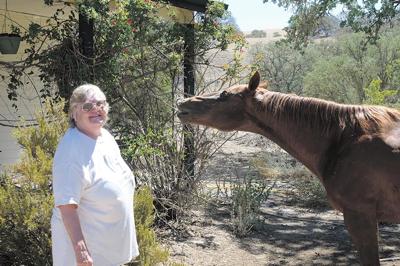
Winfree feeds Big Red a piece of honey-smeared bread to show me the horse’s rubber-lipped grin. Inside her house, colorful afghans cover the couches and an enormous rack of antlers hangs above the fireplace. It’s her paradise, almost. She loves the land, her house, the locals – all of them, she says, except “the neighbors from Santa Maria.”
Winfree first saw this green-and-brown land from a bird’s perspective, flying into Camp Roberts with the Air National Guard more than a decade ago. I’m going to retire here, she remembers thinking.
In 2000, when her parents were being forced out of their Las Vegas apartment and her father was suffering from advanced cancer, Winfree bought these 15 solitary acres outside San Miguel. Her father died three weeks after the deed was transferred, her mother 10 years later. Now the horses, a shaggy cat and a cast of wild creatures keep Winfree company.
That peace was strained in 2004, when Jeffrey and Cyndy Halverson bought the 5-acre parcel next door. Relations got off to a bad start, Winfree says, when the Halversons hired a surveyor to mark the property lines. The tension deepened one morning in 2009, when she startled upon Jeffrey pounding stakes into her yard.
He told her road-building equipment was coming the next day, she recalls; she told him unless he had a county permit, he could go to hell.
Winfree hired Monterey lawyer John Kesecker to write the Halversons a letter stating they have no legal right to build roads across her property. Doing so would introduce a number of problems, Kesecker warned: slope violations, the removal of protected oak trees, disturbance of sensitive habitat and violation of county laws protecting Native American artifacts. The Halversons’ only legal access through Winfree’s property, he wrote, is on Hidden Creek Road.
A section of the unpaved private road is on Winfree’s property, and she allows traffic to travel it freely. It has to; Hidden Creek is the only path to at least 10 different properties east of Indian Valley Road. The Halversons want additional routes onto their land.
But more important than a spat between neighbors is the Salinan history it’s uncovered. Winfree’s strongest legal argument is the protection of Native American remains in the path of the Halversons’ road grader. The Salinans – falsely declared extinct in the 1930s and still fighting for federal recognition – don’t care about disputes between neighbors, as one tribal leader explains; they just don’t want roads running over their sacred lands. And in the case of Winfree’s property, they’re banking on the law to respect the ancestors resting beneath it.
~ ~ ~
Jeffrey and Cyndy Halverson just want easier access to their property, according to their October 2012 complaint for quiet title and declaratory relief, seeking court orders to build roads across Winfree’s land.
They allege she’s preventing them from using three established “branches” of Hidden Creek Road running across her property. Each branch, according to the complaint, leads to one of three insular hilltops that constitute their parcel. They claim a fourth branch, the one Winfree lets them use, crosses creeks and is impassable in the wet season.
The Halversons state that they unsuccessfully attempted to negotiate a recorded easement with Winfree in 2005, and that they openly used the three disputed branches across her property for at least five years. Now that Winfree’s barring them from those roads, they’re asking the court to make the easements official.
The listed phone number for the Halversons’ Santa Maria home address rings the Costco Hearing Center where Jeffrey works. They don’t respond to messages left there, so I try their San Miguel-based lawyer, Charles Daugherty.
“There is probably not one iota of truth in anything she’s told you,” Daugherty says upon hearing Winfree’s name. “In 35-plus years of being a lawyer, I’ve never seen such misrepresentation and perjury of the court ever. Ever.”
There are no Indian bones on Winfree’s property, he says. No endangered species either, though he won’t produce the biologist’s report he says backs that up. He won’t discuss much of the case, other than to reiterate what’s in the complaint: The Halversons’ San Miguel parcel is landlocked, and they need an easement through Winfree’s land to get to it.
Winfree disputes the Halversons’ facts. Despite what she calls a “cartoon” map they submitted to the court, Hidden Creek Road doesn’t branch at her property and hasn’t for generations, she says. Her court file includes satellite photos showing Hidden Creek’s linear path. The Halversons haven’t been using the branch roads, she says, because they don’t exist.
And in her view, there’s no need to create them. The Halversons can keep accessing their property via Hidden Creek like they have for nine years, Winfree argues. The road crosses the driest of four gullies on her property, she says, and an alternate path would only be more likely to flood.
“I THINK THAT LITTLE OLD LADY SAT RIGHT UP IN HER GRAVE AND GAVE HIM THE FINGER.”
But in September 2012, three years after her lawyer warned the Halversons to back off, Jeffrey came back with a truck and a grading tool – an incident Winfree reported to the Monterey County Sheriff’s Office.
She alleges he tore through her backyard, her garden, her olive grove and her stand of blue oaks, crushing several of the slow-growing trees. He tore through her buried water pipes, she alleges, disabling her water system; and he tore through Changing Woman’s grave.
So Winfree sued the Halversons back, representing herself as both defendant and plaintiff. Her theory, though unsupported by the Halversons' legal filings, is that her neighbors aim to build a 20-home subdivision on their land and that they need three roads across hers to service them. She even claims they want to knock down her house as an “obstruction” in the roads’ path.
She asks the court to deny the Halversons’ requested easements and award her legal costs and damages. She also wants the socks Jeffrey Halverson wore to court.
“These [Winfree] will frame, and hang next to her mounted pig head,” states the November 2012 cross-complaint, “so that when anyone asks about the case, she can point to them and say in all honesty, ‘I sued his socks off!’”
~ ~ ~
Winfree offers me ginger ale and produces a platter holding trinket-sized rocks. These are all Salinan artifacts found on her property, she says: hide scrapers, stone tools, spearheads and a carved stone.
She says she first heard the story of Changing Woman from a 91-year-old friend of her mother’s 12 years ago – a woman, now deceased, who grew up playing on the land. The elderly woman told Winfree she’d once found a basket made of pine needles in the crumbled cave up the gully; and in the basket, what looked like a stick doll adorned with red stripes and feathers.
Since then, Winfree has come to believe Changing Woman and many other Salinans were buried on her property. Most of them, she says, are under two specific mounds, one of them marked by a brick of what she says is cinnabar used in Salinan burial ceremonies.
In her patchy little garden, which she says might have been a Salinan dance floor, Winfree points at a ridge to the west and says the sunrise falls down it in steps, right to the burial mound. This is significant to Winfree, another sign that her land was an important place to its Native American inhabitants. We hike up to that ridge and look east toward the gully with the crumbled cave. She tells me she stood here on the equinox and saw the setting sun fall into the gully’s notch, creating an effect like a giant searchlight shining on the property.
“If you stand on [the beam of light] because you’re a silly old lady, you find it casts your shadow like a giant onto the opposite canyon wall,” she says. She concluded the ridge was a solar observation point, that the Salinans did shadow dances on the equinox, and that Changing Woman was some sort of astronomer.
Squint one way, I see shadow dances. Squint another, I see a solitary older woman letting her imagination run a little loose.
A good deal of what she’s telling me, however, checks out.
The location’s right: Winfree lives less than 7 miles from the Mission San Miguel Arcángel, which the Salinans helped build, in territory the tribe’s been known to inhabit for at least 10,000 years.
She’s had three sites on her property – the two mounds and the cave – registered with State Parks’ Office of Historic Preservation by Nancy Farrell, an archaeologist with the Cultural Resource Management Services in San Luis Obispo. (That’s substantiated by a document in the court file, though a historian with the office says registered archaeological sites are classified.)
Also in the court documents: a November 2012 letter from Christina MacDonald, collections manager for the San Luis Obispo County Archaeological Society, who notes: “It would be a violation of state [environmental] law for the county to issue any permit or easement without first taking into consideration the impact that such an act would have on… archaeological sites.”
The Salinan Tribe has taken an interest, too. In a fall 2012 letter, Tribal Administrator Patty Dunton thanks Winfree for allowing members of the nonprofit Salinan Heritage Preservation Association to inspect the alleged damage. “We were impressed with the amount of cultural material on your property,” Dunton writes.
The 91-year-old neighbor’s oral history of Changing Woman and the artifacts she told Winfree she found in the cave are consistent with Salinan culture, Dunton adds. “I believe the stick may have been a clapper stick, a Salinan musical instrument made from elderberry branches. It would have been used for singing to the Water Serpent,” she writes. “I saw a few elderberry bushes on our way to the cave spring area. This makes me believe that this would have been a sacred place.”
In the letter, Dunton echoes Winfree’s outrage about Halverson’s road-building attempt and requests that the three archaeological sites be protected.
“YOU DON’T JUST PUT [THE BONES] IN A BEER CAN AND STICK ‘EM IN A GOPHER HOLE.”
Winfree even invited the Institute for Canine Forensics, a Woodside-based service providing dogs that can detect historic and prehistoric human remains, onto her land.
Five trained dogs sniffed out the two mounds, their handlers sticking pin flags wherever the dogs alerted them. The report concludes, “There is a strong indication of human remains scent in multiple locations of the two main search areas.”
One mound is peppered with flags that branch into a line scattering downhill, consistent with, say, dragging ancient bones behind a grader. Winfree thought she recognized one of the disturbed bones as part of Changing Woman’s hand: “I think that little old lady sat right up in her grave and gave [Halverson] the finger.”
~ ~ ~
Winfree turned the remains over to Monterey County Coroner Randall Dyck, and a forensic anthropologist identified one of them as a human finger bone. Based on their location and apparent age, Dyck says, he concluded the remains were Native American, so in February he notified the California Native American Heritage Commission.
The commission named as the most likely descendent the Salinan Tribe of Monterey and San Luis Obispo Counties, according to commission staffer Dave Singleton. Also given to the tribe were bones determined to be Native American that had been found in the area and held at the San Luis Obispo County Coroner’s Office, Dyck says.
The tribe assigned one of its leaders to return the remains – both those found on Winfree’s land and those held by the San Luis Obispo County coroner – to a place near their origins where they won’t be disturbed again. Singleton says he understands the tribe reburied the bones in cooperation with Winfree as landowner, adding that he’s prohibited by law from providing more specifics.
That syncs with Winfree’s version. In early June, she says, she hosted a tribal funeral and reburial involving more than 40 people. An official of her Mormon church sanctified the land for burials, two brown-robed friars from the San Miguel Mission provided last rites and members of the Salinan Tribe led the native ceremonies, she says. El Pollo Loco catered barbecue, beans and corn.
“You don’t just put [the bones] in a beer can and stick ‘em in a gopher hole,” Winfree says. “Since we already had a pre-existing ancient cemetery here, we could put them back in.”
There may be another use to come of the bones’ temporary disturbance. Theodore Schurr, a molecular anthropologist with the University of Pennsylvania, says the Salinan Tribe contacted him and expressed interest in having a sample of the remains found on Winfree’s land DNA tested for genetic markers linking them with modern-day Salinans and other tribes. “They are very interested in learning more about this individual,” he says.
If there were any doubts that Winfree’s land was a Salinan cemetery before, it is now.
~ ~ ~
All of this has me wondering if Winfree’s poor-old-lady act might be a bit exaggerated. Yes, she sometimes bungles the proper names of things. She describes left and right as “driver’s side” and “passenger side” and has a hard time remembering her house number. When she talks it’s hard to get her to stop, even as she repeats stories she’s told before.
Her submissions to the court are likewise redundant: I count 146 pages in the court file authored by Winfree, versus 17 filed by Daugherty for the Halversons. And while Winfree’s filings include case citations and boilerplate legalese, they’re also peppered with jokes that would make a by-the-books judge frown.
For example: In copping to an error in her original cross-complaint, Winfree states that she had mistakenly listed the date of Halverson’s alleged trespass as Sept. 11 rather than Sept. 9, 2012, but adds, “She still considers it a 9-11 attack!” Later in the filing she writes, “The [Halversons] with a briefcase can steal more money than Jessie [sic] James could with a six-gun.”
In one filing, Winfree explains the decision to represent herself, stating she’s “embarrassed to come before the court with an admission that she is an elderly woman, with a very limited knowledge of the legal system, on a fixed retirement.” Later she writes, “It is after midnight, and a half-blind woman with crippled fingers is made to type and try to learn enough law in a few days to defend herself against an attorney with years of experience.”
But she’s savvy enough to have appropriated the authority of the Salinan Tribe to her side of the dispute. Contemporary Council Lead Gary Pierce says the tribe tries to stay out of property spats, but it does care about respecting the peace of its ancestors. He says he’s quite certain Winfree has Salinan remains on her property and confirms the reburial of the disturbed bones.
As for the Salinan history she’s reconstructing: “I don’t think she made it up,” Pierce says. “I believe she was told that by somebody. Whether they knew what they were talking about, I don’t know. Probably not. The Salinan Tribe has been misrepresented – stuff told wrong about us all the time.”
~ ~ ~
Winfree crawls on her hands and knees up the crumbly hill to a ridge on the east side of her property. Between heavy breaths, she tells me much of her work with the military – both active-duty and as a civilian research scientist – was to find the good in biological weapons.
She says she was involved in research that helped create Botox from botulism toxin and isolate an element of anthrax to aid in kidney transplants. She conducted rescues at sea and helped secure treatment for troops exposed to Agent Orange, she says; she helped design heart monitors for astronauts and worked on methods to detect biological weapons in envelopes.
Now her obsession is with this property dispute, though that may soon come to a close. Daugherty, the Halversons’ lawyer, says Winfree agreed to a road in mediation; all that’s left for the court to resolve is her claim for more than $12,000 in damages and costs.
Daugherty then threatens to sue the Weekly if this story is published or he is named in it.
The terms of the settlement are confidential, but when Winfree hears Daugherty’s version she offers more details. Both parties agreed in June to let the Halversons keep using Hidden Creek Road, she says, with county-permitted improvements. The result will be a single 100-foot-wide access corridor across her property. It will avoid Native American artifacts, she says, but it will involve the cutting of heritage oaks.
The court has scheduled more conference and hearing dates in August and November.
Winfree supposes she’ll bequeath the land to her nephew, donate it to a conservation group or transfer it to the Salinan Tribe when she’s gone – anything to keep it out of the Halversons’ hands. “This place is worth preserving because it holds a strange history,” she says.
She’s now part of that strange history. Not strange because she and her neighbors quibbled over roads – that’s common enough – but because of the Salinan history that surfaced in the process.
Sure, there are elements of paranoia and obsession in Winfree’s battle. She insists on the Halversons’ ambitions to knock down her house and build a subdivision, neither of which are supported by the legal documents. But she’s also shown the clever calculations of a military biomathematician, creating proof of a Native American cemetery right where the neighbors wanted to build roads.
Whatever happens with the Halversons, she says, she’s no longer afraid of them: “I’ve got a whole graveyard protecting me.”
(0) comments
Welcome to the discussion.
Log In
Keep it Clean. Please avoid obscene, vulgar, lewd, racist or sexually-oriented language.
PLEASE TURN OFF YOUR CAPS LOCK.
Don't Threaten. Threats of harming another person will not be tolerated.
Be Truthful. Don't knowingly lie about anyone or anything.
Be Nice. No racism, sexism or any sort of -ism that is degrading to another person.
Be Proactive. Use the 'Report' link on each comment to let us know of abusive posts.
Share with Us. We'd love to hear eyewitness accounts, the history behind an article.