The California Rodeo Salinas can seem infinite: Every year for the last 103, thousands of Western enthusiasts converge for days of competition and celebration. The stampede of events – more than a dozen disciplines, with several held at the same time – means names, faces and feats can get lost in the dusty shuffle. And that’s just in the arena. Yet a few participants are so unique and vital, their legacies stand out.
Since the rodeo’s centennial in 2010, the California Rodeo Salinas Hall of Fame has been honoring those transcendent individuals, including livestock, for helping make it arguably the top rodeo in the country.
Like 2013’s most famed inductee. There are two lenses through which to view Ty Murray, the so-called “King of Cowboys”: as a champion and an ambassador. In both cases, he’s earned his nickname.
In his 15 years (1988-2002) atop the sport – and atop bulls and broncs – he won seven Professional Rodeo Cowboy Association (PRCA) World All-Around Cowboy Championships, a record until 2010, and two PRCA World Bull Riding crowns. Until February 2013, he was rodeo’s youngest to make a million, at 23, no easy feat in a sport that long paid competitors a few thousand bucks for a life-endangering ride.
Cody Lambert, now vice president and livestock director for Professional Bull Riders, competed with Murray.
“He had incredible physical abilities: strength, balance, that sort of thing,” Lambert says, “but he also had a work drive and a determination that was like Michael Jordan or Larry Bird. Very rarely do you have somebody physically gifted more than anybody else who works harder than everyone else.”
While Murray may be most famous for his national achievements, he left his mark at Rodeo Salinas. Former rodeo president E.J. Leach Jr. says Salinas usually brings “the best of the cowboys.” Even then, Murray won three All-Around Champion buckles – awarded to versatile competitors who win across multiple events – as well as the the 1990 Saddle Bronc and the 2000 Bull Riding. (Murray, who lives in Stephenville, Tx., didn’t reply to the Weekly’s emails and calls by press time.) The native Arizonan also took seven national all-around titles, a feat Jeff Shearer, a saddle bronc rider who competed in the same era, says Murray accomplished “handily.”
“Ty went to the National Finals Rodeo for bull riding, bareback and saddle bronc,” Shearer says. “It’s really hard. It’s different styles, it’s different body positions, different spurring.”
It wasn’t just Murray’s multi-disciplinary dominance that makes him one of the greatest ever to strap on stirrups. Many credit him with getting huge herds more interested in rodeo.
“He’s one of the few cowboys who has made rodeo more accessible to the national public,” says PRCA spokesman Jim Bainbridge. “[Rodeo] always needs that. The sport is the seventh-most-attended sport in North America, but does it have the same level of media coverage [as other sports]? No.”
Shearer agrees: Murray has become an ambassador of rodeo. “He’s really easy to like,” he says. “It gave the sport a figurehead when they needed one. They didn’t have any superstars at the time.”
Murray was profiled in Sports Illustrated, featured in Miller Lite’s “Man Laws” commercials with Burt Reynolds, and made it to the semifinals of Dancing with the Stars. His marriage to country singer Jewel brought the sport still more new attention.
But his most defining legacy came not from the arena or TV, but in a motel room in Scottsdale, Ariz., in 1992. Along with 19 fellow riders, Murray pitched in $1,000 to help form the Professional Bull Riders (PBR), an alternative to the PRCA, as bull riders sought more mainstream promotion and better bulls. Lambert says PBR’s founders wanted to turn bull riding into “a real sport that people can follow.”
Now the PBR is attracting major sponsors like Ford and Monster Energy, major network partners like CBS Sports, and 100 million viewers annually.

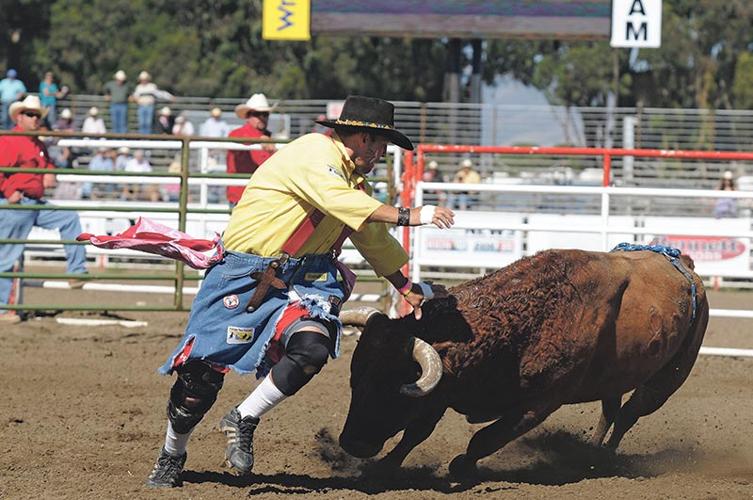
Barrel Role: Legendary bullfighter and Pro Rodeo Hall of Fame honoree Rex Dunn taught Andy Burelle the craft, and this guidance will come in handy as he protects the next crop of bullfighters in the ring this year at Salinas.
The Ty Murrays of the world would not be able to be great, however, without anything to ride on. That’s where fellow 2013 inductees Bob and Nancy Cook come in.
Their company, Rodeo Stock Contractors (RSC), provided high-quality bulls to Salinas and other rodeos for more than a decade.
“Good stock makes a rodeo,” says Shearer, who is now a judge for PBR’s premier Ford Built Tough Series. “You can have all the talent in the world, but if you don’t have a formidable opponent, you might as well have everyone compete on a bale of hay.”
Even the scoring system of rodeo is bull-centric. A total rodeo score can be worth up to 100 points, with 50 of those points rating the animal’s performance – bucking height, kick strength, spin, ride intensity and ride difficulty.
“The stock nowadays is bred to buck,” Shearer says. “The lineage goes back four or five generations. They’re athletes, just like the guys on their backs.”
While Rodeo Stock provided a variety of livestock to various rodeo events, they were best known for their bucking bulls.
“You knew you were going to be on a good bull,” says stock contractor John Growney, whose company eventually bought RSC.
While both Bob and Nancy are deceased, their contributions to rodeo – in the arena and behind the scenes – go on, and goes beyond supplying top animal athletes. Like Murray, they helped push rodeo to the mainstream, most notably bringing a bull to Oscar-winning The Great American Cowboy.
“They understood exposure,” longtime rodeo announcer Wayne Brooks says. “When they started to make a hero out of an animal, it was a way into the media that rodeo had never had.”
The Cooks also produced rodeos, and many future participants got their starts through the tough love of Bob Cook.
“If you had any weakness, he’d find it,” says Allan Jordan, a PRCA and PBR judge, who worked with Cook for nearly a decade. “He allowed us to mature under him, and he never let us weaken.”
Cook also used his take-no-prisoners attitude when he represented contractors on the PRCA’s board.
“When it came to battling for the stock contractors, nobody was as good as Bob Cook,” Growney says.
Cook gave Bob Tallman, now in the Pro Rodeo Hall of Fame, one of his first rodeo announcing gigs, and would sit with Tallman each night, critiquing his performance. Cook’s daughter, Bobbie Cook, remembers the contentious move: “[Our business partners] were very mad at my dad for hiring this no-talent kid that no one had ever heard of.”
The stern stock man also let a teenager named Larry Mahan practice on his stock. That kid from Oregon eventually became a six-time World All-Around Champion cowboy.
Whereas Bob was known as a hard-lining mentor, Nancy, who’s served as the rodeo’s secretary for 12 years, was known for her gentle motherliness.
“Even when people probably didn’t want to put up with my dad, they did because mom was around,” Bobbie says.
Those who remember Nancy say she was as meticulous as she was beautiful, with Bobbie adding she rarely went to the barn without her hair done or her jeans ironed. The San Francisco native was part bookkeeper – the Cooks had a real-estate business – part rodeo committee confidante, part family counselor.
“There was just an aura of elegance,” rodeo judge Jordan says. “The biggest crashes, the biggest downfalls, she was the calm one in the bunch. When Bob was chewing on ya, she was the one who said, ‘Let’s slow down and work it out.’”
The Cooks’ most famous bull, Oscar, is himself being honored this year.
Though small – relatively speaking – Oscar was a formidable opponent. “He was about 1,400 pounds of the wildest fury you ever saw in your life,” Brooks says. “He had more life than the guys who rode him.”
It took more than 100 rides before anyone could tame the fury. According to Naccarato Bucking Bulls, who owned some of Oscar’s descendants, the bull went without anyone completing a ride for five years. His streak continued so long, in fact, RSC cast a bronze Oscar to give the first cowboy who did. John Davis finally made the required eight seconds at the 1975 Rodeo Salinas, barely clinging to the side of the bucking beast.
“He was just so fast,” remembers Jordan. “He was small enough that you could lose him.”
Oscar’s speed was made more formidable by his immediate bucking.
“Usually when people tried to ride, they didn’t ride him for more than a jump or two,” Bobbie Cook says. “He came out of the shoot very quickly and kicked over his head.”
After appearing in The Great American Cowboy documentary, he retired to a living display at the Pro Rodeo Hall of Champions. Though the gray-colored competitor died in 1983, his legacy continues through a successful line of descendants.

Cody Lambert rode some of Oscar’s line. “They bucked,” he says. “They had a lot of Oscar’s determination – and his looks, too. They had the same color, and they were small and they were fast. They did whatever it took to get you off.”
So the Rodeo Salinas ride continues, with renewal and new stars (see sidebar, opposite page). But even amid the chaotic rush of adrenaline and arena events, the legacy of a bull, some Cooks and the King of Cowboys remains legendarily clear.
(1) comment
Its surprises me each year to see a "hip" paper like you support animal abuse.
Welcome to the discussion.
Log In
Keep it Clean. Please avoid obscene, vulgar, lewd, racist or sexually-oriented language.
PLEASE TURN OFF YOUR CAPS LOCK.
Don't Threaten. Threats of harming another person will not be tolerated.
Be Truthful. Don't knowingly lie about anyone or anything.
Be Nice. No racism, sexism or any sort of -ism that is degrading to another person.
Be Proactive. Use the 'Report' link on each comment to let us know of abusive posts.
Share with Us. We'd love to hear eyewitness accounts, the history behind an article.