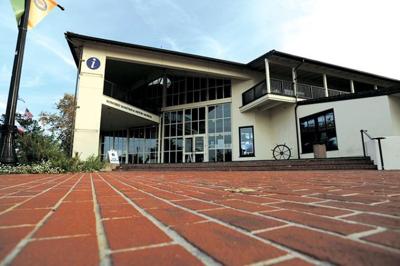

On Dec. 15, 2011, the kids came out at night. They assembled in a line across a barren Custom House Plaza, the air charged like the parking lot at a Green Day concert. Though the energy was stirred up a rock star – Brandon Boyd, lead singer of Incubus – there was no music on the agenda.
Instead, the event was an art exhibit Boyd had contributed to, the venue was the new Museum of Monterey (MoM), re-opened June 2011 after an 18-month renovation, and the result was a rare sight for the Peninsula: a line of thrilled young people coming to see art. Boyd would turn their attention to art, activism and ocean conservation in the exhibit Flows to Bay.
In the aftermath of the night’s fandemonium, Boyd posted a blog called “My Night in Monterey: Hope for 2012” on Huffington Post. The art show was shared on Tumblr, Facebook and numerous tweets, and filmed by a documentary crew Boyd brought. Flows to Bay created buzz, representing the first salvo of the new course for the re-engineered museum. Then reality barged in and woke everyone from the dream.
Behind the scenes, the museum was stirring up another kind of buzz over its new course, its owners (the Monterey History & Art Association), and its solvency. John Enns, a former MHAA treasurer and board member, writes, “When I joined the board in September 2010 the MHAA endowment fund was about $750,000. Today the endowment stands at roughly $550,000.”
The 82-year-old nonprofit Monterey History & Art Association has charged itself with preserving Monterey history and art. They are the stewards of tens of thousands of artifacts and historical objects, and the savior and owner of historic buildings including Doud House, Casa Serrano Adobe and Gardens and the Mayo Hayes O’Donnell Library.
They also own and operate the flagship Museum of Monterey.
Its earliest incarnation was as the Allen Knight Maritime Museum, in the basement of the Monterey Museum of Art, under the charge of Ret. Adm. Earl Stone. Today’s 17,000-square-foot museum building was conceived in the 1980s by wealthy benefactor Virginia Young Stanton (the building is named after her and her husband Robert), the MHAA, the city of Monterey and the state of California. It opened Oct. 31, 1992 under a $1-a-year long-term land lease from the city as the Monterey Maritime and History Museum.
The prismatic, two-story building, which includes a 102-seat theater, gift shop, conference room and community room, served as home for the maritime collection bequeathed by Adele Knight, widow of collector Allen Knight, and for years hosted lectures, art exhibits, films, book-signings and parties.
At least, on occasion.
Red Skies at Morning
After a one-year stint as the MHAA’s volunteer treasurer (all board positions are volunteer), Christine Sinnott was voted president of the board last September, succeeding Mark Baer. An attorney and Peninsula resident for 26 years, Sinnott used to come to the museum when her daughter volunteered there a decade ago.
“It was absolutely empty,” she says. “I like maritime, but it was empty.”
Poor attendance was only one of the more visible problems. According to documents it’s required to file as a nonprofit with the California Office of the Attorney General, the MHAA has been bleeding money for more than a decade.
For the fiscal year ending September 2001, their gross annual revenue was $1,079,495, with total assets at $8,218,382. Then a steady, yearly decline siphoned those numbers. In 2012, it reported $305,566 for gross annual revenue, and $3,461,000 in total assets.
The endowment, comprised of the principal chunk of money that accrues the interest the association gets to operate, dwindled from investment losses, a slow economy and/or spending, from $1.8 million in 2000 to about $540,000 today, Sinnott says.
“The state [of California] significantly supported the museum,” she says. “Then they suddenly pulled out and nobody adjusted. [That’s] at least $100,000 or $200,000 a year, back in 2000, 2001.”
During this decade of financial struggle, infighting and misbehavior didn’t help. Chronicled in supplements to their Form 990 tax filings, and investigated internally by a “compliance committee,” there was a 2011 investigation into “mismanagement and misuse of the association’s assets.” The association investigated “allegations that its collections were not adequately documented and protected from misappropriation” without drawing any conclusions.
A 2009 story in the Monterey County Herald tallied seven executive directors in 10 years; there have been three more since. Hostile letters and allegations flared into public view, bruising egos and the reputation of the board.
The hits kept coming: The unauthorized near-sale of an E. Charlton Fortune painting, pulled from an auction house before it was sold; the 16-year historian and curator Tim Thomas clumsily and controversially terminated in October of 2009; the 18-month closure for the re-branding as Museum of Monterey (and the subsequent naming confusion with the Monterey Museum of Art).
There was also the hiring of L.A. artist Andre Miripolsky, instead of one of countless local artists, to paint a wall/fence and a mural; the decision not to renew former executive director Lisa Coscino’s contract; and the shrunken endowment meeting a dearth of grants.
The ready-made metaphors were waiting: The museum, with a roof gable like the bow of a ship, was encountering “rough seas” and “weathering storms.”
The Roll Call
Mark Baer is kind of an engima, a well-liked and ageless man who wears the well-cut suits of an executive (which he is, as pro bono executive director of MoM, having taken the wheel from his friend Lisa Coscino). But he harbors the creative aspirations of an artist and writer, exemplified in the hardboiled, multi-media spoken word performances of his Joe Cupcake Chronicles. Baer claims credits in screenwriting, fashion, spoken word, novel writing, audio books, filmmaking and marketing, plus video interviews with local arts figures in his 100 Story Project. But when he puts forth his credentials for executive director that “I spent a lot of time in museums,” and suggests that a “museum is just one more creative medium,” he seems to have extrapolated more than he can chew. His words tumble out in a pastiche: “We want money, ideas, synergy… Yahoo or Google using our space as an idea center… You can build something better and everybody finds what they need.”
He seems amazed when he admits, “It costs about $1,000 a day to run a museum,” and earnest when he talks about what it’s going take to turn around the museum: “I don’t have the wherewithal to turn up the volume loud enough. There is a rumor echo chamber in this town. I hear stuff about what we’re doing that’s insane.”
His one-year term as pro bono executive director should wrap at the end of summer, but he and Sinnott concur he’ll stay involved. The two form a team, like an ’80s buddy movie: He’s a free thinking artist. She’s a pragmatic lawyer. Together they’ll fix this museum, or go crazy trying.
For someone in a visible job in a volatile organization, Sinnott has been publicly measured, articulate and professional. That may be to mitigate the press in light of staff and board being most vocal when most angry. She says the board is consulted, but “the buck stops with me.”
“The board is not having as much input as we should be,” says John McCleary, a relatively new board member and author of The Hippie Dictionary. But he adds, “we’re not a professional board.
“We are well meaning people, but have a lot of things going on,” he says. “We’re having a hard time getting a quorum… I have more respect for [Sinnott] than I thought I would. I think she’s committed. I don’t think she’s got ulterior motives. Same with Mark. They are good people doing the job they can.”
About that job, Sinnott says, “Knowing how to take care of a collection or install an exhibit does not solve the real-life reality of museums needing money to operate. Deficit financing is not something that can continue.”
Price is Just a Number
As an example, Sinnott says the exhibits of last year, mounted under Lisa Coscino’s executive direction, amounted to costs in the “hundreds of thousands.”
“The Perry Downer House was sold in 2010,” she says. “That money’s been used in the last few years. About $900,000.” That went toward the museum’s remodel and Coscino’s exhibits.
However, Baer says the Cheech Marin painting show, Chicanitas, cost “a few thousand dollars.” Coscino says that “show-in-a-box,” which included text, promotion, artwork, graphics, wall panels and shipping, cost $5,000 – plus another $3,200-$3,600 for the opening. She says Boyd wouldn’t accept money for his appearance, and that the publicity was priceless. For Music, Love and Flowers, she says they procured two grants – one for about $11,000 – and that some of the money was unspent.
But Sinnott attributes the discrepancy in these numbers to accounting confusion, and says the discrepancies were paid out of general funds.
“Lisa didn’t cost [out] everything to an exhibit that should be cost,” she says. “For instance the Monterey Pop thing. The time it takes to build the parts with staff should be allocated to that exhibit. Lisa did a good job in trying to keep costs down. [But] you can’t call it remodeling if you’re building a wall for a specific exhibit. Accounting needs to be consistent. She didn’t have a background in that area and wasn’t expected to.”
Coscino says she knows how to cost out an exhibit and thinks Sinnott is “looping” the museum’s re-opening costs with her exhibits. But she admits endowment spending was hazy.
“I don’t think I was ever able to get clarity on that,” she says. “Nor the board. It was such a mish-mash, I don’t even hold the board responsible. The lines get blurry, switching as many executive directors as they had, combined with turnover in the board.”
Regarding the cost of the Flows to Bay show, which Coscino was brought in on as a curator, she says, “I didn’t know where they got the money. It wasn’t my business. They hired me to curate.”
Sinnott’s attitude now is to learn and go forward: “I don’t want to talk about the past,” she says. “The old system didn’t work – us writing all the checks.”
Those Who Forget the Past…
The Monterey History and Art Association’s November 2012 annual meeting played out like a society drama in an Edith Wharton story. Former executive director Coscino, freshly let go, was there with a few supporters. They sat as far away from the majority of the board and the new administration as the small Stanton Theater would allow.
From the podium on the stage, Sinnott announced accounting practices and technology measures to shore up inefficiencies and the leakage of money. There was to be a fresh pursuit of grants. In the future, independent curators would bring in exhibits as well as the funding for them – pay as you go. One example is Julianne Burton-Carvajal’s four-part, year-long Year of the Missions exhibition, currently showing part three.
“I see the checks,” Sinnott says. “She’s gotten money from the [Spanish] consulate and private support. She’s a marvel.”
After the meeting, during a wine-and-cheese reception in the lobby, Baer tapped a startled Coscino on the shoulder and asked how she was doing. “Good,” Coscino replied. It would be the only interaction the two self-professed friends would share at the meeting.
Baer then told the Weekly that the participatory strategies of Santa Cruz Museum of Art and History Executive Director Nina Simon (see Q&A with Simon at www.mcweekly.com/art_culture) were the “beacon” for MoM. He said MoM wants to expand school tours, and mend the relationship with former museum historian Tim Thomas. (Thomas says he stayed away after dismissal but he’s talking with them again.)
John McCleary and his wife, Joan, the former Pacific Grove Art Center executive director, were at that meeting. They had donated many pieces to Coscino’s Music, Love and Flowers tribute to the Monterey Pop Festival. When he was asked to join the MHAA board, it prompted “soul-searching,” John says, because his mother was a city historian and worked in the historic First Theater and Stevenson House adobes – and the MHAA had saved buildings dear to her.
“There are some people on the board who are conservative,” John McCleary says. “One of the reasons I’m on the board is because I’m not conservative. A lot of people think art and history ended with the second World War. It didn’t.
“Unless we want to lose everybody under the age of 40, we have to show some new things from time to time,” he adds. “The Pop Festival was very important to the history of Monterey.” And, he adds, to civil rights, women, gays and lesbians, ecology and self-help.
The ideological divide may run along the lines of age.
“We need more younger people,” John McCleary says. The two newest members of the MHAA board – Javier Bolante, from finance and investing, and Ashley Blacow from the nonprofit Oceana – are both under 40.
“We need big vision,” Baer says. “Not parochial. There’s no going back.”
Business as Unusual
Museum of Monterey can generate healthy revenue from events; so can Casa Serrano. The board is talking about converting the Mayo Hayes O’Donnell Library, a church with an ocean view, into an event property, too.
“You run out of money, you’re out of business,” Baer says. “You’re never going to make your money at the gate.”
“It’s a business,” Sinnott says. “A big business to run.”
But is it? What business can simply ask others for money based not on a reciprocal consideration, but based on the merit of what they do? How does one monetize the value of what a museum can do for a community?
Baer talks about partnering with entities that can help them “become the second attraction after the Aquarium,” to occupy space in MoM or bring in exhibits. He says they are in talks with several potential strategic partners, and suggests the museum may not be able to stay open through the end of summer if this plan doesn’t work.
Sinnott suggests Baer doesn’t have enough of a big picture to speculate that broadly. When John McCleary hears about Baer’s prediction, he sighs.
“A lot of people who have a capitalist background do not understand nonprofits,” he says. “Different nonprofits work in different ways. We don’t want people to feel the sky is falling, because it’s not… We could get a grant tomorrow that makes it possible to keep the doors open through next year.”
Sinnott says the money problems the association faces today are the same other nonprofits have: the exodus of large donors and grants. She focuses instead on an optimistic future.
“Income is up and expenses are down… a definite sign of a good plan,” she emails. “The number of our paid admissions last month was double from the year before; event rentals are 33-percent higher, and facility rentals are almost 40-percent higher.”
Cash income through May for the fiscal year is almost 80 percent higher than for the same period last year, while assets are over $4.3 million and liabilities under $100,000, the email states.
She writes, further, that they have hosted more than 100 lectures, films, exhibits or events this year to date, and the Community Foundation for Monterey County is being tapped to manage and grow their endowment.
Sinnott says she’s not ready to announce who the next executive director may be, but she has someone in mind. Optimism is mixed with reality.
“We’re in the red. Last year we were minus $576,000, this year we’re minus $284,000. That includes things we haven’t paid yet,” she says. “[That’s] cash income, not accrual. To cut our deficit in one year is short of a miracle, but to do it again, we’ll be in the black.”
Their exhibits are still coming.
McCleary says the board is getting more cohesive: “We have very deep discussions at board meetings. It’s a very compatible board. It really is. There’s very bright, very busy people.”
The city of Monterey holds the lease to the land that MoM sits on.
“I haven’t talked to them in quite some time,” City Manager Fred Meurer says. “They’re exploring potential partners to maintain financial viability. [The city] has other matters to attend to right now, like homelessness.”
Though the MHAA has tested the faith of the city, Baer counts them as partners in their success. And according to a council report from earlier this year, the city agrees, writing: “MHAA is a nonprofit corporation which provides a needed public service to the city… staff supports minor lease amendments that will provide MHAA flexibility to operate the museum in a manner consistent with its current vision and business plan.”
That translates to getting more room to maneuver, to evolve into whatever new form they need in order to thrive.
Tomorrow Is Another Day
Colleen Bailey, executive director of the National Steinbeck Center, confirms Baer and Sinnott approached the NSC for a possible partnership. And though Bailey says her board was interested in expanding into the Peninsula, that partnerships are the “wave of the future,” and that it was smart for MoM to approach them, her board declined a spectrum of opportunities MoM presented.
“It wasn’t quite apples to apples,” Bailey says. “It wouldn’t necessarily translate to what we want to do.”
Bailey cites the Center’s newly acquired administrative control of YOSAL (Youth Orchestra Salinas) and the Steinbeck Center for Arts & Culture (formerly Sherwood Hall), and planning for the 75th anniversary of The Grapes of Wrath as forces that made yet another expansion untenable. Baer and Sinnott say that they are still in talks with NSC on smaller projects like pop-up exhibits or sharing stewardship of MHAA’s historical costumes. But for now, Bailey says, “The timing is not quite right.”
But timing, like opportunity, may lie in the MHAA’s perspective. Former Village Voice senior art critic and current New York Magazine senior art critic Jerry Saltz has said, “When the purse strings tighten up at museums, the institutions usually cut back. That’s exactly the wrong reaction. In fact, now is a good time for them to loosen up… breathe and experiment a little.”
The Museum of Monterey’s experiment is still in progress. Although Baer is at the end of his term, he seems committed to making the museum a dynamic place where history can reside with the future. Coscino, his former teammate in that mission, is working on the Flying ACE Museum about air-cooled engines in mid-century culture. She says she has no plans to be involved in MoM, but she’s still a member.
“I think about it daily,” she says. “I loved that place. I believed in what we were doing.
“The experiences I had that might be considered negative were of value as well. Sometimes challenges help one to know what is worth fighting for and what is better left behind.”
Today, historian Tim Thomas is working with the Japanese American Citizens League on a heritage museum, and has a business conducting history walking tours of the Monterey Waterfront and Cannery Row.
“Museums are like books,” he says. “The story [MoM] needs to tell is about the story of Monterey. It’s not about the things, the artifacts, it’s about the people.”
And, as Sinnott puts it, “There’s a lot of well-meaning people [behind the scenes] trying to make things work.”
(1) comment
Tim Thomas is right on it with his comment .... “The story [MoM] needs to tell is about the story of Monterey. It’s not about the things, the artifacts, it’s about the people.”
Monterey has a rich history and a number of local historians that can help tell that story!
[smile]
Welcome to the discussion.
Log In
Keep it Clean. Please avoid obscene, vulgar, lewd, racist or sexually-oriented language.
PLEASE TURN OFF YOUR CAPS LOCK.
Don't Threaten. Threats of harming another person will not be tolerated.
Be Truthful. Don't knowingly lie about anyone or anything.
Be Nice. No racism, sexism or any sort of -ism that is degrading to another person.
Be Proactive. Use the 'Report' link on each comment to let us know of abusive posts.
Share with Us. We'd love to hear eyewitness accounts, the history behind an article.