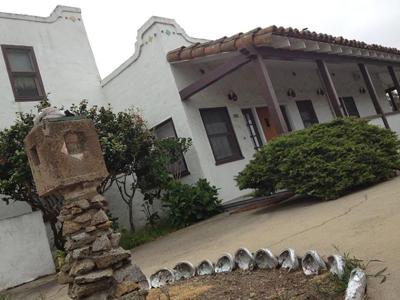
The south Seaside property near Laguna Grande Park hides behind bits of barbed wire and multiple private property signs. The tall wooden gate is locked – in an open position – by a succulent boulder of aloe.
It further beckons the imagination with a huge triple lot and architecture best described as a stucco-style ranch cut out of mainland Mexico, or the Wild West. Two smaller buildings stand away from the main house, like it was once some sort of motel. Abalone shells decorate the short wall of the pathway leading to backyard, sealed in the concrete at a time when abalone was a main catch in Monterey Bay.
The place begs for an explanation of its unique character. But rarely – pretty much never – does anyone seem to emerge from it, even though its weeds are trimmed to allow a plum tree, wild lupine and poppies to flourish. And no one nearby seems to know anything about the house behind five squat chinaberry trees, even though one of those neighbors is the Weekly, where reporters paid to know things have worked for more than a decade and a half.
Sometimes the most rewarding mysteries to unravel hide right under our noses. The big lot was home to a legend: Flora Woods, who famously ran the Lone Star Cafe brothel on Cannery Row across from Ed Ricketts’ lab, immortalized by John Steinbeck in his 1945 book Cannery Row, in which a “Dora” managed The Bear Flag Restaurant.
“As for Dora – she leads a ticklish existence,” Steinbeck writes. “Being against the law, at least against its letter, she must be twice as law abiding as anyone else. There must be no drunks, no fighting, no vulgarity, or they close Dora up. Everyone puts the bite on her. If the police give a dance for their pension fund and everyone else gives a dollar, Dora has to give fifty dollars.”
Later he add, “Probably the busiest time the girls of the Bear Flag ever had was the March of the big sardine catch… The men from the sardine fleet, loaded with dough, were in and out all afternoon. They sail at dark and fish all night so they must play in the afternoon.”
Hiro Manaka, the current – and longtime – occupant of the mysterious house on Williams Avenue, says the Cannery Row property helps explain the setup at her house a city away: It was also a house of prostitution. “That’s why it has so many rooms.” she says, smiling and peering around an old white sombrero hanging on the fence. Her husband, Royal Manaka, waits by the back door for her assistance.
Royal and his fishing family lived next door to the Bear Flag, trying to raise a family of nine with a sick mother. When they complained to Woods about the late-night noises, she kindly traded their small house for the big one in what used to be known as Lakeside.
“The scenery has changed from when I first arrived,” Hiro says, looking through 1940s newspaper clippings. “Across the street there were cows. But these houses have stayed the same.”
The separate houses are now filled with remnants of family years – old bikes, bed frames, wicker baskets and picture frames – and locked tight with deadbolts. Through one of the windows a fake red flower sits in an old sink as an easel for cobwebs. On another window, a sticker with a parrot and flower clings onto the dusty glass.
Hiro remembers when they arrived a few years before WWII and the eight-foot deep cellar in the main house contained dusty bottles of liquor, hidden away during prohibition.
A local delivery dry cleaner that used to work for the Manakas and Woods would always say, “Boy, if this house could talk, oh the stories it would tell.”
Of late, the basement was used to add plumbing to the downstairs, keeping plumbers from having to dig to lay pipe.
“I sure hope there is nothing buried under the house,” Hiro says.
The house was given a facelift when the Manakas transplanted the family.
“We had the same values as many Japanese families, which were to not bring shame on the family,” Hiro says.
Today colorful alphabet letters stick to the fridge, and a piano sits in a living room with pictures of the nine grandchildren. A few toys remain from a visit.
Standing on the front porch that wraps around the side of the house, Hiro points over to the house to the right of the main building. “That room was all windows and chirping of yellow canaries,” she says, pausing like she’s listening to them again.
The next generation will inherit the property and its stories, but much of the rich oral history will likely be lost to time and inattention. Mystery will rule, again.
Mark C. Anderson contributed to this report.
(0) comments
Welcome to the discussion.
Log In
Keep it Clean. Please avoid obscene, vulgar, lewd, racist or sexually-oriented language.
PLEASE TURN OFF YOUR CAPS LOCK.
Don't Threaten. Threats of harming another person will not be tolerated.
Be Truthful. Don't knowingly lie about anyone or anything.
Be Nice. No racism, sexism or any sort of -ism that is degrading to another person.
Be Proactive. Use the 'Report' link on each comment to let us know of abusive posts.
Share with Us. We'd love to hear eyewitness accounts, the history behind an article.