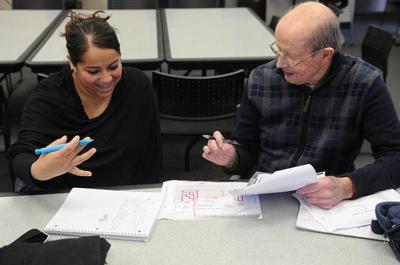
When Rocio Marin moved from her home in Michoacan, Mexico, to Salinas at age 22, she didn’t need to learn English. “In Salinas, most people can speak Spanish and I could speak with everybody,” she says.
Four years later, she moved to Seaside. “I wanted to get a job in Monterey or Carmel,” she says. “I couldn’t even ask for an application.”
Now, after nearly three years of rigorous two-hour tutoring sessions, Marin still works two jobs that don’t require advanced language skill – she cleans houses by day and waits tables by night – but she’s also reading great literature.
Under her belt so far: Of Mice and Men, Treasure Island and Black Beauty. She’s currently about halfway through Charles Darwin’s The Origin of Species.
“I had heard about his theory about evolution, how we came from the apes,” Marin says. “My studies weren’t that good when I was in Mexico, because I just got to middle school.”
Marin is one of about 70 adults enrolled in Monterey County Free Libraries’ ReadMCFL program, free English language tutoring offered at six of 17 branches. The program’s graduated hundreds of learners, 80 percent of whom are non-native English speakers.
There’s a waiting list of 100, some who had advanced degrees in their home countries and hope to hold a basic conversation in English or earn a GED.
It’s tempting to view these journeys from sputtering syllables to fluent readings of Steinbeck as a cliche version of the American dream, and in some ways, it is. But dreams are good things. And the process isn’t always so dreamy.
Marin’s tutor, David Williams, is a retired pro golfer who has been volunteering in different capacities since he retired 15 years ago, and views teaching English as the most frustrating, but also gratifying. “[English] is just so impossibly illogical,” he says. “Through, though, thorough and thought; they’ll ask, ‘Why are these pronounced differently?’ and you have no answer.”
He’s especially excited about working with Marin, who’s interested in important modern thinkers.
But Marin’s motivation to learn English came less from a desire to access literature than from the mundane routine of daily life.
“My first reason to learn English was because my partner and his friends all speak English,” Marin says. “I was feeling uncomfortable.”
Another learner, Vaitun Alhadi, decided to learn English for the most humble of reasons: She felt lonely.
“It’s not just about jobs, it’s how you live,” she says. “I want more friends.”
Alhadi had many friends in her native Indonesia, but when she moved to Del Rey Oaks with her husband six years ago, she struggled to leap linguistic barriers. No longer.
“Now, I have friends who are Mexicans and Americans,” she says.
Teachers like to remind literate people there are other things that they take for granted.
“In our increasingly technologically complex world, we’re really talking about helping people succeed in life,” Supervising Librarian Cathy Andrews says. “We’re working on reading, writing, conversational English skills. It’s not just being able to read a book. It’s being able to read a manual at work, to look at a bus schedule, or figure out the right tip for a bill.”
More than a quarter of Monterey County adults are illiterate, based on federal data from 2003, and county librarians say that figure is only going up, with an estimated 80,000 adults lacking basic English reading and writing skills.
Interest in the tutoring is the highest it’s ever been, which Andrews attributes in part to the down economy. Even to benefit from basic employment services – filling out forms, or training programs at the county’s One-Stop Centers – takes basic language skills.
When Marin moved to Seaside, she applied to a job at Wendy’s, where the only opening was for a cashier position. She struggled to make change for customers, while her Spanish-speaking colleagues in the kitchen made fun of her.
“Now I can speak more English than them, and that’s why I feel so proud,” Marin says. “They just know the basic stuff for their jobs.”
Marin says she owes her success to Williams, and she doesn’t even have the words to adequately thank him. One day soon she will.
The next literacy tutor training takes place 6-8:30pm Tuesday and Wednesday, Jan. 15-16, at the Marina and Seaside public libraries. Contact Cathy Andrews to register in advance at 883-5797 or AndrewsCS@co.monterey.ca.us
(0) comments
Welcome to the discussion.
Log In
Keep it Clean. Please avoid obscene, vulgar, lewd, racist or sexually-oriented language.
PLEASE TURN OFF YOUR CAPS LOCK.
Don't Threaten. Threats of harming another person will not be tolerated.
Be Truthful. Don't knowingly lie about anyone or anything.
Be Nice. No racism, sexism or any sort of -ism that is degrading to another person.
Be Proactive. Use the 'Report' link on each comment to let us know of abusive posts.
Share with Us. We'd love to hear eyewitness accounts, the history behind an article.