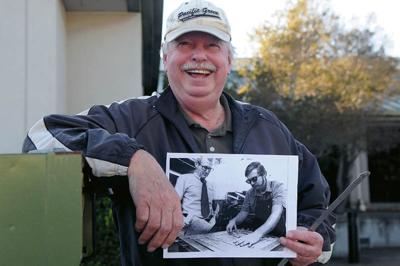
Here are some things they don’t teach much anymore: the use of pica poles and slugs, the meaning of words like hot type and ligatures. And here are some things that were true in 1960, when Larry Ellis first went to work as a printer at the Monterey County Herald: Sen. John Kennedy accepted the Democratic Party nomination for president, NBC cancelled the Howdy Doody show, and Ellis and his cohorts in the International Typographical Union were a force to be reckoned with in the Herald’s composing room as they laid out pages the old-fashioned way – with precise measurements and exacting standards, by hand.
That ended this year when Ellis, 71, picked up his pica pole – the metal ruler that was a newspaper printer’s most important possession – and left for good after his job putting ads together for the paper was outsourced to India.
He was literally the last man out.
“I lost it, even though I knew a week in advance that it would be my last day,” Ellis says of his final day, April 27, 2012. “I became very emotional. And I never imagined our jobs would be sent to another country.”
Not only was it the end of a career that began when he was 19, it was also the denouement of the last remaining link to what once had been the heart and soul of the daily newspaper.
For decades, Ellis was a member of the ITU, whose members numbered about 75 at the paper during the union’s heydey, when the Herald was located in downtown Monterey. The printers worked in the composing room, a large, windowless area bordered on three sides by the newsroom, the pressroom and the advertising department. (As an aside, I came to know Ellis during 18 years as a reporter and editor at the Herald.)
Quiet and steady in his work, Ellis was as reliable as the sound of the Presidio bugler’s somber notes at sundown. While reporters got bylines and recognition – and thus the glory – the unsung printers put the paper together and protected it by noticing and flagging all manner of errors, thus keeping everyone else from looking stupid.
Ellis describes the atmosphere of the Herald for many years as beyond collegial, bordering on familial. When the paper printed in the afternoon, after the cacophonous press run had finished, people from all departments would gather on Friday afternoons, have a small party and often head out for dinner en masse.
“By the time I left, it had long lost that family atmosphere,” he says. “It was hard to still feel like a family when so many people simply didn’t stay put for long.”
For some of the printers, changes became unsettling or disparate, or it was time to retire anyway. Some died, some faded away. But Ellis glided through every phase as a printer, starting when papers relied on “hot type” machines, which used letters cast from molten lead (called slugs) to generate type. The machine could cast an entire line of type at once – thus they were called linotypes – and they remained the most important equipment in the composing room well into the 1970s.
But in the course of a generation, an unrelenting series of changes came, including the automation of linotype, laser typesetting machines and Macs. Among Ellis’ last duties were gathering the text, pictures and a layout description for ads and putting it all together – the work now done overseas. When India suffered a massive blackout earlier this year, Ellis quipped, “I was surprised the Herald was published today.”
But maybe Ellis’ feelings about his job – “I spent 52 years of my life learning how to do quality work,” he says – and his departure from it, are best summed up in a poem he wrote titled, “Walking Off Those Herald Blues”:
I got no more working at those Herald blues.
They gave me enough severance pay to buy some walking shoes.
Everyday is a vacation, I now belong to the retired nation.
I got no more working at those Herald blues.
I got no more punching a stupid time clock.
I carry my severance pay around, wrapped in a sock.
It’s a strange sensation, belonging to the retired nation.
Using my new walking shoes, gonna walk off those Herald blues.
I’m now retired, don’t work no more.
I done signed the papers, and they showed me the door.
They outsourced my job, it was gone in a flash.
As far as I’m concerned, they can just kiss my cash!
(0) comments
Welcome to the discussion.
Log In
Keep it Clean. Please avoid obscene, vulgar, lewd, racist or sexually-oriented language.
PLEASE TURN OFF YOUR CAPS LOCK.
Don't Threaten. Threats of harming another person will not be tolerated.
Be Truthful. Don't knowingly lie about anyone or anything.
Be Nice. No racism, sexism or any sort of -ism that is degrading to another person.
Be Proactive. Use the 'Report' link on each comment to let us know of abusive posts.
Share with Us. We'd love to hear eyewitness accounts, the history behind an article.