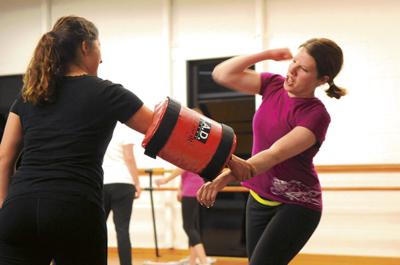
Students passing by Valley Hall at CSU Monterey Bay stop and stare as women throw air punches: right hammer fist, left shield. One kicks a bag with a thud and yells “No!” Another sends a push kick to a bag, yelling “Stay back!” Onlookers’ eyebrows go up.
The ladies drawing all the attention were participating in a Rape Aggression Defense program – called RAD – run by CSUMB police officers.
Numbers reveal a disturbing need: According to RAD, 90,000 rapes are reported each year in the United States – which means one every seven minutes – but 90 percent of rapes are unreported. One in three women is sexually assaulted in her lifetime.
The fact that violent abuse is happening may not be terribly surprising, sadly enough. But as I learned while participating in the RAD training, the techniques taught definitely can be.
The biggest surprise: Sometimes fighting back is the worst thing to do, since an ill-timed punch can lead to an even more violent response.
“You may only get one chance,” says Robin Leland, a four-year police officer and one-year RAD instructor. “You may only get one chance to inflict some sort of pain, so you want it to be the best you can give right off the bat.”
The more preferable defense is waiting for a moment to escape. Trainers described being aware of exits, placing as much furniture between you and your attacker as possible and dropping a glass to cause a distraction. These techniques and self-defense moves, in other words, aren’t designed to teach women to knock out attackers, but to provide strategic options other than compliance – to escape the situation as quickly as possible: “To develop and enhance the options of self-defense, so they may become viable considerations to the woman who is attacked,” says RAD founder Lawrence N. Nadeau.
“YOU DON’T REALIZE HOW MUCH POWER YOU POSSESS.”
For some moves to work best, such as a knee to the groin, a woman has to bring the attacker closer to them, grabbing and pulling the perpetrator’s shoulders closer and down as the knee strikes up. Other times that’s overkill.
“For example, if a male forcefully grabs his date by the arm in the middle of a crowded Sunday afternoon football party, a spear strike to his throat or a knee to the groin would not be appropriate defense on her part,” the RAD manual reads. An appropriate action: Demand the person to “Let go!” in a strong, confident voice. A stomped foot or strike to the forearm also helps.
A more slippery skill is knowing at what range a knee to the groin is more effective than a push kick. Also intriguing was how easily undersized women could fend off larger attackers. Hint: It’s not by going toe-to-toe with him, but by using leverage.
“You don’t realize how much power you possess,” Leland says.
She took us through a scenario: A man has his arm around your shoulder. If you grab his fingers with your opposite hand, spin outward and lift his fingers, you can bend his fingers and arm back into a lock where a little force can snap fingers and hyper-extend his elbow.
We also learned to identify the attacker’s vulnerable locations – hint: aim for groin, throat and eyes – and to use personal weapons including fists or knees or pepper spray. We were schooled on how to obtain good balance by learning three stances: defensive, where feet are staggered and knees are slightly bent, hands out in front; warning, where your feet are in defensive stance while arms are raised as you shout, “Stay back”; and cautious contact, where feet are in defensive stance with your weaker arm in front of you so the outside of your forearm is facing the attacker and your strong arm is close to your torso in a fist.
Another key: To avoid panic, and practice through self-defense services or with others who have been trained.
In the moment a person decides to fight back, they must go with 110 percent of their force. This is an all-or-nothing situation. Throwing a punch without full force can do more harm than good.
While RAD courses won’t return to CSUMB until March, the Monterey County Rape Crisis Center also provides self-defense classes to any group of eight or more. Be sure not to practice self-defense on a partner or close friend, as a person may need to use tactics in real situations. In self-defense, surprise is key.
“I don’t want anyone to fear for their life, for their safety,” Leland says. “Don’t be afraid to act.”
To schedule courses with the Rape Crisis Center, call 373-3955 or visit www.mtryrapecrisis.org. For more on the RAD program, visit police.csumb.edu/rad-self-defense-system.
(0) comments
Welcome to the discussion.
Log In
Keep it Clean. Please avoid obscene, vulgar, lewd, racist or sexually-oriented language.
PLEASE TURN OFF YOUR CAPS LOCK.
Don't Threaten. Threats of harming another person will not be tolerated.
Be Truthful. Don't knowingly lie about anyone or anything.
Be Nice. No racism, sexism or any sort of -ism that is degrading to another person.
Be Proactive. Use the 'Report' link on each comment to let us know of abusive posts.
Share with Us. We'd love to hear eyewitness accounts, the history behind an article.