In history-conscious Monterey, locals know that the California constitution was signed at Colton Hall or that Robert Louis Stevenson wrote poems and stories in a downtown adobe.
But they don’t know about Monterey native Tiburcio Vasquez, who grew up in a small adobe behind Colton Hall and became one of the Wild West’s most notorious bandits and a key figure from Monterey’s darker, murkier past, when the county was one of the most violent in the nation – with a murder rate that dwarfed Dodge City’s or Tombstone’s.
Now, Bay Area author John Boessenecker has revived that swashbuckling period in local history in his new Vasquez biography, Bandido.
“If you go on the adobe walk, they don’t show you the tree [behind the Cooper Molera house] where the gambler was lynched,” Boessenecker says. “What they don’t show are the murders.”
Perhaps Monterey’s gunslinging past has been buried, Boessenecker says, because it doesn’t jibe with the city’s image as a seaside tourist mecca.
Boessenecker’s fascination with Vasquez began when he was a teenager in the 1960s: “I don’t think I had my driver’s license when I went to the San Francisco library and saw a microfilm account of his hanging.”
In recent years, Boessenecker combed court documents, San Quentin Prison archives and old newspaper stories to separate myth from fact about the man he calls one of Monterey’s most famous native sons.
When Vasquez was 15, California became part of the United States. Anglos flooded in, and Californios, as the descendants of the state’s Mexican settlers were called, began to lose their land, their opportunities for work and their rights.
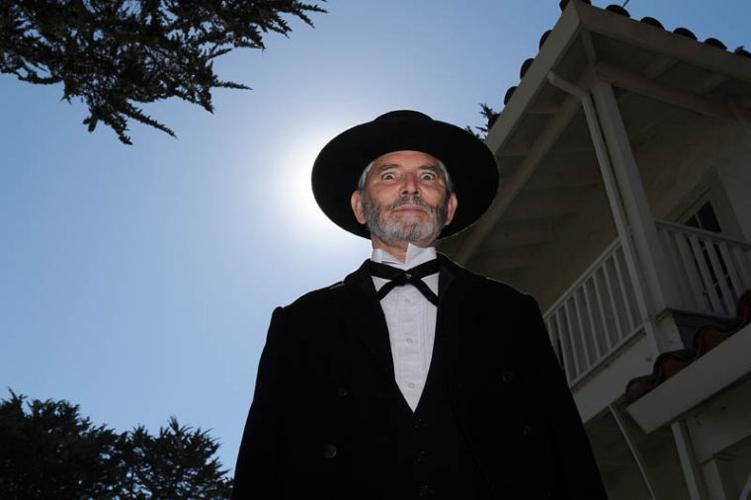
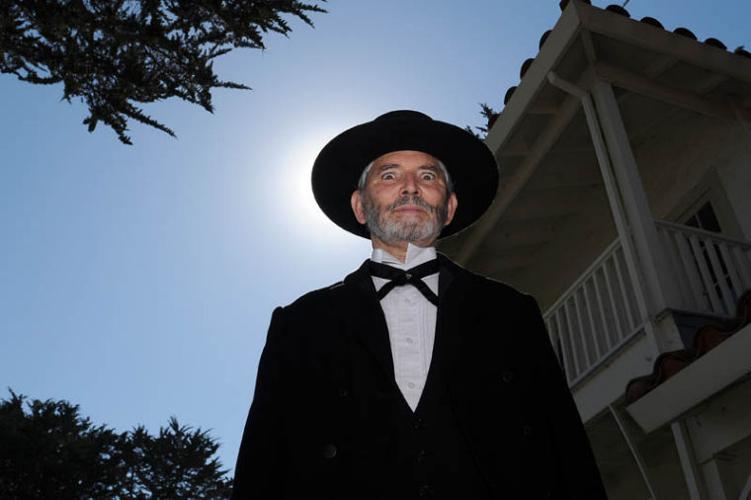
“I grew up with Tiburcio Vasquez stories,” says Pat McAnaney, a Carmel Valley counselor and Vasquez descendant, who says he has kept the legend alive by dressing up like his great-great-great uncle and giving talks to school kids about Vasquez’ exploits.
“The main thing I try to stress was the world turned upside down and there wasn’t much place for him in the European world,” McAnaney says.
“A spirit of hatred and revenge took possession of me,” Vasquez once said. “I had numerous fights in defense of what I believed to be my rights and those of my countrymen. I believed we were unjustly deprived of the social rights that belonged to us.”
Vasquez’s story has echoes in those of today’s young gangsters who may feel just as disenfranchised as Vasquez did, McAnaney notes. But like many of them, Vasquez had a choice, McAnaney says. The youngest son of a middle class family with deep roots in California, he was the only one of his siblings to turn to lawlessness. His brother Antonio Vasquez owned the adobe that now houses the Parker Lusseau bakery and his sister ran a dance hall on Alvarado near what is now the Monterey Hotel.
But Vasquez roamed the state, robbing, drinking, gambling and chasing women, cutting a romantic figure on his trademark white horse. He was a poet with a sense of humor who wrote what could have been the first outlaw ballad, about himself.
So powerful was his legend that he was reported to have robbed people on Nob Hill in San Francisco and others at Lake Isabella in Southern California on the same day, an impossibility before cars or airplanes.
“They didn’t want to be robbed by just anyone,” McAnaney says.
Vasquez was finally captured, tried, convicted, and executed at the age of 39 for a robbery near Hollister where three men were killed. Boessenecker writes that Vasquez fired at least one of the fatal shots, but Vasquez insisted he never killed anyone.
In the 1960s and 70s, Vasquez became a sort of Robin Hood figure for Chicano activists, and as a result, a southern California high school, a Bay Area health clinic and the vast Los Angeles County wilderness area, Vasquez Rocks, where he once hid out, now bear his name.
But Boessenecker says he’s mostly debunked the notion that Vasquez stole from the rich to give to the poor; he held on to the money that he stole, and he wasn’t a revolutionary.
He was a gentleman, however, and Boessenecker notes a reporter’s description of Vasquez on the day of his execution, “… the little bandit smoked his cigar and sipped his claret with an air of perfect composure.”
His last words before the noose was wrapped around his neck: “Pronto.”
(0) comments
Welcome to the discussion.
Log In
Keep it Clean. Please avoid obscene, vulgar, lewd, racist or sexually-oriented language.
PLEASE TURN OFF YOUR CAPS LOCK.
Don't Threaten. Threats of harming another person will not be tolerated.
Be Truthful. Don't knowingly lie about anyone or anything.
Be Nice. No racism, sexism or any sort of -ism that is degrading to another person.
Be Proactive. Use the 'Report' link on each comment to let us know of abusive posts.
Share with Us. We'd love to hear eyewitness accounts, the history behind an article.